

Meet Britain’s top Jewish educator
Helena Miller, a soft-spoken 30-year veteran teacher, received the Max M. Fisher Prize for Jewish Education in the Diaspora this week
 Add ToI as a Preferred Source on Google
Deputy Editor Amanda Borschel-Dan is the host of The Times of Israel's Daily Briefing, What Matters Now and The Reel Schmooze podcasts, and heads up The Times of Israel's features.
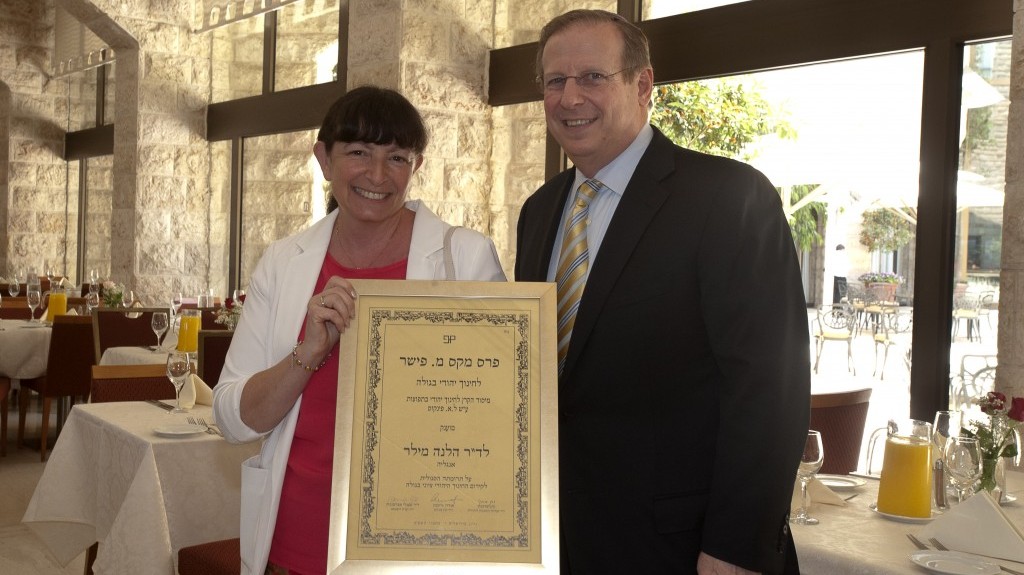
“In order to find your place in the world you need to know who you are,” said Britain’s top Jewish educator Dr. Helena Miller recently to the Times of Israel. “One of those things is your Jewish identity. Once you have a strong sense of who you are, you’re in a strong position to interact with the wider community.”
On Tuesday, Miller received the Max M. Fisher Prize for Jewish Education in the Diaspora (through the L.A. Pincus Fund) at a ceremony in Jerusalem. The 30-year veteran educator lives in London, where she is the director of Research and Evaluation at the United Jewish Israel Appeal (UJIA) and the co-chair of Limmud International.
But she is currently best known for her work in setting up JCoSS, London’s Jewish Community Secondary School, where Jewish students of all denominations (and even no denomination) study Jewish and secular curricula together.
Paying homage to Miller at Tuesday’s ceremony were 500 Jewish leaders from around the world, including JAFI Chairman Natan Sharansky and several MKs. In presenting Miller with the award, Jane Sherman, member of the L.A. Pincus Fund Board and daughter of Max M. Fisher, said, “This award is to recognize an individual who has excelled in achieving the three goals the Max M. Fisher Prize represents – to inspire, connect and empower within the field of Jewish education… She has literally changed the face of Jewish education in the UK.”
But Miller takes a more modest approach. Speaking by telephone from her London home after receiving word of her win, the soft-spoken educator said, “The reason I am setting up these pluralist institutions is not because I don’t like what’s going on in these other places. I just feel there is room for choice and a broader access point for people to get involved.”
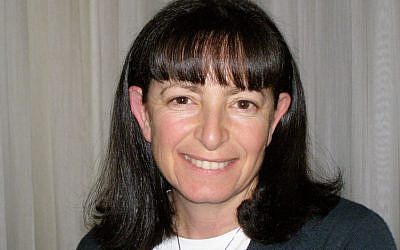
The first of Miller’s three-decade educational career was spent teaching in regular non-Jewish schools. Before that she was involved in youth work — leading activities in synagogues and summer schemes, and running the summer camp for the Reform movement.
Through Limmud, the grassroots non-denominational Jewish learning organization that has spread all over the globe since its 1980 inception in England, Miller was first exposed to pluralistic learning.
“It opened our eyes to a much broader range of Jewish practice and thought. By the third year, my husband was running it.
‘It’s possible to develop a wide Jewish life without being pigeonholed’
“Now I’m co-chair of Limmud International [since 2009], but I’ve always been there as a teacher, a participant, and made friends from across a wide spectrum. We’ve learnt that it’s possible to develop a wide Jewish life without being pigeonholed.”
In her personal life, Miller is the poster child for Jewish pluralism. From 1988 she has been active in a congregation-led group in North London that is aligned with a Reform synagogue, but she also maintains a membership in an Orthodox synagogue as well.
“What we’ve done is develop a way of expressing our Judaism that is comfortable for ourselves. We are committed to the Reform movement because it was our original community. But we’re also committed to an intensity of Jewish expression that goes beyond the Reform movement.”
In Britain, she said, approximately two thirds of the Jewish community affiliate with the Orthodox, but it doesn’t necessarily mean they’re Orthodox practicing. Which for Miller, was the opening she needed to begin building pluralistic institutions.
“Many of the Orthodox synagogues have alternative prayer groups, such as a women’s megilla reading. So even within the boundaried organizations there are all kinds of initiatives happening to move things forward. People think the UK is staid and less vibrant, but actually there are many cross-community initiatives going on.”
‘People think the UK is staid and less vibrant, but actually there are many cross-community initiatives going on’
In England there are approximately 30,000 Jewish students aged 3-18. Each year only some 1,000 11-year-olds enter a Jewish secondary school, which begs the question: In a school system in which Jewish education is basically free, why wouldn’t every Jewish parent take advantage of it?
Some, obviously, may not live in proximity to a Jewish school. Others, however, decide to send their children to gifted programs, single-sex programs. In short, in the a la carte British educational system, Jewish education is not always the most appetizing entree.
“There’s a lot of debate in this country about Jewish schools and integrating into the wider community when going to university. My experience is that so long as you as a family are engaged in a wider world,” then there will be no problem with integration.
In keeping with the spirit of pluralism, Miller summarized her position on Jewish education. “I think it’s about making Judaism accessible to as wide a group as possible, and about giving people the tools to live a vibrant Jewish life.”









The Times of Israel Community.