

Over 70 hours of new footage revealed for 20th anniversary of ‘Seinfeld’ finale
Some of our favorite Jewish moments in honor of the groundbreaking sitcom which ended this week in 1998
 Add ToI as a Preferred Source on Google
Yaakov Schwartz is The Times of Israel's deputy Jewish World editor
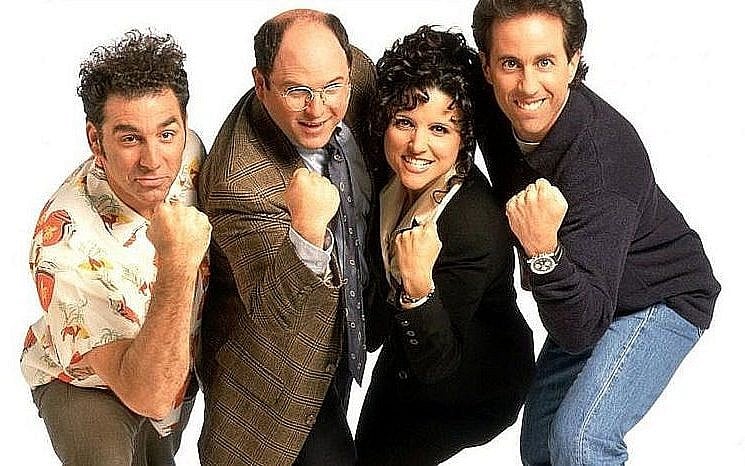
For those who have memorized every cannily-coined catchphrase from their nine-season “Seinfeld” DVD box set, this week, which marks the 20th anniversary of the series’ 1998 finale, brings some good news.
No, it’s not the rumored reunion episode – but it might be just as good. To celebrate the series, The Hollywood Reporter was given access to over 70 hours of previously unseen “Seinfeld” footage, including interviews with the cast, crew, and creators of the sitcom, now recognized as one of the most popular, and radical, in American history.
The THR article reveals inside stories behind the show’s production, auditions and casting, detailing how the iconic characters developed. It also delves into the writing process that led to some of the series’ most well-known plotlines.
Since it launched in 1989, “Seinfeld” not only revolutionized the sitcom platform – it also changed how Americans, and later the world, perceived Jews, bringing Jewish culture into the mainstream in a way that hasn’t been seen since the early Woody Allen era.
Famously about “nothing,” the series was created by Jerry Seinfeld and Larry David, and starred the former (David did not want to appear on camera, though he makes some notable faceless cameos). It follows the life of Seinfeld, a stand-up comedian, and his friends, as they get themselves in and out of scrapes while managing to avoid any meaningful life lessons.
Though Seinfeld’s Judaism isn’t always overtly mentioned, there is something quintessentially “Jewish” about the show, which is packed with references to everyday Jewish life — from Seinfeld’s parents’ Florida condo, to a dog named Farfel, to a fiasco involving a loaf of marble rye.
THR revealed that the famous episode, appropriately named “The Rye,” was penned by Jewish writer Carol Leifer, whose friend once sneaked into a host’s kitchen to take back a rye that went unserved. Leifer also drew from the time her parents overstayed their welcome after a lunch at her fiance’s house. When Leifer asked why they stayed so long, her father said he was waiting for cake.
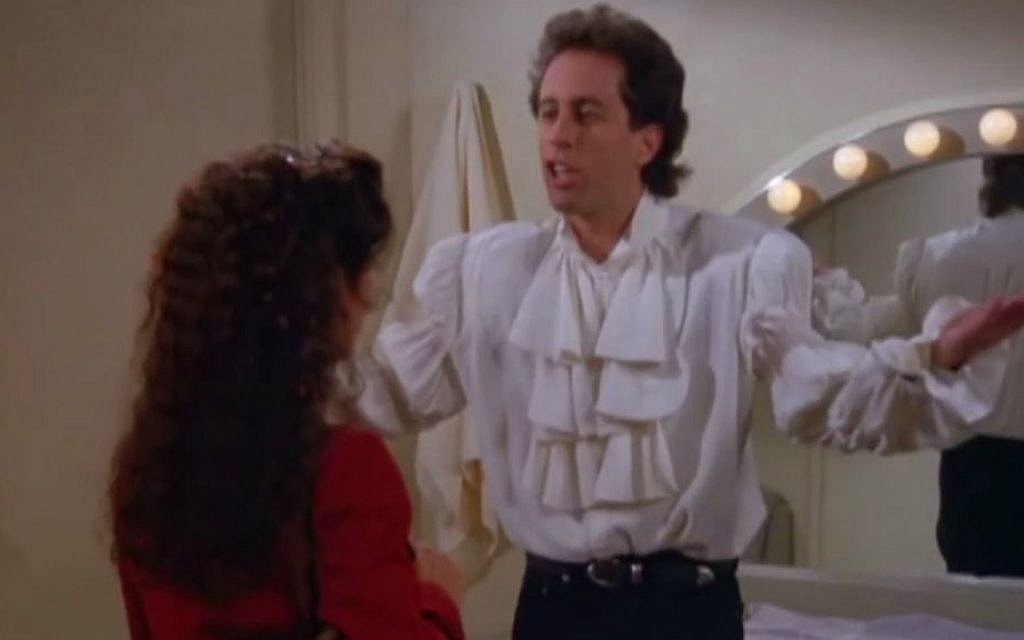
The cast also exudes an unmistakably Jewish vibe. Jason Alexander’s character George Costanza isn’t Jewish, but Alexander – born Jay Greenspan – most definitely is, and used Woody Allen as George’s prototype. He also proudly speaks about visiting Israel, and is a regular guest at Jewish nonprofit events.
Julia Louis-Dreyfus, who played Elaine on the show, is a tertiary Jew – her grandfather was billionaire Pierre Louis-Dreyfus, and she is a distant relative of Alfred Dreyfus, the victim of the infamous 1894 Dreyfus affair.
Actor Michael Richards, who plays Seinfeld’s eccentric neighbor Cosmo Kramer, doesn’t have any Jewish blood, though he has said that he’s “adopted” Judaism as his religion despite not officially converting.
And of course, there’s Seinfeld – smug, snarky, and unapologetically supportive of Israel. Case in point, he made two trips to the Jewish state in recent years, and made headlines for going to a tourist-oriented anti-terror camp during his last visit.
To celebrate the 20th anniversary of the “Seinfeld” finale, here are a few of our favorite “Jewish moments” from the series.
Kramer runs a Jewish singles event
Kramer hands Jerry and Elaine flyers for a Jewish singles event, saying he expects them to be there. “But I’m not Jewish,” says Elaine. “Well, neither am I,” Kramer responds. Later, as he’s making kreplach for the event in Jerry’s kitchen, Kramer tries to convince Jerry to try one. “Eat, eat,” he says, “you’re skin and bones!”
George is a white supremacist
Jerry and George spot an opportunity for a free limo ride home from the airport when they see a driver holding a placard for someone who missed the flight that Jerry was on. But, as it turns out, George must pretend to be a neo-Nazi leader to avoid detection. If you’ve ever tried to picture a couple of New York Jews trying to impersonate a white supremacist, it goes pretty much how you’d think.
Shiksappeal
Elaine discovers that Jewish men have a “thing” for non-Jewish women. “What does being a shiksa have to do with it?” she asks George. “You’ve got shiksappeal,” he says. “Jewish men love the idea of meeting a woman that’s not like their mother.”
https://www.youtube.com/watch?v=y0F_WFpT5II
The mohel
Jerry and Elaine are invited to be the godparents to their friend’s son. Of course, in Judaism, that means helping with the circumcision — and holding the baby during the procedure. Jerry and Elaine like the prospect of being godparents, but the bris part, not so much. Then the mohel, who is in charge of performing the circumcision, shows up.
The babka
When the four friends are invited to a dinner party, Jerry and Elaine must bring a dessert. But when the person ahead of them in line buys the last chocolate babka, it sparks a philosophical argument and a chain of events that puts a damper on their whole evening.
The Cadillac
Jerry buys his father a new car as a gift. Of course, in the heavily-Jewish Florida retirement community of Del Boca Vista, nothing is so simple.
The kosher meal
When on an airplane, Elaine goes to the bathroom and when she returns, is told that the only meal left is a kosher meal. “A kosher, meal,” she says. “I don’t want a kosher meal. I know even know what a kosher meal is!”
The anti-Dentite
This entire episode is chock full of hilarious Jewish jokes — but the scene where Jerry visits a confessional to discuss his reservations about the legitimacy of his dentist’s conversion to Judaism is comic gold. Jerry’s gripe? He thinks Dr. Whatley converted just for the jokes.









The Times of Israel Community.