

Shrugging off criticism, PM backs Jewish state bill
Despite opponents saying bill discriminates against Arab minority, Netanyahu says ‘no contradiction’ between proposed legislation and equal rights in Israel
 Add ToI as a Preferred Source on Google
Raoul Wootliff is a former Times of Israel political correspondent and Daily Briefing podcast producer.

Prime Minister Benjamin Netanyahu on Monday threw his support behind a controversial bill that would enshrine Israel as “the national home of the Jewish people,” dismissing criticism that the measure discriminates against Arabs.
Speaking at his weekly Likud faction meeting, Netanyahu said the bill, which passed in the Ministerial Committee for Legislation on Sunday, “flies in the face of everyone who tries to deny our right to Israel.”
The latest incarnation of the proposed law, like many of its predecessors in recent years, has already stirred objections from opposition lawmakers who contend the bill would discriminate against the country’s Arab minority.
Slamming criticism that calls the proposal discriminatory to Israel’s Arab and other minority populations, Netanyahu says “there is absolutely no contradiction between the Jewish state bill and equal rights in Israel.”
Judaism is already mentioned throughout the country’s laws, and religious authorities control many aspects of life, including marriage. But the 11 existing Basic Laws deal mostly with state institutions like the Knesset, the courts or the presidency, while Basic Law: Human Dignity and Liberty defines Israel’s democratic character. The nation-state bill, proponents say, would put Jewish values and democratic values on equal footing.
According to the language of the proposal, while every individual has the right “to preserve his culture, heritage, language and identity,” the right to realize self-determination “is unique to the Jewish people.”
In another controversial clause, Arabic would be relegated from an official language to one with “special status,” which would ensure its speakers the “right to accessible state services.”
“The bill constitutes an overwhelming response to all those who deny the deep connection between the Jewish people and their land,” the prime minister said.
Netanyahu said the bill would be brought to the Knesset within 60 days and he “expects all the Zionist parties to support it.”
Opposition leader Isaac Herzog criticized the bill drafted by Likud MK Avi Dichter as threatening to “trample on the delicate balance between Jewish and democratic.”
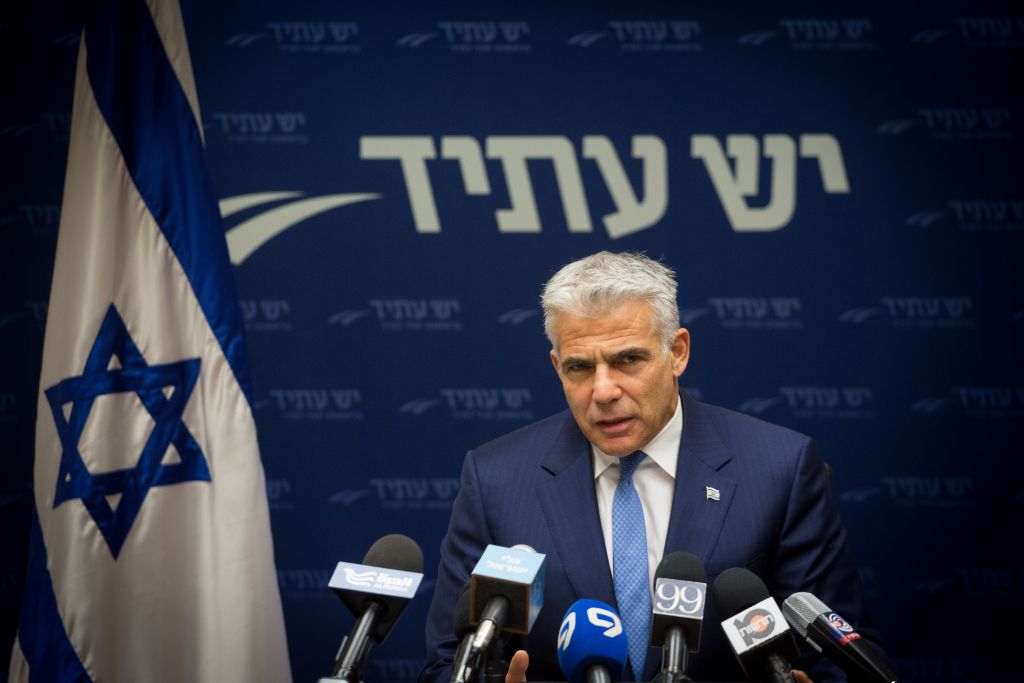
Yesh Atid chairman Yair Lapid said he supports the idea of a nation-state bill to define Israel as a Jewish state, but cannot back the law in its current form.
“We support the Jewish state law, but what was passed yesterday was not the Jewish state law,” Lapid told his weekly faction meeting, referring to Dichter’s bill.
Lapid and Herzog both said they supported Likud MK Benny Begin’s version of the law, which is just a short paragraph-long declaration of the Jewish nature of the state.
Lapid said he would not support Dichter’s, which includes a number of controversial clauses, including downgrading Arabic from an official language to one of “special status.”
“If the coalition is serious and it really wants to pass a nation-state bill with wide support, then we will support it,” Lapid said.
“But with this, they are trying to create chasms within Israel and it’s unnecessary. The bill creates many, many problems,” he adds.
Asked what specific changes would be needed for the bill to receive the support of the party, Yesh Atid MK Yael German told The Times of Israel that it would need to enshrine, in writing, “equal rights for all citizens.”










The Times of Israel Community.