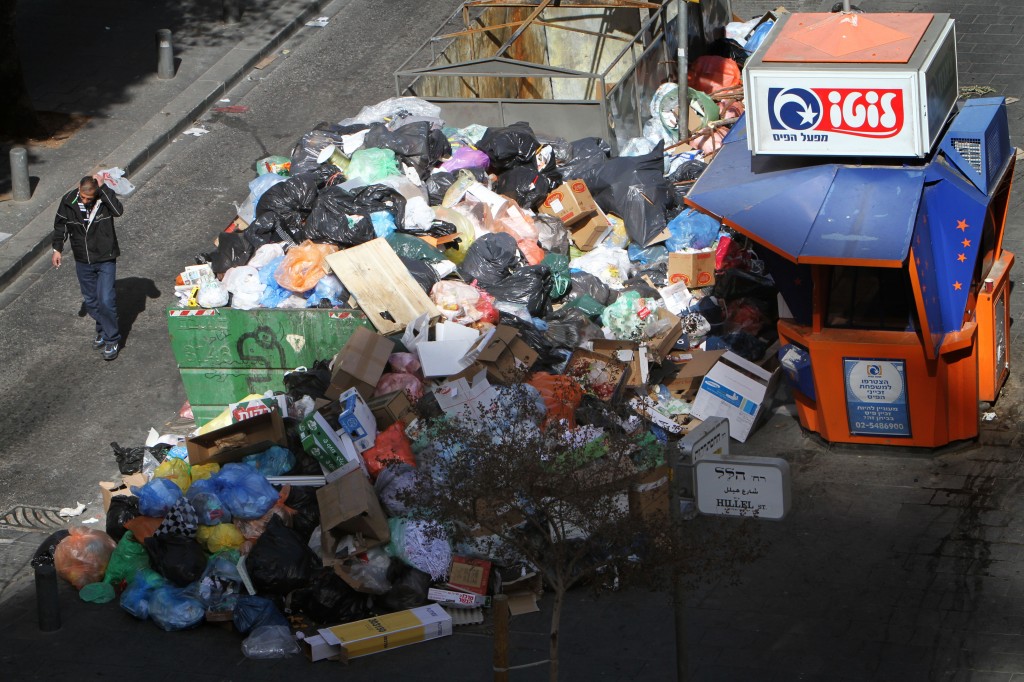
Uncollected garbage in Jerusalem due to the current general strike (photo credit: Miriam Alster/Flash90)
Israel’s general strike enters its third day on Friday and is likely to continue through the weekend. While the Finance Ministry and the Histadrut labor union continue to work towards an agreement, the Israeli public remains on the losing end of the battle.
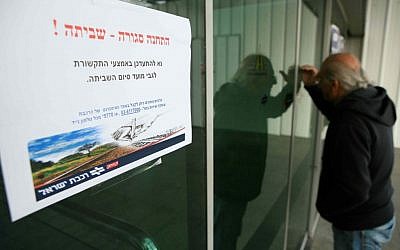
Since the strike began on Wednesday morning, Israelis have had no train service, forcing many to rely on alternate public transportation or to drive themselves, resulting in more crowded buses and heavier traffic jams.
A man looks in a Tel Aviv train station window. The sign reads "The station is closed - Strike!" (photo credit: Yehoshua Yosef/Flash90)
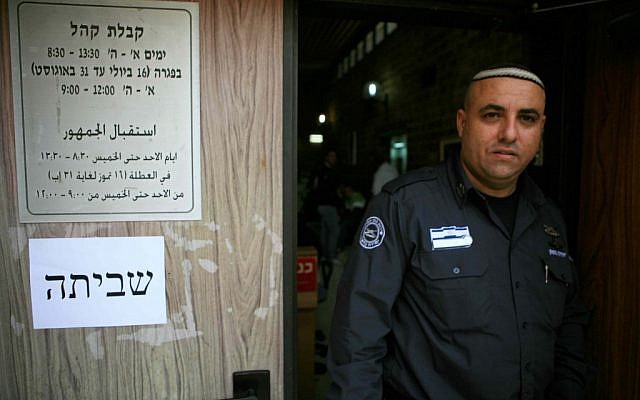
Government and municipality offices have been closed, as have banks and post offices. University administrative staffs and kindergarten workers have also participated in the strike.
A security guard stands outside a closed office in kfar Sava Thursday. (photo credit: Yehoshua Yosef/Flash90)
Israel is poised to enter the Sabbath on Friday at sundown having had no garbage pickup since Tuesday before the strike. The strike is estimated to cost the Israeli economy some $500 million each day.
Protesters light candles for the deceased 'working man's honor' outside the Labor Court Wednesday. (photo credit: Nati Shohat/Flash90)
Representatives will meet again on Friday at noon in the hopes of enabling Israeli daily life a return to “normal” by Sunday morning.
Get The Times of Israel's Daily Editionby email and never miss our top stories
But even if the strike ends, the next one is never far off. Workers at dairy co-op Tnuva are preparing to strike, according to Globes, meaning milk and cheese products may become more scarce, and doctors have also threatened to return to the picket lines over a dispute over using time clocks.
Help us report truthfully on social media
As a multimedia journalist, my job is to take the quality, fact-based journalism produced by The Times of Israel newsroom and make it accessible across every platform — from Instagram posts to podcasts to short-form videos.
This is how many, especially young people, consume news these days. But misinformation is rampant on social media. Our team at ToI produces accurate, responsible short-form reporting on Israel and the Jewish world.
If you believe in the importance of factual social media journalism, please consider joining our reader support group, The Times of Israel Community. Your financial support is essential to sustain responsible multimedia reporting.
We’re really pleased that you’ve read X Times of Israel articles in the past month.
That’s why we started the Times of Israel - to provide discerning readers like you with must-read coverage of Israel and the Jewish world.
So now we have a request. Unlike other news outlets, we haven’t put up a paywall. But as the journalism we do is costly, we invite readers for whom The Times of Israel has become important to help support our work by joining The Times of Israel Community.
For as little as $6 a month you can help support our quality journalism while enjoying The Times of Israel AD-FREE, as well as accessing exclusive content available only to Times of Israel Community members.
Thank you, David Horovitz, Founding Editor of The Times of Israel


 Add ToI as a Preferred Source on Google