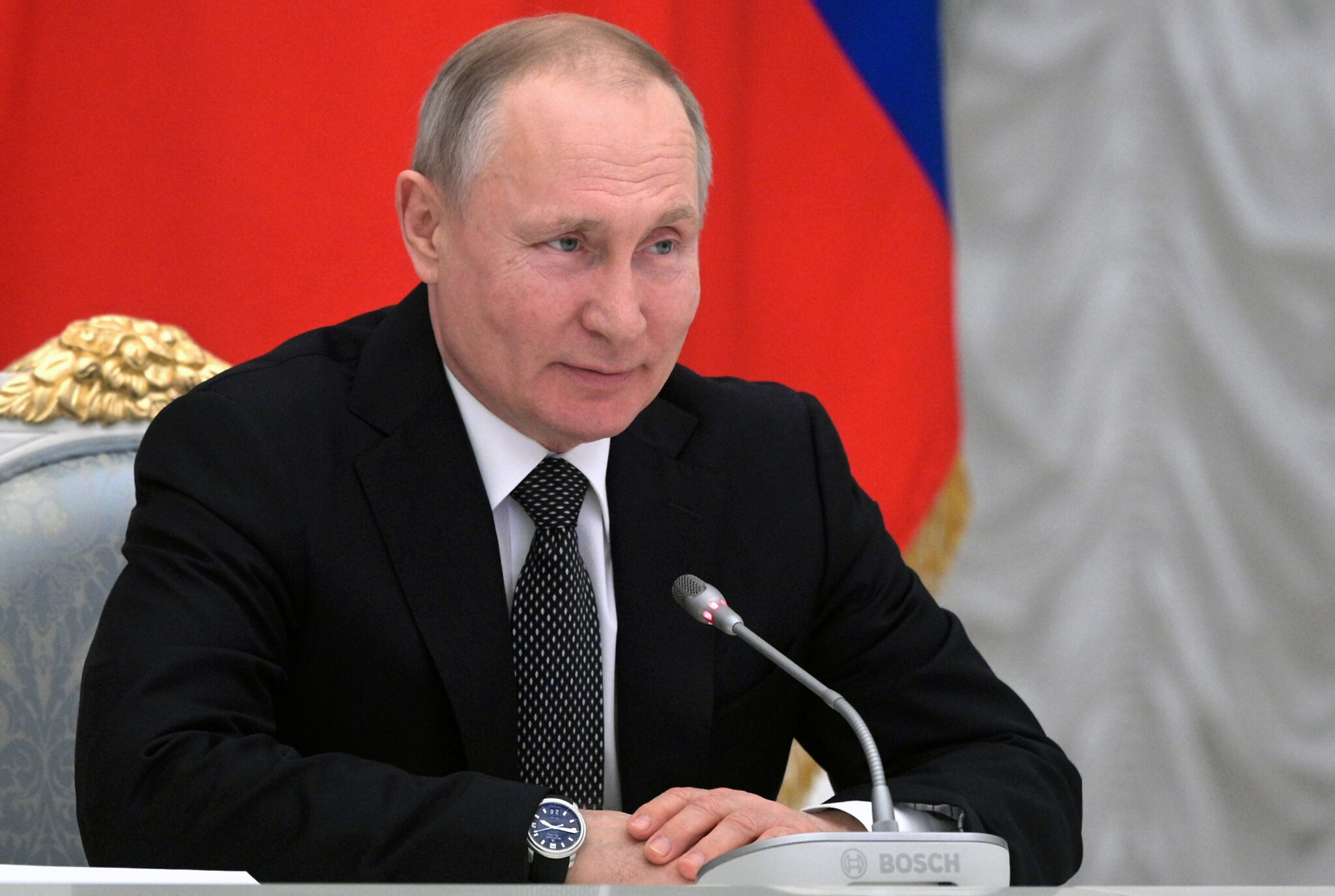
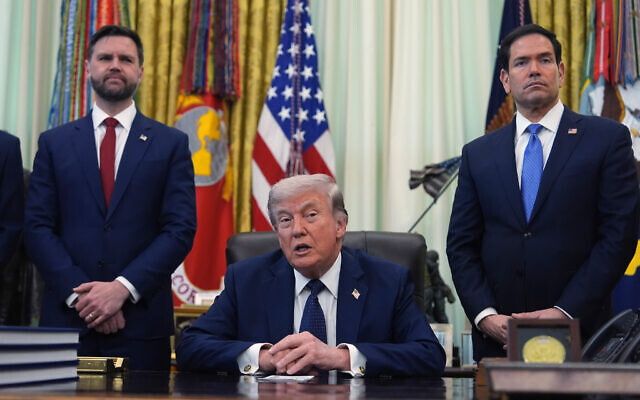
Russian President Vladimir Putin speaks during a meeting with members of a working group created to discuss constitutional amendments in Moscow, Russia, February 26, 2020. (Alexei Druzhinin, Sputnik, Kremlin Pool Photo via AP)
MOSCOW — Russian President Vladimir Putin has said he rejected an offer to use body doubles for personal protection during a conflict in Chechnya.
Speaking in an interview with the news agency Tass, a segment of which was released Thursday, Putin said the plan dated back to the early 2000s.
He said that it “came at the most difficult moment of fighting terrorism.”
In the early 2000s, Russia was fighting a war against separatists in Chechnya who also launched attacks elsewhere in the country.
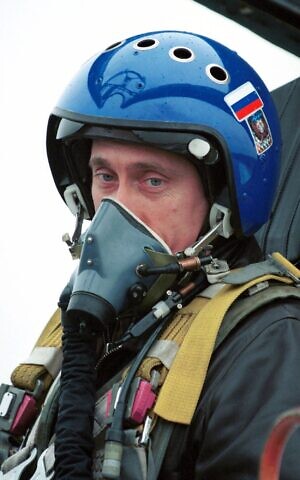
In this file photo taken on March 20, 2000, Russian President Vladimir Putin, wearing a blue helmet and an oxygen mask, sits in Su-27 fighter jet after his flight into the war zone in Grozny, Chechnya. (Sputnik, Kremlin Pool Photo via AP, file)
Putin visited troops in Chechnya hours after predecessor Boris Yeltsin stepped down on December 31, 1999.
Get The Times of Israel's Daily Editionby email and never miss our top stories
He later said that a helicopter he was using came under fire during that trip.
Putin also made several other trips to Chechnya while fighting was still raging there.
During one of those trips in March 2000, Putin flew into Chechnya in the seat of a second pilot in a fighter jet.
Advertisement
Putin didn’t elaborate on his motives behind rejecting the proposal to have body doubles.
The 67-year-old former KGB agent who has ruled Russia for more than 20 years also reaffirmed that he has continued to shun a personal cellphone.
He said that he feels “more comfortable” relying on protected communications means and may occasionally use an aide’s phone.
Help us report truthfully on social media
As a multimedia journalist, my job is to take the quality, fact-based journalism produced by The Times of Israel newsroom and make it accessible across every platform — from Instagram posts to podcasts to short-form videos.
This is how many, especially young people, consume news these days. But misinformation is rampant on social media. Our team at ToI produces accurate, responsible short-form reporting on Israel and the Jewish world.
If you believe in the importance of factual social media journalism, please consider joining our reader support group, The Times of Israel Community. Your financial support is essential to sustain responsible multimedia reporting.
We’re really pleased that you’ve read X Times of Israel articles in the past month.
That’s why we started the Times of Israel - to provide discerning readers like you with must-read coverage of Israel and the Jewish world.
So now we have a request. Unlike other news outlets, we haven’t put up a paywall. But as the journalism we do is costly, we invite readers for whom The Times of Israel has become important to help support our work by joining The Times of Israel Community.
For as little as $6 a month you can help support our quality journalism while enjoying The Times of Israel AD-FREE, as well as accessing exclusive content available only to Times of Israel Community members.
Thank you, David Horovitz, Founding Editor of The Times of Israel


 Add ToI as a Preferred Source on Google