Rare Nazi Enigma machine auctioned off for almost half a million euros
Machine’s code was famously decoded by Alan Turing and his team, contributing to allied war effort; German Admiral Karl Doenitz ordered sophisticated M4 model in 1941
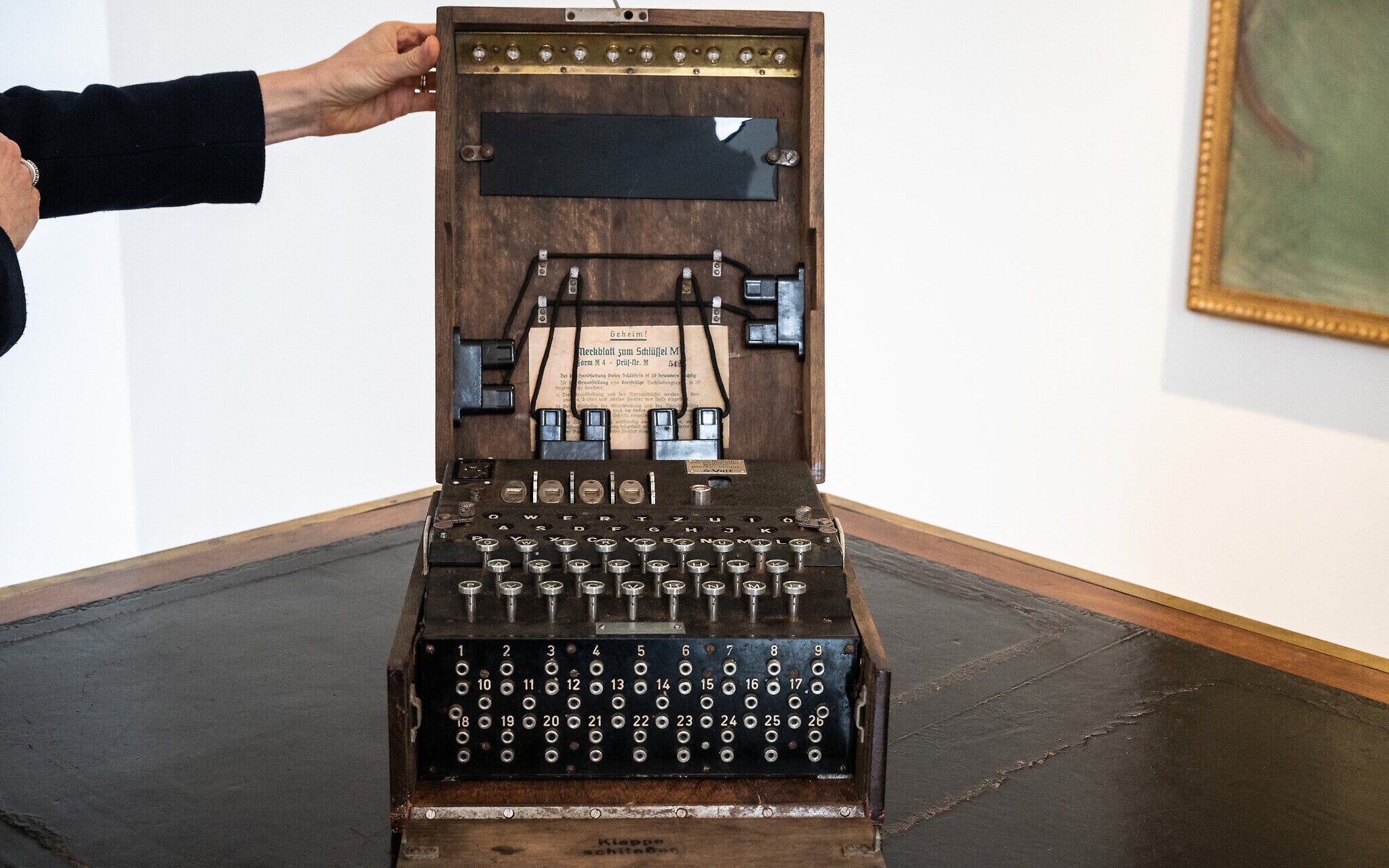
An Enigma M4 rotor key machine used for encrypted communication during World War II, ahead of its auction exhibited at the Christie's auction house in Paris, France, on November 13, 2025. (BERTRAND GUAY / AFP)
PARIS, France — An extremely rare and operational Nazi Enigma encryption machine, famously cracked by Allied codebreakers during World War II, has sold for nearly half a million euros in Paris, double its expected price, auction house Christie’s said Wednesday.
Based on keys and complex rotor systems, Enigma machines were used by the Germans for encrypted communication during the war, initially beyond the decoding capabilities of Allied intelligence services.
The Enigma M4 sold in Paris was a new, even more sophisticated version ordered by German Admiral Karl Doenitz in 1941 for communication with his submarine fleet as the Nazis attempted to blockade Britain.
Enveloped in a wooden case and featuring a keyboard and four rotors, it sold for 482,600 euros ($556,900) to an unidentified buyer on Tuesday in Paris, Christie’s said in a statement sent to AFP.
It was previously owned by a French collector.
Get The Times of Israel's Daily Editionby email and never miss our top stories
Another M4 machine, the rarest type of the surviving Enigma machines, sold for $365,000 in New York in 2015, which was said by auction house Bonhams to be a record at the time.
Alan Turing, said to be the father of theoretical computer science and artificial intelligence, who was prosecuted in Britain in 1952 for homosexual acts and agreed to be chemically castrated. He was posthumously pardoned by the Queen in 2013. (YouTube screenshot)
Enigma was cracked by British mathematician Alan Turing and his team under a top-secret program whose vital contribution to the Allied victory in the war only came to light in the 1990s.
It was the subject of a book by British author Robert Harris and an Oscar-nominated 2014 film, “The Imitation Game,” starring Benedict Cumberbatch.
Advertisement
Help us report truthfully on social media
As a multimedia journalist, my job is to take the quality, fact-based journalism produced by The Times of Israel newsroom and make it accessible across every platform — from Instagram posts to podcasts to short-form videos.
This is how many, especially young people, consume news these days. But misinformation is rampant on social media. Our team at ToI produces accurate, responsible short-form reporting on Israel and the Jewish world.
If you believe in the importance of factual social media journalism, please consider joining our reader support group, The Times of Israel Community. Your financial support is essential to sustain responsible multimedia reporting.
We’re really pleased that you’ve read X Times of Israel articles in the past month.
That’s why we started the Times of Israel - to provide discerning readers like you with must-read coverage of Israel and the Jewish world.
So now we have a request. Unlike other news outlets, we haven’t put up a paywall. But as the journalism we do is costly, we invite readers for whom The Times of Israel has become important to help support our work by joining The Times of Israel Community.
For as little as $6 a month you can help support our quality journalism while enjoying The Times of Israel AD-FREE, as well as accessing exclusive content available only to Times of Israel Community members.
Thank you, David Horovitz, Founding Editor of The Times of Israel


 Add ToI as a Preferred Source on Google