

Rivlin urges France to oppose ICC’s ‘legally, morally bankrupt’ war crimes probe
Ahead of meeting with Macron, president pens op-ed in French daily, warning that investigation could hurt peace efforts and insisting that Israel respects international law
 Add ToI as a Preferred Source on Google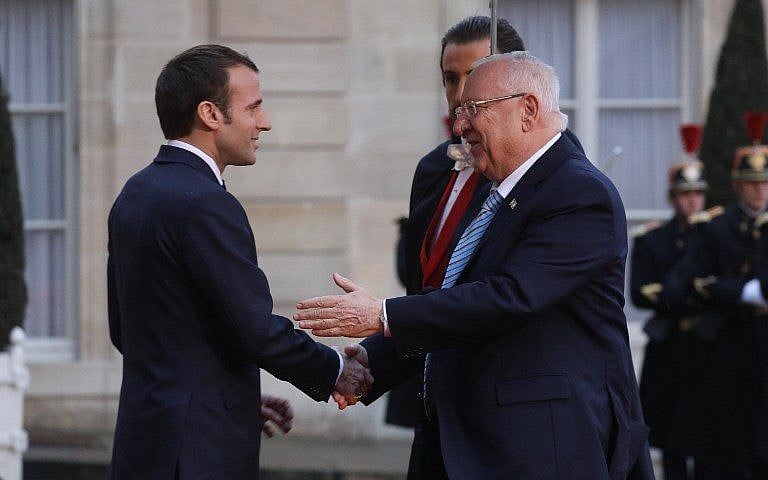
President Reuven Rivlin on Thursday called on France to reject the International Criminal Court’s “legally and morally bankrupt” decision to investigate Israel for war crimes in the West Bank, Gaza Strip and East Jerusalem.
Rivlin made the plea via op-ed in the Le Figaro French daily, hours before his planned meeting with French President Emmanuel Macron in Paris.
“Friends may not always agree, but I believe we are committed to hearing each other in order to better understand each other’s perspectives, motivations and decisions,” the president wrote, explaining why he would be raising his objection over the ICC probe with Macron. The ICC investigation will also examine alleged war crimes by Palestinian terror groups.
“The decision by the chief prosecutor of the International Criminal Court to investigate Israel for possible war crimes is a dreadful misapplication of international law. A court established to deal with the gravest crimes of concern to the international community is being used a political weapon. It is a morally and legally bankrupt decision,” Rivlin wrote.
France has yet to take a position on the ICC decision, which has been condemned by the United States and some European states.
The president insisted that Israel is “deeply committed to the theory and the practice of ensuring that war crimes, genocide and crimes against humanity are never allowed to go unpunished because domestic legal systems are unwilling or unable to prosecute individuals responsible for them.”
He assured Le Figaro readers that Israel has “established beyond any doubt that we are both able and willing to investigate ourselves when allegations of this kind are brought.”
“The soldiers and civilians that ICC is threatening to investigate are our children and grandchildren, our neighbors and friends. We will do everything we can to protect them, just as they protected us when asked to do so,” Rivlin wrote.
Lamenting the “asymmetric armed conflict” Israel has found itself engaged in, Rivlin said enforcers of international law should say “not only what is not allowed, but also about what a state that wants to protect the lives of its civilians is allowed to do.”
Rivlin also argued that “one of the most egregious consequences of the ICC’s decision is that it will make it even harder for Israelis and Palestinians to find common ground.”
“Until the Court concludes its investigation, which could take several years, it is hard to see the two sides engaging in serious negotiations,” he said. “At a time when the recent agreements between Israel and Arab countries make the prospect for such progress better than any time in the recent past, this is an act of perverse logic.”
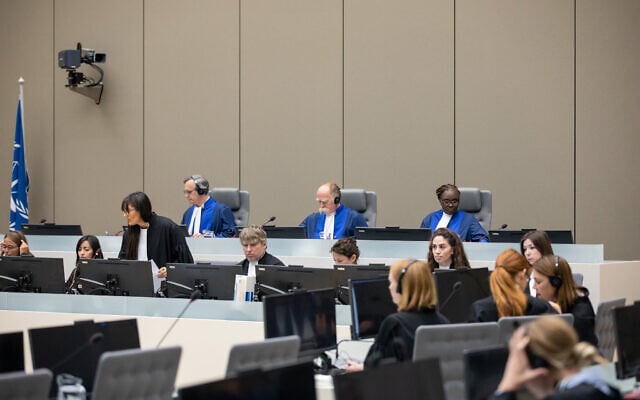
“I call on friends of Israel and the Palestinians, in France and beyond, to state clearly, once and for all, that the road to peace runs directly between Jerusalem and Ramallah. Detours via the ICC in the Hague and the UN Human Rights Council in Geneva are counterproductive to the cause of peace and undermine the chances of an agreement between us,” he concluded.
On Wednesday, Channel 13 reported that Israel received a letter from the ICC formally detailing the scope of its war crimes investigation against Israel and Palestinian terror groups. According to the report, the letter arrived over the weekend and the National Security Council has already met to begin formulating Israel’s response.
The report said the one-and-a-half page letter briefly laid out the three main areas the probe intends to cover: the 2014 war between Israel and Hamas; Israeli settlement policy; and the 2018 Great March of Return protests, a series of violent demonstrations along Gaza’s border with Israel that left dozens of Palestinians dead.
Neither Israel nor the ICC published the letter or acknowledged it had been sent.
Israel has 30 days to respond, the report said, adding that Jerusalem is leaning toward doing so after having largely refused to cooperate with The Hague-based international court until now. However, Israel is expected to use its response as an opportunity to once again voice the argument that the ICC has no jurisdiction to hear the case.
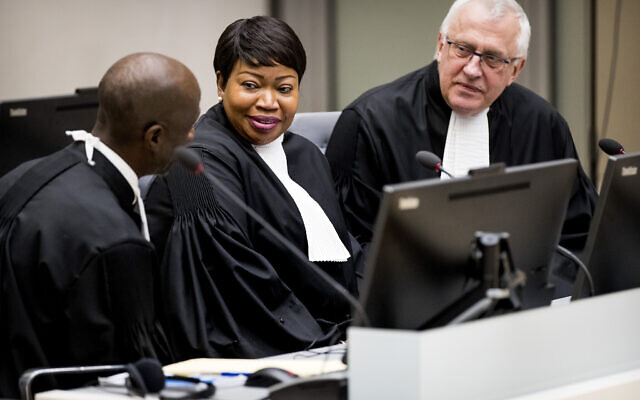
Israeli officials hope the argument over jurisdiction will succeed in delaying the case until outgoing ICC chief prosecutor Fatou Bensouda is replaced in June by British lawmaker Karim Khan, who Jerusalem hopes may be less hostile or may even cancel the probe.
Earlier this month, a number of officials told Channel 13 that they’re concerned the ICC may already start issuing arrest warrants against former IDF officers in the coming months.
Bensouda announced on March 3 that she was opening an investigation into actions committed by Israel and the Palestinians in the West Bank, Gaza, and East Jerusalem since 2014. The announcement of the investigation came less than a month after the court ruled it had the jurisdiction to open a probe. A preliminary investigation to settle the justiciability question took more than five years.




The Times of Israel Community.