

At least 40 Muslim Brotherhood activists killed in clash
Egyptian troops open fire on protesters after attack on compound where former president Morsi is believed to be held
 Add ToI as a Preferred Source on Google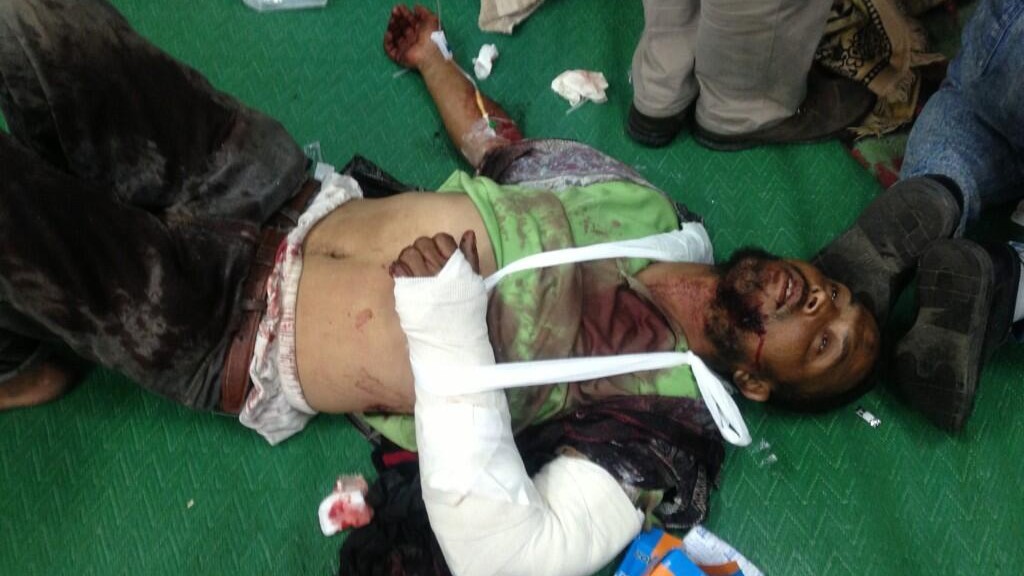
Amid fears of imminent civil war, turmoil in Egypt continued early Monday morning, with an Egyptian health ministry official saying that at least 40 people were killed in clashes outside a military building in Cairo.
A Muslim Brotherhood spokesman, Gehad El-Haddad, reported in a series of tweets that soldiers had fired live ammunition, bird shot, and tear gas at a large gathering of Muslim Brotherhood protesters during their morning prayers. The tweets included graphic images of casualties in what appeared to be a hospital setting.
Ministry spokesman Khaled el-Khatib said initial reports also indicated at least 322 were wounded, although he gave no details on the circumstances of the killings. Military spokesmen said gunmen opened fire on troops at the building, where ousted president Mohammed Morsi is rumored to be held under arrest, killing at least five supporters of Morsi and one officer.
Muslim Brotherhood spokesman Mourad Ali and a witness at the scene, however, said military forces opened fire at dawn on the protesters outside the Republican Guard building. The different accounts could not be reconciled.
Citing the military, Egyptian state television reported that the soldiers opened fire in response to a “terrorist” attack on the compound, which has been the target of previous attempts by Muslim Brotherhood supporters to free Morsi. On Friday, at least four activists were killed by army fire there.
The military said it had arrested some 200 people and seized weapons, ammunition and Molotov cocktails. It confirmed that at least five pro-Morsi activists had been killed in the exchange.
Satellite broadcaster Al-Jazeera showed footage from a nearby field hospital of at least six dead bodies laid out on the ground. A medic from the area, Hesham Agami, said ambulances were unable to transport more than 200 wounded to hospitals because the military had blocked off the roads.
Al-Shaimaa Younes, who witnessed the incident, said military troops and police forces opened fire on the protesters during early morning prayers. “They opened fire with live ammunition and lobbed tear gas,” she said by telephone. “There was panic and people started running. I saw people fall.”
Women and children had been among the protesters, she said.
Citing the “massacre” at the Cairo compound, al-Nour, the ultraconservative Salafist Islamist movement, announced that it was pulling out of the bloc of factions that have been wrangling over who will fill the prime minister’s spot in the interim government.
The appointment of a prime minister is the key next step in building a post-Morsi leadership. The prime minister is to hold far greater powers in running the country than the interim president — Adly Mansour, a senior judge who was sworn into the post earlier.
The bloc of secular, leftist and liberal factions that led the giant wave of protests against Morsi last week are now the main grouping in a loose collection of movements trying to fill out leadership posts. They are pushing for one of their own as prime minister to have a strong voice in shaping the country.
On Saturday, al-Nour blocked the appointment as prime minister of the most prominent liberal figure, Mohamed ElBaradei, who is deeply distrusted by the Islamist movement as too secular.



The Times of Israel Community.