

UN to vote on extending Syria chemical weapons inspectors
US-sponsored resolution to prolong experts’ mandate could be vetoed by Russia at Security Council
 Add ToI as a Preferred Source on Google
UNITED NATIONS (AP) — The UN Security Council has scheduled a vote Tuesday on a US-sponsored resolution that would extend the work of inspectors seeking to determine who is responsible for chemical weapons attacks in Syria, and the big question is whether Russia will veto it.
Russia, a close ally of Syria, has criticized the Joint Investigative Mechanism program.
Russian Ambassador Mikhail Ulyanov, who heads the country’s delegation to the General Assembly’s disarmament committee, told UN reporters on Oct. 13 that before making a decision, Russia wanted to wait for the inspectors’ report, expected Oct. 26, on the April 4th chemical attack in Khan Sheikhoun that killed over 90 people.
US Ambassador Nikki Haley has pressed for a vote before the report.
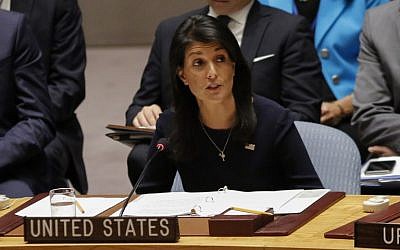
She said Wednesday there was “overwhelming support” among Security Council members to extend the inspectors’ mandate. But she said Russia wants first to see if their report blames Syria for the Khan Sheikhoun attack. In that case, she said, Moscow will have no faith in the joint investigative body of the Organization for the Prohibition of Chemical Weapons and the United Nations.
Haley said Russia’s position was unacceptable. “We can’t work like that,” she said.
“We can’t go and pick and choose who we want to be at fault, who we don’t,” she said.
The attack in Khan Sheikhoun sparked outrage around the world as photos and video of the aftermath, including quivering children dying on camera, were widely broadcast.
The United States blamed the Syrian military for the attack and launched a punitive strike days later on the Shayrat air base where it said the attack was launched. Syrian President Bashar Assad has denied using chemical weapons.
A fact-finding mission by the Organization for the Prohibition of Chemical Weapons reported on June 30 that sarin nerve gas was used in the Khan Sheikhoun attack. But the mission wasn’t authorized to determine responsibility. That job was given to the Joint Investigative Mechanism.
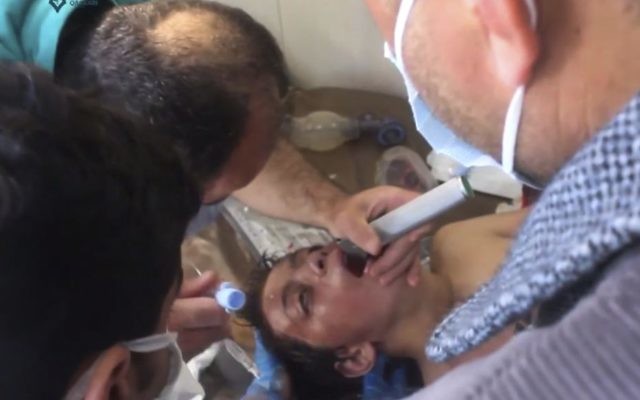
Russia has accused the United States and its Western allies of rushing to judgment and blaming the Syrian government for sarin use in Khan Sheikhoun. It has also criticized the June 30 report by the fact-finding mission as “very biased.”
The JIM inspectors determined last year that the Syrian government was behind at least three attacks involving chlorine gas and that the Islamic State extremist group was responsible for at least one involving mustard gas.






The Times of Israel Community.