

A season to remember, celebrate — and give thanks
A local academy for twentysomethings wants Israelis to practice feeling gratitude, and has designated ten days to spread the word
 Add ToI as a Preferred Source on Google
Jessica Steinberg, The Times of Israel's culture and lifestyles editor, covers the Sabra scene from south to north and back to the center
It’s all well and good to savor an evenly-grilled chicken skewer in celebration of Israel Independence Day. But the folks at the Ein Prat Academy want Israelis to appreciate more than just a barbecue on the national holiday. They want gratitude, ten days of gratitude. Just say toda (thanks).
The midrasha, a place of learning for Israelis in their 20s, is based in the Judean Desert and embarked on Aseret Yemei Toda, or Ten Days of Thanks, last year. The aim was to make the ten days stretching from Holocaust Remembrance Day (this Thursday, April 16) to Israel’s official Memorial Day and Independence Day (April 22 and 23) more meaningful.
This year, the ten day period began on Tuesday, April 14, two days before Holocaust Remembrance Day.
“These days are so meaningful, but there’s not enough we can do ritually,” said Anat Silverstone, CEO of Ein Prat. “Once someone is out of school and the army — out of the frameworks that provide ritual — there’s not much to do.”
But the school had a plan. Based on the ten days of repentance between Rosh Hashanah and Yom Kippur, the academy created a Ten Days of Gratitude project.
They were looking to create more layers of meaning during those national days of remembrance, and, in particular, to remind Israelis to be thankful for what they do have.
“Gratitude is an emotion that isn’t enough in existence in Israeli society,” said Silverstone. “There’s a lot of cynicism and criticism, and that’s important in a society like ours, but gratitude isn’t common enough. It should be a norm in our society, and that was the motivation.”
When the program was first conceived of by the midrasha, it was run internally for several years, said Avigayil Heimowitz, an alumnus who is Ein Prat’s marketing director.
“We don’t even know who started it,” said Heimowitz.
But as Ein Prat succeeded in its initial internal efforts, it was decided last year to bring it to Israeli society, said Heimowitz.
There are currently three circles of activity including events for alumni, particularly those looking for deeper discussion and conversation; creating awareness on the street, using blackboards placed in public spots in Tel Aviv, Beersheba and Jerusalem for people to jot down thoughts about gratitude; and a PR effort, with materials available to download for youth groups, schools and organizations, as well as activities for families to use on Independence Day.
They can’t measure how successful the initiative was last year, except for counting Facebook “likes” and “shares.” But they’re also paying attention to how many cities and organizations are taking part in this year’s efforts.
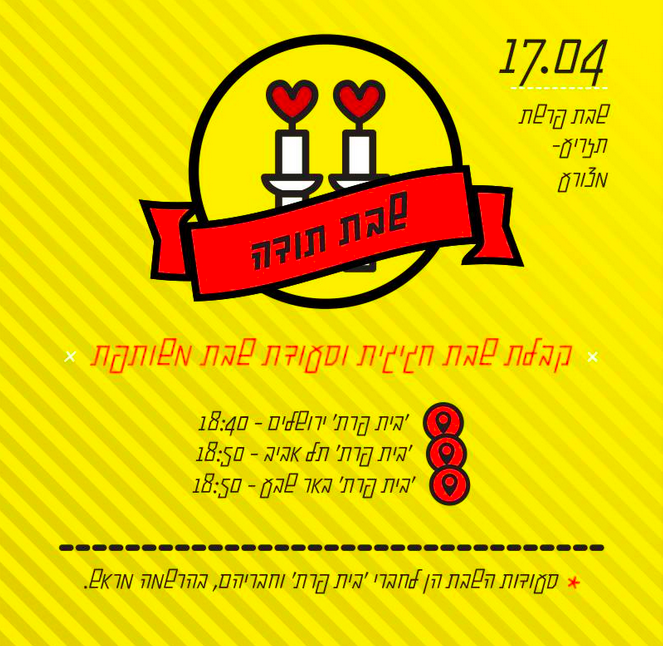
Starting Tuesday, there will be blackboards hung in ten cities, as well as gratitude “tickets” placed on parked cars and billboards hung with messages and teasers to engender thankfulness.
The initiative’s website offers listings of gratitude events during the ten-day span, including where to learn about gratitude, where one can offer gratitude and what songs can be sung about gratitude.
“It’s a presumptuous initiative,” said Silverstone, “because our dream is to expose Israeli society to the possibility of being more grateful. Not only feeling grateful, but acting grateful.”
In a sense, said Silverstone, that’s what makes the program similar to the ten days of repentance earlier in the year. The ten days between the Jewish New Year and Yom Kippur are meant to be used by people to take an accounting of the soul, she pointed out, to figuring out what they have done wrong in the course of the previous year and to decide whom they need to ask forgiveness from.
“I don’t think we’re supposed to be remorseful all year long; that’s not the idea,” she said. “But we are supposed to take those ten days each year and practice being remorseful. We’re saying the same thing about being grateful. Take these ten days and focus on being grateful. You can see and realize how rewarding it is.
“Practicing gratefulness makes us happier people, and that makes for a healthier society.”








The Times of Israel Community.