

As American as Apple iPhones
The Israeli press eagerly awaits Obama’s IS address, gushes over the new iPhone 6, and speculates on the future of the Jewish Home party
 Add ToI as a Preferred Source on Google
Marissa Newman is The Times of Israel political correspondent.
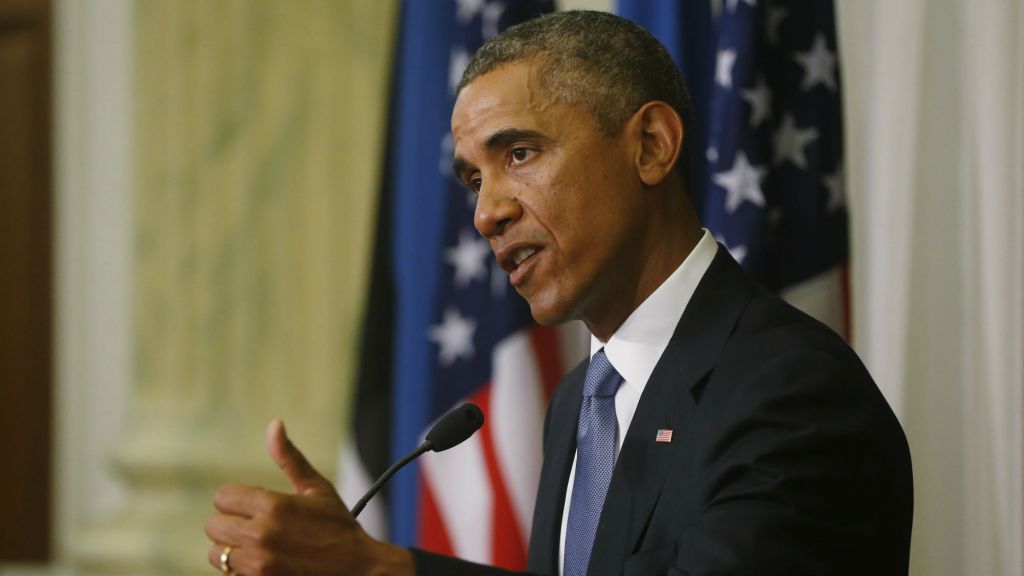
With eyes towards the US, the Hebrew newspapers Wednesday are rife with anticipation: Yedioth Ahronoth leads its coverage with the Apple iPhone 6 announcement, and Israel Hayom and Haaretz wonder what President Obama will say in his evening address outlining the American military campaign against the Islamic State.
Haaretz, meanwhile, also highlights a Jewish Home faction internal constitution bill spearheaded by party head Naftali Bennett, which is set to come to a party vote on Wednesday.
Ahead of the presidential address, Israel Hayom features the time of Obama’s speech, his expected strategy (a three-year air campaign), and speculate on whether the US president will decide to strike Syria as well as Iraq.
In a column on the US’s Islamic State policy, the paper’s Boaz Bismuth evaluates Obama’s shifting legacy.
“Barack Obama was elected so that America would not fight any more. That at least was the dream of the 44th president,” he writes in an op-ed.
“Obama so wanted to write a modern version of ‘War (Bush) and Peace (Obama),’ but in his second and last term he is ending off with a version of ‘War (Bush) and War (Obama),” he continued. “But there are justified wars, Mr. President, and you won’t have to hand over your Nobel Peace Prize because of it. Perhaps Obama’s first war will be the first successful accord of his presidency…. And how ironic that could be.”
Both Israel Hayom and Haaretz feature a joint ABC and Washington Post poll according to which 71% of respondents support US airstrikes on IS targets in Iraq, and 65% back expanding the operation to Syria. According to the survey, Obama’s approval rate stands at 42% overall, but drops to 38% when asked solely about his foreign policy.
Haaretz’s Chemi Shalev highlights the significance of the Wednesday night presidential speech.
“His approval ratings continue to nosedive, as Tuesday’s ABC-Washington Post poll shows,” he writes about Obama. “Americans might be suffering from chronic disappointment from Obama or have possibly grown weary of his distant and aloof style of leadership. One way or another, Obama’s Wednesday night speech on the battle against ISIS on Wednesday night is drawing the kind of attention and creating the kind of suspense that have eluded Obama in recent years. That’s why it could turn into a landmark event, cementing Obama’s position as a terminally crippled lame duck or resuscitating his image as a leader who can march forward with confidence.”
Meanwhile, Haaretz reports on the internal Jewish Home constitution vote, which, it argues, has Bennett attempting to downplay the party’s religious-national core, to make it more appealing to secular voters and boost his political standing.
“Like Liberman and Lapid, he has set himself a goal: becoming prime minister. And he believes that to conquer this summit, he must be freed of the rusty chains and the religious, party-hack image of his rabbis and teachers and adopt the habits of a modern leader. Someone who is new, strong and innovative, who has broad powers, and who is capable of connecting with large segments of the public rather than only with religious Zionists and settlers whose electoral wingspan is fairly limited,” it writes of Bennett.
“If Bennett succeeds in passing the new bylaws, Likud leader Benjamin Netanyahu and Labor Party leader Isaac Herzog will be left gnashing their teeth in jealousy. But if he fails in today’s central committee vote, it will be a resounding slap in the face that is liable to shake Jewish Home to its foundations.”
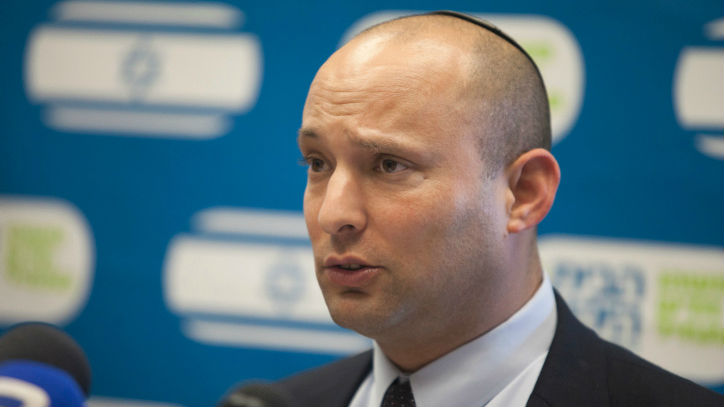
Israel Hayom quotes unnamed Jewish Home officials who describe the atmosphere in the party as “hysterical.” The paper reports that the effort would significantly increase Bennett’s hold over the party.
Over in Yedioth, the paper gushes over the new iPhone and its various features, and spotlights Israel’s role in developing the new technology.
“Did the Apple centers in Israel participate in developing the new iPhones and the smart watches that Apple launched yesterday? It seems so,” it reports. “Apple has several development centers in Israel (in Haifa, Herzliya, Raanana, and Tel Aviv) which employ hundreds of workers in various fields. Apple has never addressed the nature and type of work done here, but it’s clear that Israeli staff were involved in developing some of the technologies that eventually became part of the new devices launched yesterday. Sources in the industry assess that the Raanana development center was involved in developing the smart watch.”
The paper asserts that since the death of Steve Jobs, the Israeli branches of Apple have played a larger role in development, and currently “are the largest and most important development centers of the company outside of the US.”








The Times of Israel Community.