

Blood-soaked on the Bosphorus
Deadly attack on Istanbul’s Ataturk Airport keeps Israel’s once-and-again ally in the headlines for yet another day
 Add ToI as a Preferred Source on Google
Ilan Ben Zion is an AFP reporter and a former news editor at The Times of Israel.
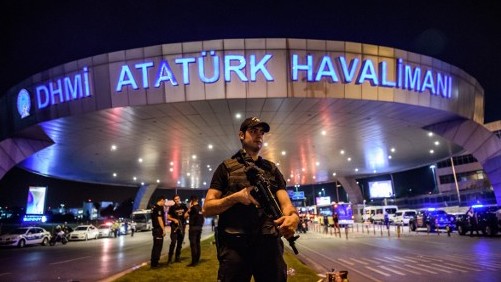
Turkey remains in the headlines of the Hebrew press for another consecutive day, but not because of the accord signed by Ankara and Jerusalem to restore diplomatic relations after six years of hostility. A twin suicide bombing and shooting ripped through Ataturk Airport in Istanbul around 10 o’clock at night, killing at least 28 and injuring dozens more, according to Israeli coverage that relies heavily on the news wires. By morning the death toll rose to at least 36 (and later to 41).
The news agency coverage of the terrorist attack on one of the world’s busiest airports is peppered with eyewitness accounts by Israelis who were in the terminal at the time. No Israelis were reported among the injured or killed, but the papers can’t help recalling March’s bombing in Istanbul in which three Israelis were among the dead.
“We were standing in line, and suddenly there was terrible hysteria. People started running into the terminal and we didn’t know what was happening,” Shimon, an Israeli who was at the airport, tells Yedioth Ahronoth. “We heard screams, cries. We needed to find places to hide, even in the bathroom.”
Israel Hayom talks to a group of 10 Israelis who were on their way to Morocco. Shimon Saluk (it’s unclear whether it’s the same Shimon who spoke to Yedioth Ahronoth), tells the paper “they closed the skies and there are no flights. We don’t know when we’ll get back to Israel. The police here are in shock, there’s a complete mess. I didn’t hear noise, we just saw people running amok like crazy, shouting and screaming. People ran to hide in the toilets, in duty free, everywhere possible. We, the group of Israelis, moved aside in order not to be a target for anyone.”
It remained unclear whether the Islamic State or Kurdish rebels were behind the bombing.
This latest bombing in Istanbul reminds Turkish President Recep Tayyip Erdogan where the real battlefront is, Zvi Bar’el writes in Haaretz. “Turkey for a while already can’t claim immunity from Islamic State terror attacks, after it joined the military campaign of the Western coalition. A terror attack like this is hard to improvise and carry out at the last minute, and it can attest to the fact that despite the great intelligence efforts Turkey invests in locating Islamic State cells and the tireless war against the PKK, there’s an effective terror network inside Turkey that manages to fly under the radar of intelligence and strike civilian targets.”
While there’s likely no connection between the bombing and the signing of the deal with Israel the same day, Bar’el says it dashed any hopes that mended fences between the two states would result in increased Israeli tourism to Turkey.
In Israel Hayom, Boaz Bismuth writes that Turkey, formerly a top global tourist destination, has become a top global terrorist destination. The bombing at one of the busiest airports in Europe is a “major achievement and great success” for the terrorists, he says. The fact that it hit a civilian target hints to the fact that it was carried out by the Islamic State.
“It’s an unacceptable reality for the Turks. It’s an attack on tourism, it’s an attack on the economy, it’s an attack on the image of the country,” Bismuth writes. Turkey’s aspirations to become a global power and an economic powerhouse have collapsed, “and it has turned into an isolated country surrounded by enemies.”
“From a state with zero conflicts that it aspired to, it’s turned into a state with zero neighbors,” he says. He lays the blame on Erdogan for belonging to NATO and flirting with the Islamic State to fight the Kurds. “Erdogan made a dangerous and incorrect calculation.”
He also says it’s unlikely that this attack was a result of Ankara’s deal with the Jewish state. “An attack like this is planned far in advance. We need to wait.”
In the papers, the carnage in Istanbul trumps the signing of a rapprochement accord between Israel and Turkey, and the opposition by several members of the cabinet to its ratification.
Nonetheless, Yedioth Ahronoth reports that what was expected to be a smooth rubber-stamping of the deal with Turkey hit some speed bumps in the security cabinet.
The paper reports that the deal was signed “almost in hiding,” with the two parties signing the papers in their respective foreign ministries with no press present. It says that three ministers — Jewish Home’s Ayelet Shaked and Naftali Bennett, and Defense Minister Avigdor Liberman — were against the deal and three supported it, with four others on the fence.
While Haaretz makes front page news of the fact that Israel, despite its academic institutions’ global prowess, is below the OECD average in math and reading, Israel Hayom buries the embarrassing revelation way back on Page 13. “Discouraging statistics,” is what the tabloid calls it.





The Times of Israel Community.