

Everybody’s verdict
A look at the punditry on the eve of the Azaria decision offers a view of societal fissures exposed by the case, helpfully anchored by the IDF chief’s dismissal of the ‘everybody’s child’ myth
 Add ToI as a Preferred Source on Google
Joshua Davidovich is The Times of Israel's Deputy Editor
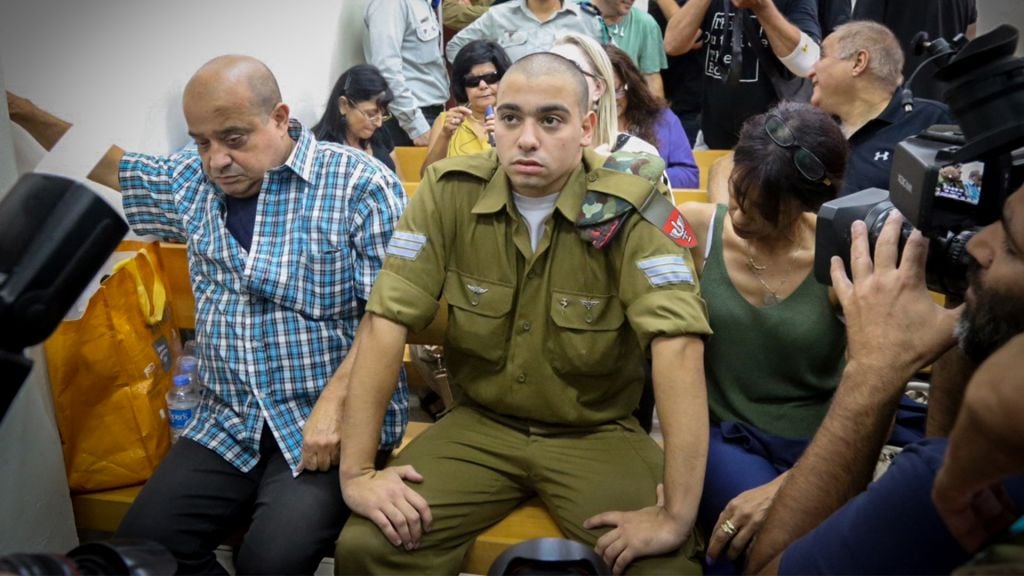
At the time of this writing, violent protests are taking place in central Tel Aviv as Judge Maya Heller reads out her verdict in the manslaughter trial of IDF soldier Elor Azaria, with all indications pointing to a guilty verdict.
As dawn broke on this cloudy Wednesday, though, papers reached doorsteps and newsstands without such foreknowledge, and instead with a single question scrivened across their front pages: will Azaria, who was filmed shooting a wounded Palestinian assailant in March, be found innocent or guilty, with all the prescience of the Israeli pundit class leaving them still unable to peer into the near future.
One could say at this point, with the verdict read, those curtain raisers are nothing but fish wrap, yesterday’s news as it were. But given the pungency of the Azaria case for the Israeli zeitgeist, the way the case highlighted deep fissures in society – and in some cases dug them deeper – a look at what was being said on the eve of the verdict offers something of a window into the heart of the nation.
“The biggest loser here is Israeli society, which has absorbed a blow to one of its biggest assets, the ethos of the IDF as a people’s army,” writes Yossi Yehoshua in Yedioth Ahronoth, repeating words that have probably been written a hundred times since the start of the highly charged trial. “The IDF, which always stood outside Israeli societal disputes, which was a uniting force – has turned into a bone of contention stuck in a crisis of confidence that will take a long time to recover from.”
Coverage is saved from continuing to fill that overflowing cup of platitudinal punditry though by IDF Chief of Staff Gadi Eisenkot, who said Tuesday that a soldier “is not everyone’s child,” an oblique reference to one of Azaria’s defenders’ rallying cries, and much of the commentary in Wednesday’s papers is anchored around his comments.
Yehoshua describes Eisenkot as “well-thought, cautious and responsible in using the power of words. He also shies away from making public statements,” wondering why he would decide to send out such a message a day before the verdict.
But the bigger question capturing real estate in the papers is whether or not Eisenkot is correct – or more accurately, whether or not certain pundits agree with him.
In Israel Hayom, Gen. (Res.) Dan Bitton calls Eisenkot’s comments unwarranted intervention, given the chief of staff’s power, though the fact that the writer himself testified in the trial on behalf of Azaria’s defense lets you know he’s not exactly an uninterested analyst.
“Unlike the situation for the state, the army doesn’t separate between powers. The army is a dictatorship, and all the authority is granted by law to the chief of staff. The second a chief of staff and army spokesman make statements against a soldier publicly, they have ended the case. The military court, under the aegis of the chief of staff, will validate the assertion of Eisenkot, who sealed the fate of Azaria even before a basic probe was carried out,” he writes.
In Yedioth, though, Nahum Barnea backs Eisenkot, even if it means taking the “everyone’s child” saying a little too literally.
“Azaria isn’t everyone’s child. Really, he’s not a child. If he was a child we wouldn’t put a gun that can kill in his hands. If people his age were kids we wouldn’t put them on a plane worth a hundred million dollars or on a tank worth millions. We wouldn’t put our lives in their hands and we wouldn’t expect them to endanger their lives for the country,” he writes. “Azaria is of course a child of his parents, but he’ll also be that when he’s 40 or 50. His role in that has no connection to the responsibility demanded of him as a soldier in the Israel Defense Forces.”
Haaretz doesn’t offer much in straight up commentary on the Azaria trial beyond a cartoon linking the soldier’s legal woes to those of Prime Minister Benjamin Netanyahu, showing Azaria saying “there won’t be anything because there was nothing,” a favorite refrain of the suspect in chief.
In fact, it’s Netanyahu that the paper devotes more ink to, including an analysis by writer Ido Baum which predicts continued legal woes for the prime minister – reading between the lines of a statement by Attorney General Avichai Mandelblit on cases that have been closed and comparing him to predecessor and current inmate Ehud Olmert.
“It is worth reading the exact wording [of Mandelblit’s statement] very carefully. Even those cases were not closed, instead Mandelblit wrote: ‘No grounds exist to continue the examination on these matters at this time.’ The emphasis is on the words ‘at this time.’ In other words, the books are still open. It is possible that publicizing the affairs in which he did not find sufficient evidence may actually lead to further information being received on those matters,” he writes. “The affairs that he decided to continue, as well as those that are still being investigated, remind one of the cases against former prime minister Ehud Olmert. For example, the claims of receiving funds from businesspeople has similarities to the affair in which Olmert received envelopes stuffed with cash from businessman Morris Talansky. For the suspicions of double funding for overseas trips, see the entry on Rishon Tours.”
Israel Hayom, meanwhile, squeezes what little good news it can from Mandelblit’s statement, focusing on the fact that Netanyahu isn’t being investigated for the so-called “Bibitours” flight-funding case and throwing that in the face of Channel 10 reporter and Netanyahu arch-nemesis Raviv Drucker, who first reported on the affair.
“Drucker, Channel 10 and the rest of the media that took part in the ‘Bibitours’ scam paraded around with the story like a victory torch that would light their way to their goal: bringing down Netanyahu,” commentator Moti Tochfeld writes. “Two days ago, the attorney general extinguished their torch.”







The Times of Israel Community.