

British warn Israel against undermining Iran deal
Foreign minister William Hague tells Parliament that nuclear agreement is a ‘significant step’ toward advancing regional security
 Add ToI as a Preferred Source on Google
Ilan Ben Zion is an AFP reporter and a former news editor at The Times of Israel.
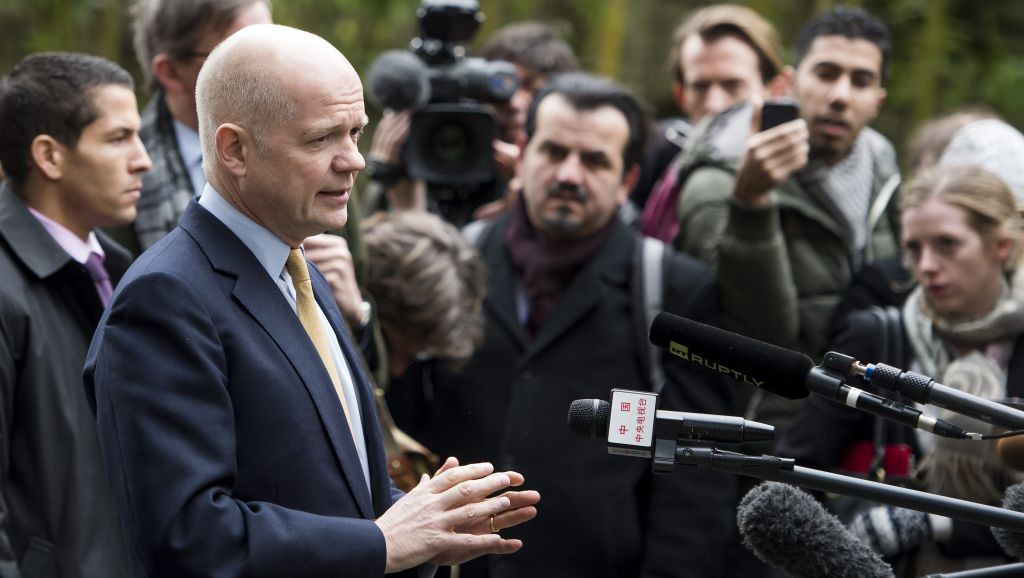
British Foreign Secretary William Hague on Monday cautioned Israel and other states from taking action to undermine an agreement struck with Iran a day earlier.
While briefing Parliament, Hague called the agreement a “thorough and detailed first stage agreement” which he said was a “significant step towards enhancing the security of the Middle East and preventing nuclear proliferation.”
“We would discourage anybody in the world, including Israel, from taking any steps that would undermine this agreement and we will make that very clear to all concerned,” Hague said.
The agreement signed early Sunday between Iran and six world powers rolls back some sanctions on Iran in return for limits on nuclear enrichment, the shuttering of certain sites and an agreement by Tehran to allow some international oversight.
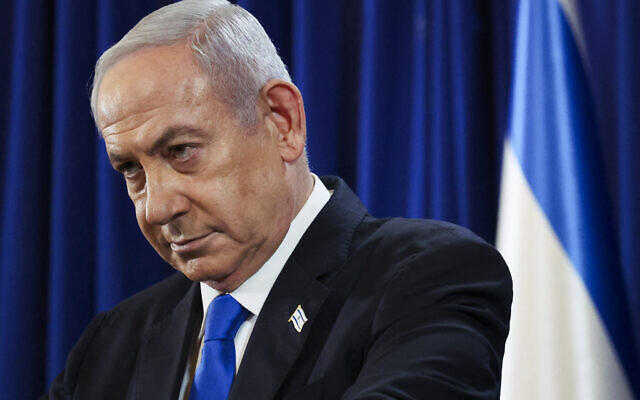
Israeli had lobbied intensively against the deal, which it says lets Iran keep enrichment capabilities. On Sunday, Prime Minister Benjamin Netanyahu called the agreement a “historic mistake.”
Speaking about the particulars of the deal, Hague remarked that the “bulk of the international sanctions” in place “will not be lifted until a comprehensive settlement is reached and we will enforce them robustly.”
He said the still-stringent sanctions levied against the Islamic Republic are an incentive for Iran to comply with the agreement and halt its nuclear program.
“The fact that we have achieved for the first time in nearly a decade an agreement that halts and rolls back Iran’s nuclear program should give us heart that this work can be done and that a comprehensive agreement can be attained,” he said. He warned, however, that if Iran does not abide by its agreements, it would bear “a heavy responsibility.”
Hague’s counterpart across the English Channel, French Foreign Minister Laurent Fabius, said Paris could lift some of the crippling sanctions against Iran within weeks.
“We have agreed to ease a certain number of sanctions,” Fabius was quoted by France24 saying, emphasizing that an eventual final deal with the Islamic Republic rested on mutual respect of the deal signed in Geneva on Sunday.
Fabius was also quoted saying that Israel was unlikely to attempt military intervention in Iran for now, “because no one would understand” it “at this stage.”
Hague said the implementation of the interim agreement would take place after discussions with Iran and the IAEA, and would likely take effect at the end of January.
On Monday, India indicated it would begin paying Iran some $5.3 billion it owes for oil exports as early as next week, Reuters reported.








The Times of Israel Community.