

Hundreds injured in Port Said clashes
Protesters set fire to the city’s Security Directorate over an ongoing riot that has left about 40 dead
 Add ToI as a Preferred Source on Google
Adiv Sterman is a breaking news editor at The Times of Israel.
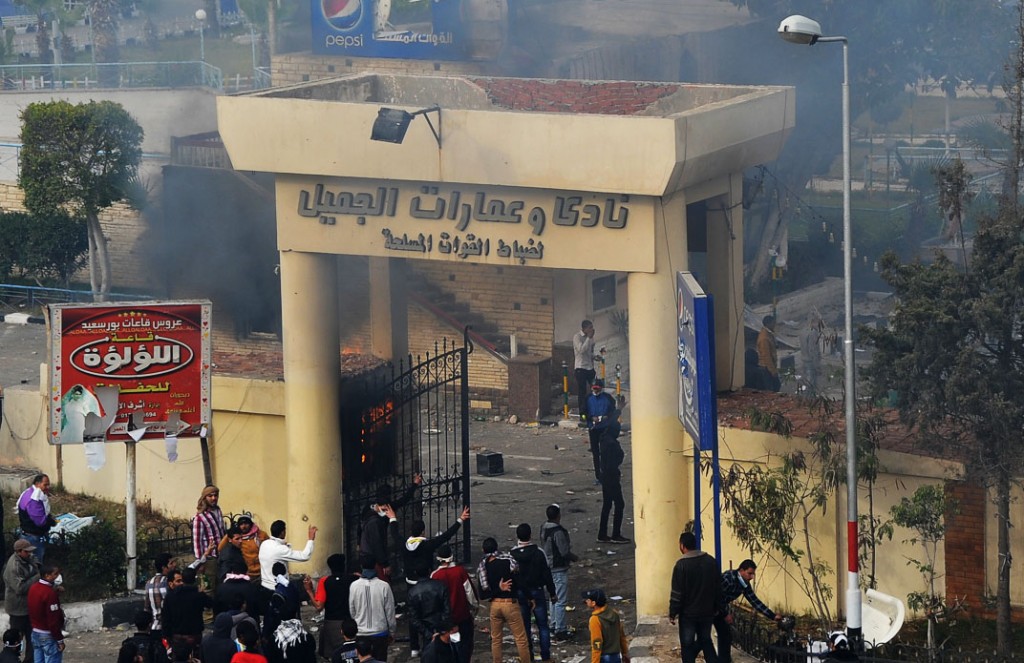
Three hundred and ten people were injured over the weekend in clashes between police and protesters in Port Said, the Health Ministry’s undersecretary in the city reported.
Protesters attacked the Port Said Security Directorate with Molotov cocktails and rocks Sunday after authorities transferred 39 defendants in an ongoing football violence trial to an unknown location late Saturday, Egyptian daily al-Masry al-Youm reported.
Most of the protesters were injured by tear gas, though some 30 suffered injuries after being hit by bird shot, Egyptian media reported.
The Egyptian Interior Ministry said it decided to move the prisoners from Port Said because it wanted to avoid civil unrest.
On January 26, a Port Said criminal court sentenced 21 people to death for their involvement in a football riot that killed over 70 fans in February 2012. Most of the other defendants’ fate had not yet been determined and their final verdict is expected to be set on Saturday.
About 40 people have been killed in the post-verdict clashes between protesters and security forces so far.
For nearly two weeks, protesters and strikers have shut down much of the Mediterranean port city, filling up the streets with one angry rally after another. At the height of the unrest, they succeeded in closing off a multimillion-dollar port for days — forcing some ships to reroute — and in sealing off a major factory complex.
The strikes in this city of 750,000 at the tip of the strategic Suez Canal rattled Islamist President Mohammed Morsi and his government in a way that previous protests haven’t, because they directly hit the economy. Opponents of Morsi, some of whom now openly call for his ouster, have looked to Port Said as a model for stepping up their campaign against him with a possible wave of civil disobedience in other parts of the country.
The plans for wider strikes are being pushed mainly by younger revolutionary groups.
But in the process they appear to be pulling in opposition politicians, who had previously been reluctant — and at times unable — to step up street action against Morsi and the ruling Muslim Brotherhood. The opposition is searching for a way to organize public anger against Morsi at a time when it has called for a boycott of parliamentary elections due to begin in April.






The Times of Israel Community.