

In Egypt, the dawn of an old day
The ability of new president Sissi to deal with jihadists, and the economy, will determine his country’s fate

 Add ToI as a Preferred Source on Google
Avi Issacharoff, The Times of Israel's Middle East analyst, fills the same role for Walla, the leading portal in Israel. He is also a guest commentator on many different radio shows and current affairs programs on television. Until 2012, he was a reporter and commentator on Arab affairs for the Haaretz newspaper. He also lectures on modern Palestinian history at Tel Aviv University, and is currently writing a script for an action-drama series for the Israeli satellite Television "YES." Born in Jerusalem, he graduated cum laude from Ben Gurion University with a B.A. in Middle Eastern studies and then earned his M.A. from Tel Aviv University on the same subject, also cum laude. A fluent Arabic speaker, Avi was the Middle East Affairs correspondent for Israeli Public Radio covering the Israeli-Palestinian conflict, the war in Iraq and the Arab countries between the years 2003-2006. Avi directed and edited short documentary films on Israeli television programs dealing with the Middle East. In 2002 he won the "best reporter" award for the "Israel Radio” for his coverage of the second intifada. In 2004, together with Amos Harel, he wrote "The Seventh War - How we won and why we lost the war with the Palestinians." A year later the book won an award from the Institute for Strategic Studies for containing the best research on security affairs in Israel. In 2008, Issacharoff and Harel published their second book, entitled "34 Days - The Story of the Second Lebanon War," which won the same prize.
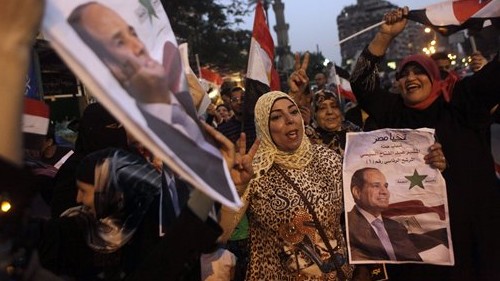
Although votes from roughly half the ballot posts stationed across Egypt have yet to be counted, preliminary results leave little room for doubt: The nation’s former military chief, Abdel-Fattah el-Sissi, has been elected as Egypt’s next president.
The low turnout among the Egyptian population is a matter of concern, with less than half of the country’s eligible voters, 44.4 percent, exercising their democratic right. Over 90% of them cast their vote for the immensely popular retired army general.
The country’s Central Election Commission insisted on a third day of voting, and for good reason. The low vote count is indicative of the disregard many of the country’s Islamists have for the elections as well as for the Egyptian military. Indeed, it is conceivable that if the Muslim Brotherhood had participated in the electoral process, an entirely different outcome may have ensued.
This is the dawn of an old day. Egypt is destined to return, more or less, to the state it was in before revolution swept the nation in January 2011. The military establishment that crowned Hosni Mubarak president in place of the late Anwar Sadat is the same establishment that gave rise to the country’s newly elected leader.
For its part, the Brotherhood will continue to be persecuted as outlaws. The demonstrations and sit-ins that it stages, which devastated the country’s economy and split the Egyptian nation in half, will rage on even after Sissi takes office.
Seen in that light, the success of the new president now depends not only on how well he is able to contain the Islamists’ unrest, but also on his ability to appease the country’s younger population, the leaders of the 2011 revolution who feel their efforts to bring change to Egypt were all in vain.
But above all, Sissi’s success will be measured in his ability to resuscitate Egypt’s faltering economy. To achieve this goal, Sissi will need continued assistance from the Gulf states and from the international community, as well as significant breakthroughs in his war on terror.
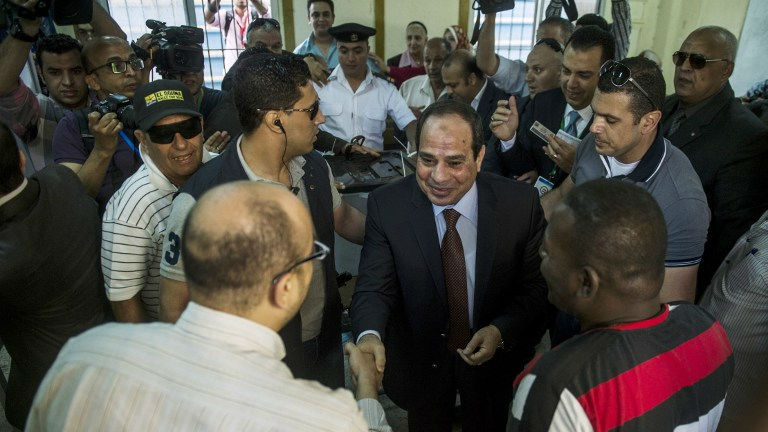
The incoming president is expected to continue dealing heavy blows to jihad operatives in the Sinai and elsewhere. He knows that if the al-Qaeda-affiliated radicals succeed in their attempts to carry out attacks, state tourism — perhaps the most critical asset to Egypt’s economy — will go up in smoke. With that in mind, Sissi will probably continue the ongoing military operation in the peninsula, possibly at an accelerated rate and in multiple areas.
On that front, at least as far as Israel is concerned, Sissi’s victory is excellent news. In media interviews conducted over the past few weeks, the former military chief stressed that preserving relations with Israel was a national interest. Military cooperation between Israeli and Egyptian security forces is therefore expected to continue in the coming years.
It is difficult to determine whether a decade down the line the special relationship between the two countries will still hold strong. It appears that as long as Sissi maintains stability in Egypt, cooperation with Israel will indeed remain intact. Yet if protests against the government expand, and the masses once again take to the streets, Sissi’s reaction may lead to a rift in diplomatic ties between Egypt and the Jewish state. In such a case, the leadership may be inclined to find a scapegoat to blame for its problems.
Israel, traditionally, would be a leading candidate for the role.





The Times of Israel Community.