

Live updates (closed)
 Add ToI as a Preferred Source on Google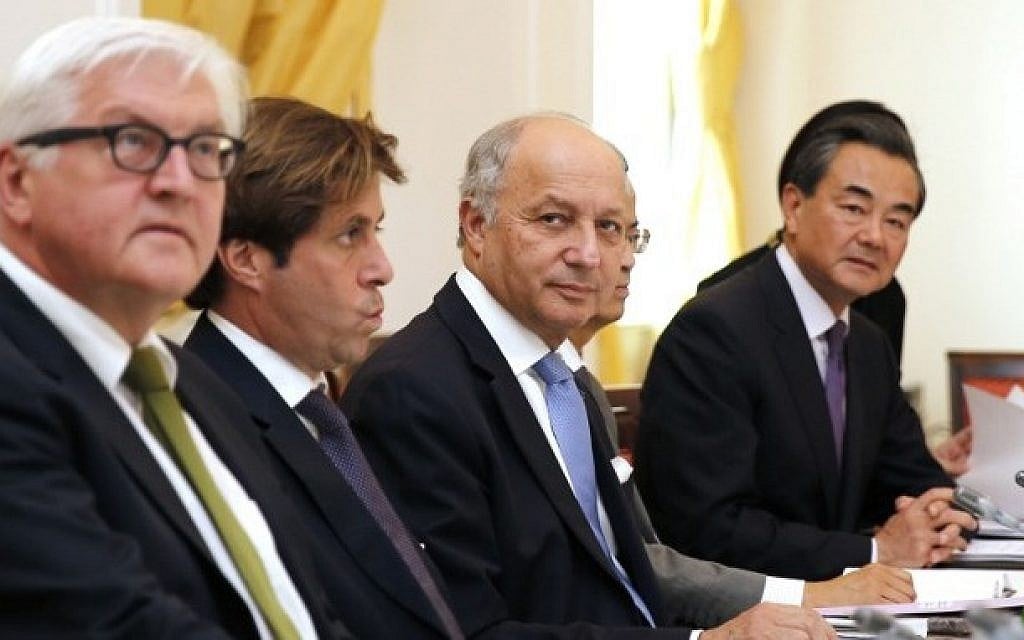



The Times of Israel liveblogged Monday’s events as they unfolded.
Lapid lays ‘bad agreement’ at PM’s feet
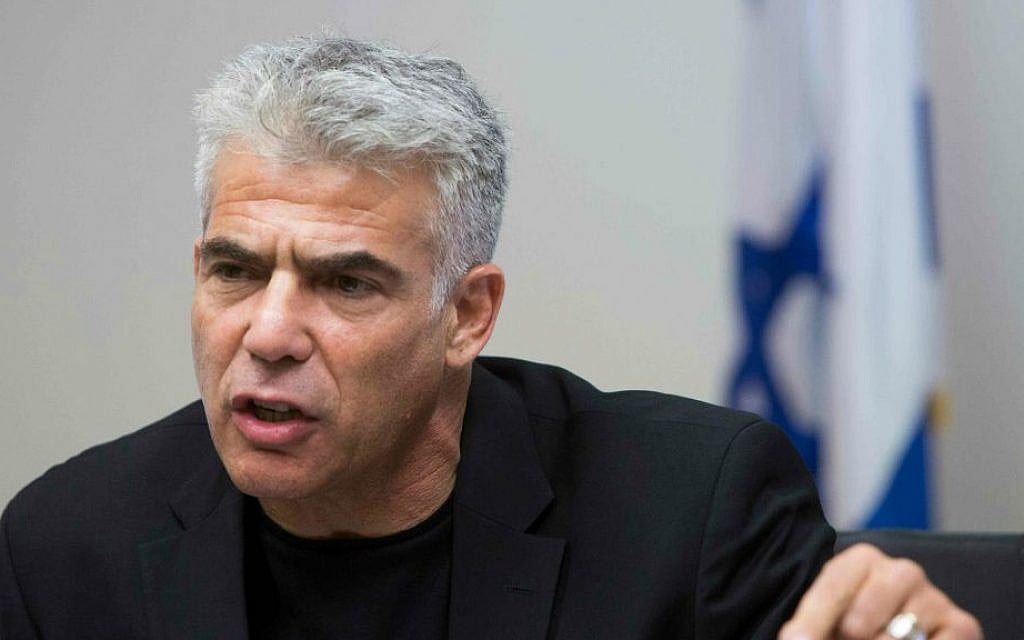
Yesh Atid chairman Yair Lapid says that if world powers sign an agreement with Iran on its nuclear program, Prime Minister Benjamin Netanyahu “must resign, because for three election campaigns he committed to being the leader who would prevent such a bad agreement.”
Speaking to Ynet, Lapid says Netanyahu “told the citizens of Israel: ‘I am the only one who can prevent a deal with the Iranians’ and in the end, because of him this bad agreement was not prevented.”
“This is an agreement born in sin, a bad agreement. When they sit in Vienna, there is no senior Israeli official present. When they go to Congress and the US administration, there is not a single person willing to listen to a word of what Netanyahu is saying,” he says.
The former finance minister criticizes the prime minister for not focusing on the issue of monitoring and inspections: “This is an agreement that doesn’t allow inspectors to go and check whether Iran is secretly developing nuclear weapons. It is an agreement that essentially only freezes centrifuges. It takes only 24 hours to resume work with centrifuges. It is an agreement that makes Iran officially a nuclear-threshold state.”
Iraq jet accidentally bombs Baghdad, kills 7
A bomb fell from an Iraqi Sukhoi warplane and exploded in eastern Baghdad because of a “technical problem,” killing at least seven people, security and medical officials say.
“One of the bombs became stuck because of a technical problem, and during its (the aircraft’s) return to base it fell on three houses in Baghdad Jadida,” security spokesman Brigadier General Saad Maan says in a statement.
The jet was coming back from a bombing run when the accident occurred, Maan says.
Officials say that the blast, which occurred near the Rasheed air base, also wounded at least 11 people.
— AFP
Lapid says gov’t ‘betrayed’ Russian immigrants, US Jews
Lapid slams Netanyahu, as well, on the government’s rejection of the conversion reform.
The government “betrayed” three groups of citizens, says Lapid, speaking to Ynet. First are women: “A woman who goes to a rabbinical court on matters related to marriage is in a worse position than before, and has become a second-class citizen in the view of the [rabbinical] courts.”
“The second betrayal is against 300,000 Israeli citizens who are told, you will be drafted to the army, and in Operation Protective Edge you will die, but in real life you’re second-class citizens and your conversion will never come.”
“Finally,” Lapid says, the government “betrayed world Jewry. On the one hand they try to recruit US Jews to fight the Iranian nuclear program, to get more security assistance for Israel. But yesterday we told them – their rabbis are not rabbis, their conversions are not conversions, their synagogues are not synagogues. The State of Israel pronounces them second-class Jews.”
Lapid is referring to the rolling back of a massive reform in the amount of control the Chief Rabbinate has over issues of marriage, conversion, and the laws of Kashrut. The reform, worked out during the previous government, was championed by Yesh Atid, among other parties.
It would facilitate the conversion of immigrants from the former Soviet Union who were eligible for citizenship but not recognized as Jews and are required to undergo Orthodox conversion in order to marry in Israel. It would also take away part of the power the Chief Rabbinate holds and delegate it to municipal rabbinates, where some Jewish adjudicators are more liberal than others, thus allowing couples with complicated issues relating to their status as Jews to register for marriage in a municipality of their choice.
Finally, a bill on private Kashrut certification was postponed following objection from ultra-Orthodox parties. The bill would let businesses be considered kosher without needing a certificate from the Chief Rabbinate.
The legislative package, as a whole, would bring Israel slightly closer to a separation of religion and state and would divest institutions controlled by ultra-Orthodox political parties of some of the authority they currently hold.
Iran says last few ‘tough’ issues are left
Global powers leading negotiations for a nuclear deal with Iran had a “few last” but “tough” issues left to resolve, an Iranian official say.
Three months ago there were a number of unresolved issues, the official says, asking not to be identified. But now “there are only a few items left which need to be tackled by the ministers. That is why the ministers are here,” he says, speaking as top diplomats began crunch talks in Vienna chasing a deal.
— AFP

China’s Foreign Minister Wang Yi speaks to journalists as he arrives at the Palais Coburg Hotel where the Iran nuclear talks meetings are being held in Vienna, Austria, on July 6, 2015. (Joe Klamar/AFP)
Dispute in Vienna over Iran’s ballistic missiles
An unresolved issue in the Iranian nuclear talks revolves around Iran’s ballistic missile program.
According to Reuters, Western diplomats say the Iranians want all sanctions to be removed, including measures related to the country’s ballistic program. The Iranians, Reuters quotes the diplomats as saying, insist the country’s ballistic missile program has nothing to do with the country’s nuclear program.
The Western diplomats are quoted as saying they cannot accept the Iranian position.
Is Egypt part owner of the King David Hotel?
An Egyptian bank is suing to be announced as a shareholder in Jerusalem’s luxurious King David Hotel.
The bank, Banque Misr, submitted a lawsuit at the Jerusalem District Court through Isareli lawyers Ron Yeshayahu and Gil Makov demanding a declarative verdict against the Guardian of Absentee Property that would return to the bank the stocks in the hotel that were taken from it in the past, according to a report in Calcalist, an Israeli financial paper.
After the hotel opened in 1929, The Israel Land Hotels Company gave 1,000 shares to the Egyptian Zilka Bank. The Zilka Bank was merged with another bank when then Egyptian president Jamal Abdel Nasser nationalized all Egyptian banks. The Banque Misr, today still owned by the Egyptian government, was established as a result from the merger.

The King David Hotel (photo credit: Shmuel Bar-Am)
Banque Misr has 500 branches in Egypt and in other countries.
The King David Hotel, one of the most luxurious in the country and the place where visiting diplomats often choose to stay, was opened at the initiative of Egyptian businessmen. It was purchased by the Israeli Federman family and became part of its network of Dan hotels.
The fact that the hotel was once owned by Egyptians and that an Egyptian bank held stocks there evaporated from memory until in 2007, an Israeli-Arab lawyer, Ashraf Jasser, alerted the bank that it legally still had ownership of hotel shares.
The bank appointed Jasser to file a lawsuit on its behalf, but he ended up swindling the bank on the pretext that an Israeli court fee stood at NIS 10 million. After receiving the money, Jasser filed the lawsuit – paying the actual NIS 975 fee – and took the remainder of the money.
For this and other acts of fraud Jasser was convicted in the Haifa District Court two years ago and given nine years in prison and a fine to compensate the bank by the maximum sum allowed – NIS 258,000. He did not pay back the money.
The bank recently turned to the Jerusalem District Court in a request to renew the lawsuit. The state has yet to file its defense.
Euro at lowest ever, after Greek ‘No’ vote
Following the Greek “No” vote the euro has plummeted to its lowest ever rate against the shekel.
The currency of the Eurobloc trading zone, launched in 2002, has dropped 0.53% over the weekend and is traded at NIS 4.16.
The US dollar has appreciated by 0.18% and is being traded at NIS 3.77.
Deri ‘happy Lapid is only a former minister’
Economy Minister Aryeh Deri shoots back after a tirade by Yesh Atid leader Lapid earlier today indirectly criticized him for blocking legislation on reforms to conversion and kashrut laws.
“A decision on the conversion draft accepted by the government, as written, with all the periods and commas in the text, is the exact draft written by the former minister Avigdor Liberman [of Yisrael Beytenu] with former chief rabbi Shlomo Amar in 2009. This was the compromise by Yisrael Beyetenu that indeed never became law but this was the compromise, the draft we [at Shas] disagreed with, but we agreed to compromise and this was the draft brought by the government. It’s not the one we wanted, it’s the draft by Yisrael Beytenu,” he adds.

Economy Minister Aryeh Deri seen at a ceremony to take up his position at the ministry, May 17, 2015. (Yonatan Sindel/Flash90)
Deri then attacks Lapid and says: “Look at the coalition agreement. We could have gotten twice as much if we had recommended to the president a government headed by Boujie [Isaac] Herzog.
“You would then hear the minister Lapid, the former minister, and I am happy to say he is a former minister, and the former minister Tzipi Livni who are now crying foul – you would hear them justify why the ultra-Orthodox should be given so much and why it constitutes integration and why it is good. So the hypocrisy must stop,” Deri says.
Large brush fire in Jordan Valley
A large brush fire erupted near the communities Tel Te’omim and Sde Trumot, in the Jordan Valley.
Two agricultural structures, a storage facility and an olive grove are being consumed by the flames.
Firefighters are still battling the fire, but have succeeded in containing the fire and keeping it from consuming residential homes. They have evacuated ten houses that were in danger of catching fire.
Obama heads to Pentagon for briefing on IS
US President Barack Obama is making a rare visit to the Pentagon to get an update from military leaders on the campaign against the Islamic State.
Obama’s meetings follow a wave of weekend airstrikes by the US-led coalition in eastern Syria. The coalition says it was one of the most sustained aerial operations carried out in Syria to date.
Obama has insisted he will not send US troops into combat to fight the Islamic State in Iraq or Syria. However, he has acknowledged that the US lacks a “complete strategy” for training Iraqi troops to carry out ground missions.
Efforts to train Syrian rebels are also sputtering. Fewer than 100 rebels are being trained by the US, far less than the goal of producing 5,400 fighters a year.
— AP
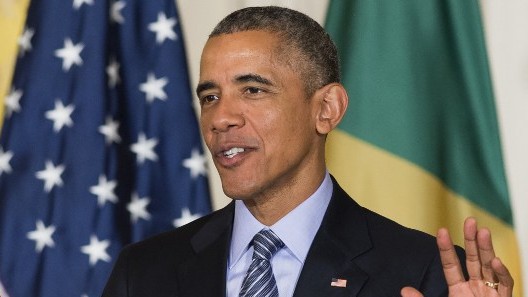
US President Barack Obama speaks during a joint press conference with Brazilian President Dilma Rousseff in the East Room of the White House in Washington, DC, June 30, 2015. (AFP PHOTO / SAUL LOEB)
Oil dives as Greek vote shakes world markets
Oil prices plunge as investors digest the implications of Greece rejecting tough austerity demands from creditors that could send the debt-strapped nation crashing out of the eurozone, analysts say.
The crude market was also pushed sharply lower by the prospect of returning Iranian crude oil supplies, they added.
Brent North Sea crude for August delivery plummets $1.98 to $58.34 a barrel in London early afternoon deals, compared with Friday’s closing level.
West Texas Intermediate for August delivery plunges $2.79 to $54.14 a barrel compared with Thursday, after which US markets shut ahead of the long Independence Day holiday weekend in the United States.
“Commodity markets have largely responded in the ways we had anticipated to the growing risks of Grexit,” says analyst Julian Jessop at research house Capital Economics.
“Oil prices in particular have fallen, undermined also by the prospects of a deal with Iran and signs of recovery in the US rig count.”
— AFP

Illustrative: A new well is drilled beside pumping Jacks at the Chevron section of the Kern River Oil Field near Bakersfield, California, on June 24, 2015. (Mark Ralston/AFP)
IDF to set up special commando division
IDF Chief of Staff Lt. Gen. Gadi Eisenkot announces the establishment of a new commando brigade that will unite several elite units – Maglan, Duvdevan, Egoz and Rimon. The new brigade will be under the command of Division 98, the paratroopers reserve service division.
The brigade will be headed by an officer of the rank of colonel.
Maglan is a special artillery unit, using several types of secret guided missile technologies. Egoz is the elite platoon of the Golani brigade. Duvdevan is an elite unit operating in the West Bank, until now under the command of the Judea and Samaria Division. Rimon is the elite platoon of the Givati Brigade.

Chief of General Staff Gadi Eisenkot, seen here when he was still a major general. (Photo credit: Flash 90)
Erdogan to try his hand at computer coding
A pro-government Turkish newspaper has reported that President Recep Tayyip Erdoğan will code a simple computer game or program to encourage young software developers, the Turkish Hurriyet website reports.
According to the report, from the paper Sabah, Erdoğan “prepared an important plan for Turkey to leap forward in the IT sector.”
The Turkish president’s “three-step project” aims to bring up “world-class IT experts, programmers and software developers” by taking inspiration from Scandinavian countries, especially Estonia.
“It is detected that students use [technological] means on social media and games,” the paper reports, adding that the president’s program aims to divert this energy into coding instead.
Erdoğan “will first gather bright brains, who accomplished significant work in software, e-entrepreneurship and IT, around the presidential dining table,” Hurriyet quotes the Sabah report. Then he “will call on the business world to invest in software and programs.”
In the third and the final step of the project, Sabah reports, “Erdoğan will write a simple game or a program command with students at these festivals, which will encourage them.”

Turkey’s President Recep Tayyip Erdogan greets members of parliament as he arrives for a swearing-in ceremony at the Turkish parliament in Ankara, Turkey, June 23, 2015. (AFP/ADEM ALTAN)
Thousands attend senior cop’s funeral
Thousands of people are attending the funeral of senior police officer Ephraim Bracha in Modiin, in central Israel.
Bracha committed suicide yesterday. He fought allegations that he took bribes from Rabbi Yoshiyahu Pinto and after his death the Police Investigations department ruled that he was not guilty of any wrongdoing.
Bracha was considered a first-rate investigator.
His family requested that no media outlets be present at his burial.
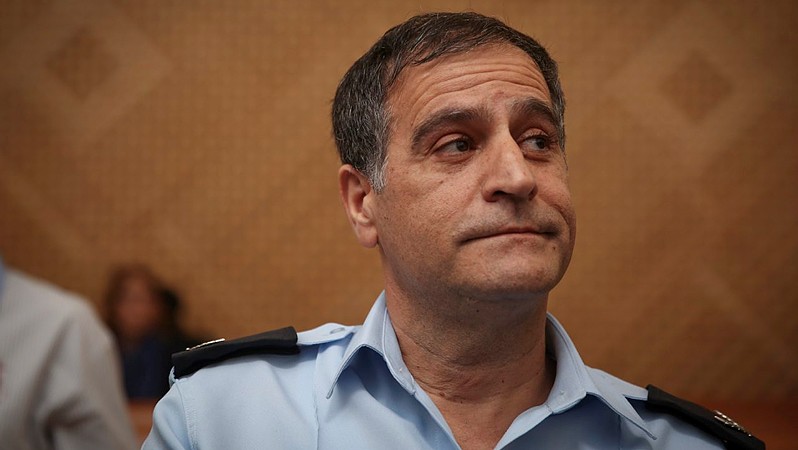
Chief superintendent Ephraim Bracha seen at the Supreme Court in Jerusalem on October 20, 2014. Bracha committed suicide on Sunday, July 5 2015. (Hadas Parush/Flash90)
No fire from Gaza will be tolerated, Rivlin says
The prime minister, president and defense minister are attending a ceremony at Mount Herzl Military Cemetery in Jerusalem marking the one-year anniversary of Operation Protective Edge.
The government also decided to change the designation of the campaign from its previous definition as an operation. The new designation denotes a conflict larger than an operation – Protective Edge was Israel’s longest conflict in years – but still lower than the designation of war.
A conflict defined as war allows businesses and individuals to sue the state for damages, a privilege not available with lower designations like operation or conflict.
During his speech at the ceremony, President Reuven Rivlin said:
The next conflict will be even more difficult than the last. It is clear that such a conflict will require a decisive and difficult decision. And the residents and leaders of the Gaza Strip must understand: the State of Israel will not accept a situation in which our blossoming towns – the granary of the State of Israel, of which we are so proud – are subjected to repeated and ongoing attacks. Not as drip after drip, not as rain, and not as a flood.
When there is no fire toward Sderot, Nahal Oz, Nir Banim, Ashdod or Ashkelon – then there will be no fire toward the Gaza Strip. The rehabilitation and rebuilding of Gaza is an Israeli interest, with the sole condition that Gaza ceases to be a front to carry out attacks against Israel at any given moment. Only the eradication of terror will bring an end to the murder of innocents on both sides.
Operation Protective Edge commanders get promotion
Golani Brigade commander Colonel Ghassan Alian will be promoted to brigadier general and will become chief infantry and paratroopers’ commander.
Givati Brigade commander Col. Ofer Winter will be promoted to OC Central Command and Col. Ofer Levi will be promoted to OC Southern Command. Both men will also be given the rank of brigadier general.
The promotions are announced as the prime minister, president and defense minister are marking the one-year anniversary of Operation Protective Edge, Israel’s war against Hamas in Gaza last year.
Several other officers were given new positions today. The field commanders who were heavily involved in fighting during Protective Edge feature prominently among the promoted generals. Alian was wounded during the war.

Colonel Ghassan Alian on patrol near the West Bank city of Jenin, July 30, 2013 (Yossi Zeliger/Flash90)
IDF says officer who killed teen was in ‘mortal’ danger
The IDF says a senior West Bank commander who killed a Palestinian stone-thrower last week opened fire because he felt “mortal” danger after stones hit his jeep’s windshield.
The military says that Col. Israel Shomer exhausted “all measures” before firing at 17-year-old Mohammed al-Kasbeh, without elaborating on what the measures were.
However, Palestinian witness Haroun Hazeen tells the Associated Press that the officer got out of his jeep and opened fire immediately, shooting even as al-Kasbeh fled. Hospital physician Samer Saliba says al-Kasbeh was shot in the face and back.
An initial army investigation backed Shomer.
Sarit Michaeli from the left-wing human-rights group B’Tselem says the high-profile case sends a message to soldiers that lethal force is acceptable even when stone-throwers no longer seem to pose a threat.
— AP

Mourners carry the body of Palestinian youth Mohammed al-Kasbeh, 17, during his funeral in the Qalandiya refugee camp, near the West Bank city of Ramallah, July 3, 2015. (Flash90)
Sides in Vienna preparing to push deadline — again
An Iranian diplomat in the delegation that arrived in Vienna for nuclear talks says the sides “are not committed to any date” and that the West must “make decisions.”
Officials in the Iranian delegation have already floated the notion that the deadline for the talks will again be pushed back from July 7, tomorrow, which in itself is a week’s extension over a previous June 30 deadline.
According to Haaretz, the arrival of Western diplomats in Vienna on Sunday revealed gaps in the expectations of these countries versus that of the Obama administration’s envoy, Secretary of State John Kerry.
Iranian sources blame mainly France, represented at the talks by Foreign Minister Laurent Fabius, for toughening the West’s position to a point beyond the maximum concessions Iran is willing to make.
Clinton calls for ‘bipartisan’ effort to defend Israel
Democratic presidential candidate Hillary Rodham Clinton is calling for a bipartisan national effort to fight back at the Boycott, Sanctions and Divestment (BDS) campaign against Israel, which she calls “the latest effort to single out Israel on the world stage.”
Clinton, in a personal letter to top Democratic Party donor Haim Saban, expressed her “alarm” over BDS and said that “we need to make countering BDS a priority.” In the July 2 letter, made public today, Clinton sought Saban’s advice on “how we can work together — across party lines and with a diverse array of voices — to reverse this trend with information and advocacy, and fight back against further attempts to isolate and delegitimize Israel.”
The former US secretary of state condemned BDS for attempting to “punish Israel and dictate how the Israelis and Palestinians should resolve the core issues of their conflict. This is not the path to peace,” she wrote. The need to fight BDS remains particularly critical at a time of rising anti-Semitism in Europe and around the world, she added. “We need to repudiate forceful efforts to malign and undermine Israel and the Jewish people.”
Saban lauded Clinton’s call to ramp up efforts to combat BDS, and said her comments underscored his long-standing contention that she has been — and will continue to be — a strong friend of Israel. “As I have been saying all along, when she becomes president, Hillary will reinforce the US-Israel relationship,” he said. “These two allies share the same values and interests. In this letter, Hillary proves her unwavering commitment to Israel and the Jewish community.”

Hillary Clinton speaks at the Saban Forum in Washington on December 5, 2014. (YouTube screenshot)
PM mourns Operation Protective Edge fallen, sends warning to Israel’s enemies
Prime Minister Netanyahu says at the ceremony to mark one year since Operation Protective Edge that “Hamas was beaten the worst ever since its establishment. We are closely monitoring occurrences in the south and are prepared to act with force when necessary.
“I say to all enemies of Israel — Hamas, Hezbollah, Iran and the Islamic State, too — whoever tries to harm us, their blood is upon their heads,” he adds.
Netanyahu then quotes from the Lament of David (2 Samuel, 1), a biblical text also recited during Memorial Day ceremonies: “The bow of Jonathan turned not back, and the sword of Saul returned not empty.”
Netanyahu also says his government will not spare “any effort” to bring home the bodies of Shaul Oron and Hadar Goldin, two soldiers who fell in battle and whose remains are held by Hamas. He also speaks of Daniel Tragerman, a toddler who was killed by the mortar shell at the end of the war.
“There is no end to our yearning, there is no limit to our pride. May the memory of our soldiers, of our sons, the heroes of Israel, and of our citizens, from the toddler, 4-year-old Daniel, to the eldest — may their memory forever be cherished by the heart of the nation,” he concludes.
After the ceremony, the prime minister and his wife, Sara, remain for 20 minutes at the military cemetery on Mount Herzl, speaking to families who lost loved ones during the campaign. According to Ynet, the prime minister’s security guards allow the crowd to come near him, something that rarely occurs.
One of those who approaches the prime minister is Ella Bar, the girlfriend of Paz Eliyahu, who died in a battle inside the Gaza Strip. She talks with Netanyahu about the issue of girlfriends of fallen soldiers, who are not recognized by the Defense Ministry as part of Israel’s community of the bereaved.
Netanyahu and his wife say they will examine the issue and check whether the existing situation can be changed. The prime minister instructs one of his aides to note down Bar’s request.
Speaking later to Ynet, Bar says: “I thank the prime minister for mentioning the partners of the fallen in his speech. I think more can be done on this, but I was moved to hear this mention as a kind of recognition of us, the girlfriends.”
Asked by another person how he feels a year after the battles, Netanyahu answers: “I think we achieved something great.”
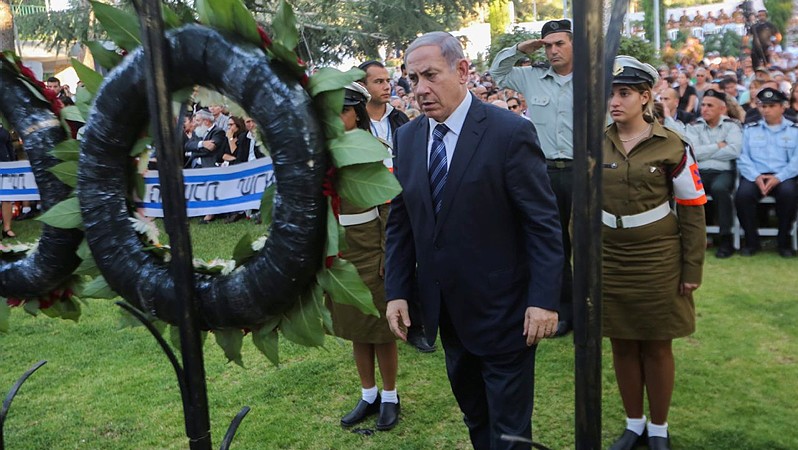
Prime Minister Benjamin Netanyahu lays a wreath during a ceremony marking one year since Operation Protective Edge at the Mount Herzl military cemetery in Jerusalem on July 6, 2015. (Gili Yohanan/Flash90/Pool)
US ‘will only accept deal that closes off Iran’s pathways to a bomb’
US State Department spokesman John Kirby says Secretary of State John Kerry “remains in Vienna as we work toward reaching a final deal.
“We will only accept a deal that effectively closes off Iran’s pathways to a nuclear weapon. We are not there [yet], and there are some important issues to be resolved.
“If we can resolve those issues this week, we’ll have a deal. If we can’t resolve them this week, we won’t have a deal,” he continues.
Kirby claims that “there has been progress made, there’s no doubt about that, but there still remain disagreements and still differences over some particular factors” that have so far prevented the sides from reaching a deal.
“[It’s] not insignificant that you saw all ministers meeting together. Everyone is rowing on the oars to get a deal done,” Kirby states.
He adds that July 7 was not the deadline, and that the sides decided to extend the Joint Plan of Action (the interim agreement from 2013) for seven days — a “technical issue.” Kirby says an extension of the deadline “is possible, but not a certainty.”


read more: