

Last-minute winner
Late-night news that Aryeh Deri is being investigated for fraud beats out 3 other high-level probes for top spot in the Hebrew papers, at least those that hadn’t gone to print
 Add ToI as a Preferred Source on Google
Raoul Wootliff is a former Times of Israel political correspondent and Daily Briefing podcast producer.
Sensational sex scandals, high-level police investigations and contentious court hearings are popular choices to fill the front pages of Israel’s dailies. But the editors of Wednesday’s Hebrew papers had a particularly wide selection to choose from for their front pages, following a day of all three: scandals, investigations and court hearings.
Unfortunately for them, the biggest scandal of them all — which could become a criminal investigation and may well end in a court hearing — was announced after the print deadline, sending reporters and editors scrambling to write the news, get it on the front page, and print (or reprint) the morning editions. Only some succeeded.
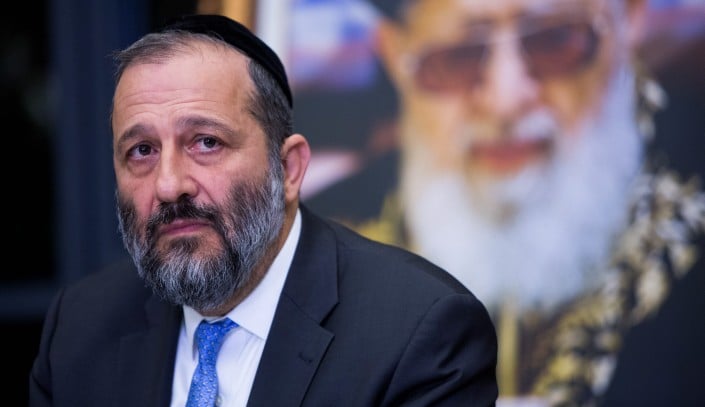
Shortly after midnight Tuesday, Interior Minister Aryeh Deri named himself as one of two senior Israeli politicians being investigated in separate corruption cases, after the investigations — but not the names of those implicated — were reported on Channel 2 News hours earlier.
Israel Hayom manages to get the story onto its front page in time, leading with the headline: “Attorney general: Investigating circumstances connected to Minister Deri.”
In a short article, snugly fit between other news, Israel Hayom political correspondent Mati Tuchfeld gives the bare details of the story, highlighting the incredible context which makes the announcement newsworthy.
“Interior Minister and Shas leader Aryeh Deri is once again at the center of a corruption investigation, 17 years after being convicted of bribery and sentenced to three years in prison,” he writes.
Deri served 22 months in prison from 2000 to 2002 after he was convicted of taking bribes while serving as interior minister, the post he again holds today.
The first copies of Yedioth do not mention Deri, including only a small piece about the Channel 2 report, but thanks to a second press run, the paper leads with the story, using a stark red background to highlight the strangely familiar words: “Deri is suspected of fraud.”
The report on page three expresses shock and disbelief that Deri, after having already served time for fraud, could again be implicated.
“Is it possible,” it asks, “that after having already been convicted, served time in prison and returned to political life, Aryeh Deri is on his way back to the investigation room over fraud?”
Haaretz, on the other hand, does not mention Deri at all, having gone to print before his announcement and evidently not having opted for a reprint.
Nonetheless, the paper adds details to the Channel 2 report, giving new information on the two investigations.
“Amit Segal, a reporter for Channel 2 television, reported on one of those cases last night and Haaretz has obtained information about the second case, which involves suspicions against a key player in Israel’s political system,” the paper reports. “Though both cases have been under investigation for the last few months, both are still at a relatively early stage, so it’s hard to predict whether they are liable to end in indictments. So far, neither of the politicians have been questioned under caution.”
The story that may have led the front pages if it weren’t for Deri is Tuesday’s military hearing and extended remand of soldier who was caught on film shooting an incapacitated Palestinian stabber last week.
During the hearing for the soldier, a military prosecutor stated he believed the suspect had deliberately executed the Palestinian, but hinted he may not be charged with murder. The prosecutor said the accused man shot the Palestinian stabber in the head though the assailant no longer posed a threat.
Israel Hayom and Yedioth Aharonoth both take a quote from the prosecutor as their headline, stating, “There is evidence on both sides,” referring to the soldier’s claim that he thought the Palestinian had a bomb and was trying to detonate himself.
Senior Israel Hayom commentator Dan Margalit writes that a planned letter from the chief of staff outlining the army’s rules of conduct in light of the incident is necessary based on the moral challenges facing soldiers in the recent wave of terror attacks.
“The fight against the Palestinian terrorists has created multiple dilemmas among those who are ultimately expected to decide, with sound judgment and at breakneck speed, whether to pull a trigger or not,” he writes.
“Unlike others, Defense Minister Moshe Ya’alon and IDF Chief of Staff Gadi Eizenkot are not trying to seize the populist mantle by issuing a ‘license to kill’ with no restrictions. Yes, empty the magazine on the terrorist, but never shoot before exercising good judgment,” he concludes.
Haaretz military correspondent Amos Harel says the letter is an attempt to prevent public sentiment in favor of the soldier getting out of hand.
“Members of the General Staff are of the view that there is an immediate need to define for soldiers and commanders what the policy is on the use of force and on opening fire. This is in an effort to prevent the storm on Facebook and news website comments from affecting the soldiers in a way that, in extreme circumstances, could drift to protests in the units, a refusal to obey orders or other violations of rules in the course of incidents involving terrorists,” he writes.
“The text of the message is currently being drafted, but Eisenkot intends to use his message to highlight the IDF’s binding open-fire regulations, the IDF’s values and the importance that he attaches to maintaining them. He also intends to underline the need to avoid controversies of a political nature within the army and highlight the lessons that arise from the Hebron incident,” Amos concludes.
Haaretz contributor Uzi Baram, in a cutting editorial, says the support the soldier has received indicates much deeper problems within Israeli society.
“What can we learn from all this? Will racism bring down the little solidarity that characterized Israeli society? It seems that it will. Because 20 years ago a soldier who shook the hand of the infamous Kahanist Baruch Marzel would have been perceived as a strange and dubious character. Today boundaries that we naturally assumed to be permanent have been crossed,” writes Baram.
Relegated to an even smaller box on the front page of Israel Hayom, and covered on the inner pages of Yedioth, is Tuesday’s confrontation between Brig. Gen. Ofek Buchris and a former female subordinate who is accusing him of raping her.
Conversely, the news that Israeli stage and TV actor Moshe Ivgy was placed under house arrest Tuesday following questioning by police over sexual harassment allegations against him — which on other days may have been a front page sensation — makes a small appearance on the front page of Yedioth and is reported inside Israel Hayom.








The Times of Israel Community.