

Pick your poison
The French election is seen as a battle over the fate of France and much more, while others are unsure if a Hamas election will change anything at all
 Add ToI as a Preferred Source on Google
Joshua Davidovich is The Times of Israel's Deputy Editor
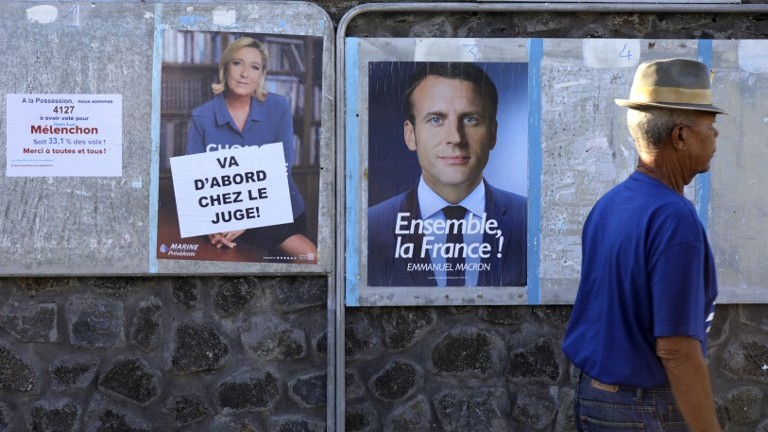
France’s presidential election has the nearly undivided attention of Israel’s print press Sunday morning, with the drama in the race amped up high.
While centrist candidate Emmanuel Macron is cruising toward a crushing victory of far-right Marine Le Pen according to polls, memories of US President Donald Trump’s surprising defeat of Hillary Clinton and other Le Pen-like populists shocking pundits, pollsters and populists alike have papers unwilling to put all their eggs in the Macron basket.
Coverage is colored by the rise of Trump, Le Pen and their ilk and the election is viewed mostly as a key test of whether that populist wave will continue to gallop through the countryside, or will be stopped in its tracks, spiced with a heaping sprinkling of extra doubt thanks to leaked documents purportedly from the Macron camp that could hurt the candidate..
“The election will not only determine the future of France but of the entire European Union,” Haaretz Paris correspondent Dov Alfon writes. “Their decision will also determine, for the entire world, whether victory in democratic elections will, from now on, be accomplished through a well-planned cyberattack accompanied by a no-holds-barred smear campaign against which there is no defense.”
In Yedioth Ahronoth, columnist Nadav Eyal writes that in a “normal world” Macron would have the election in the bag, but after Trump and Brexit and thanks to Russian hackers, nothing is normal anymore. As for the Macron papers, whether they are real or not matters little, since the far-right is adept at making sures lies get all the way around the world before the truth puts its pants on.
‘Throw mud at the wall and something will stick. That’s how the global far-right works’
“Your average French guy heard the rumors of a ‘bombshell,’ read snippets of the papers online, some of them possibly lies. The product of a foggy reality. Social media accounts of alt-right Americans, supporters of Trump or white supremacists or both, tweeted them nonstop, as if they had received an order,” he writes. “Yesterday a senior tweeter in the white army asked whether a document she tweeted didn’t prove that Macron held talks with a Lebanese arms dealer about arming the Islamic State in France. There was nothing in the paper that came close to this dishonest accusation. A nice saying in Arabic goes: Throw mud at the wall and something will stick. That’s how the global far-right works; They work without borders, with international solidarity. There’s an irony in that, I must admit.”
Israel Hayom’s front page headline “France chooses its identity” sums up everything at stake, but the main news story also focuses on the hack, leading off with Macron’s camp calling the leak a “massive coordinated attack.”
French journalist Caroline Delage notes that no matter what happens, the vote is already historic given the anti-establishment identities of the two candidates, which will also mean the two will have a hard time governing. But her column makes it clear she is no big fan of Le Pen and her worldview, which given its placement in the pro-Trump paper, shows that the two would-be leaders are not one and the same.
“Voters will have to choose between one France and another one. A France crushed, broken, pressures and scared or a France victorious, courageous and enthusiastic,” she writes. “Even if it’s tough, one cannot forget that a France that’s ill will one day be a France that is healthy. Today, they need to choose between an optimistic and pessimistic France. This doesn’t just mean Macron or Le Pen, but rather elections that will determine the character of France.”
Another “election,” that of the new Hamas politburo chief, also garners a flurry of headlines and punditry in the press.
In Yedioth Ahronoth, Alex Fishman notes that the election comes amid possibly the greatest internal rift to ever rive the terror group and that Ismail Haniyeh was chosen “as a smiling face” in the hope he can gladhand and fundraise like his predecessor Khaled Mashaal.
“Hamas needs diplomatic support and money. Haniyeh, elected yesterday, is supposed to manage this diplomacy. Haniyeh, without any diplomatic experience, is the pragmatist of Hamas: he didn’t serve time in Israeli prison, hasn’t been directly involved in terror, and lives in the Gaza refugee camp, not hotels in Qatar. The world will be happier to speak with him as an authentic representative of the Palestinians, for he is the smiling face of Gaza.”
Both Fishman and Haaretz columnist Amos Harel note that his pragmatism and ability to navigate challenges will be tempered by having to work with hothead Yahya Sinwar, who replaces him as Hamas’s leader in Gaza. And those challenges are aplenty.
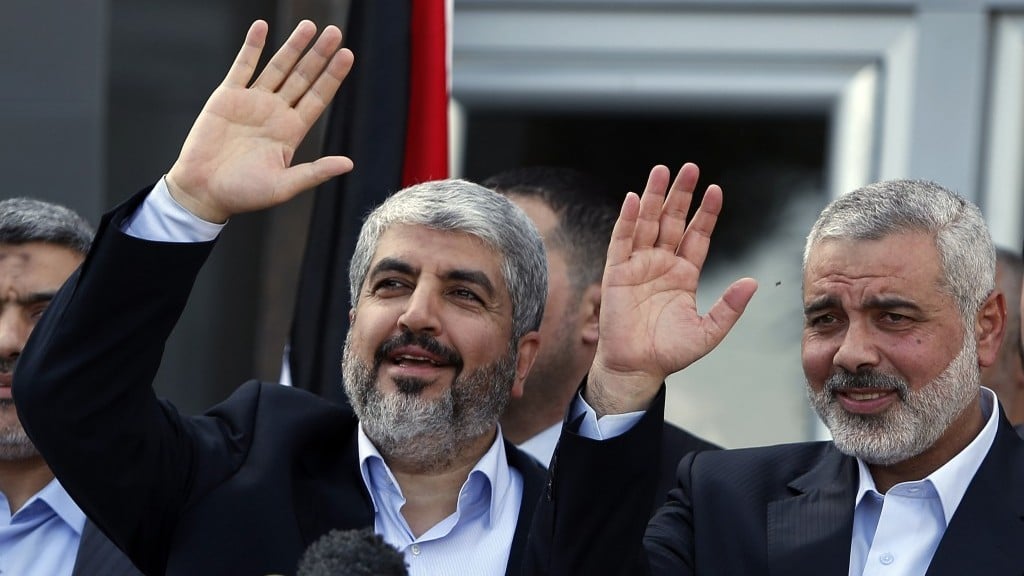
“Haniyeh faces difficult challenges in the near future, and in confronting them he will have to take into account the positions of Sinwar and the other Hamas military leaders,” Harel writes. “Two sources of pressure can already be seen: the moves of the Palestinian Authority to reduce salary payments to its employees in the Gaza Strip, and the cessation of assistance in payments for fuel and electricity, which have already worsened the impossible situation of civilian infrastructure in the Strip. Another important source of pressure is expected when Israel begins major engineering work on the border with the Gaza Strip to block the assault tunnels dug by Hamas.”
Like the others, Israel Hayom columnist Gershon Hacohen, a former IDF general, ties the election of Haniyeh to the publication of the new Hamas program which seems to moderate some old positions. Hacohen explains that for Islamists politics and religion are inextricably linked, and political concessions are only made in service of an unmoving politico-religious goal in the future. In other words, nothing will change.
“This is another expression in the belief of a phased doctrine, which was championed by Khaled Mashaal in explaining the end of Operation Protective Edge that his acceptance of a state on ‘67 lines, as part of a two-state logic, is only temporary and prepares for the full vision which he will continue to fight for without any concession,” he writes. As the torchbearer for Mashaal, it seems that with Haniyeh’s entrance into the new post, nothing will change.


The Times of Israel Community.