

Pride and prejudice
The Hebrew media accuses police of not taking sufficient measures to thwart an attack at Jerusalem’s annual gay pride parade
 Add ToI as a Preferred Source on Google
Adiv Sterman is a breaking news editor at The Times of Israel.
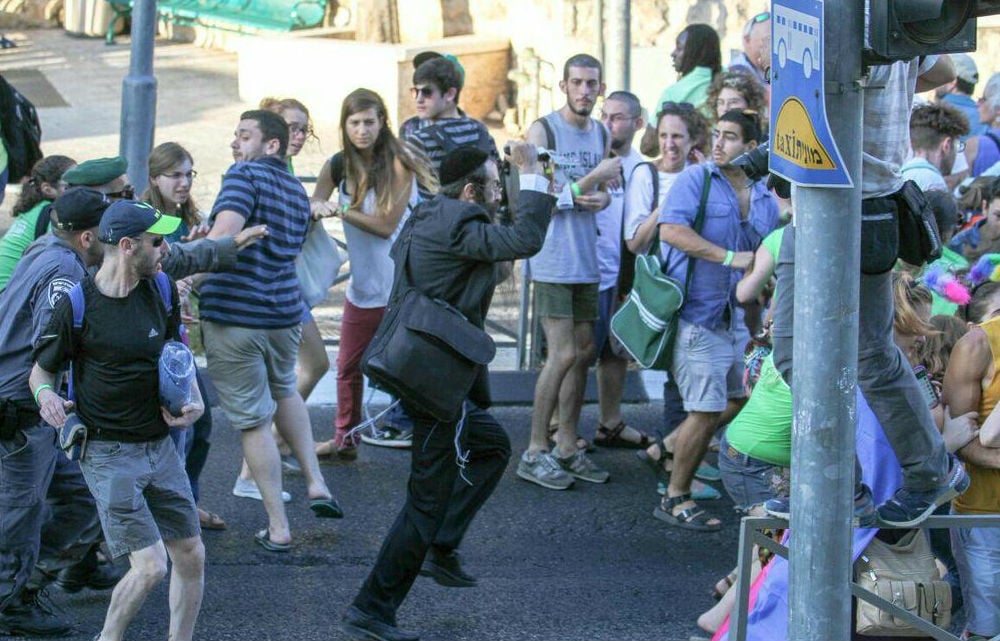
Friday’s papers, published before news broke of an arson attack on a Palestinian family in which an infant was burned to death, devoted the bulk of their attention to another hate crime carried out only hours earlier by Yishai Schlissel, an ultra-Orthodox man, who charged at marchers in Jerusalem’s annual gay pride parade and stabbed six people.
Across the board, the Israeli media points an accusatory finger at the police for failing to take proper steps in order to distance Schlissel from the event, despite the fact that he had been released three weeks ago from prison, where he had served 10 years for a similar attack on the gay pride parade in 2005. Schlissel called his 2005 attack “a mission from God” and had said in recent days that the “foul march” must be thwarted.
“Pride and blood,” reads Yedioth Aharonoth’s headline, plastered over an image which captures the exact moment when Schlissel pulled out a knife.
Reporter Roi Yanovsky writes that following the attack, Jerusalem District Police chief Moshe Edri admitted that although security forces were aware of Schlissel’s recent release, they did not have “accurate information” on his intentions and therefore could not have known he was planning to stab marchers. Edri’s comments, unsurprisingly, were heavily criticized by a number of current and former security officials, among them Aryeh Amit and MK Micky Levy, both of whom served as Jerusalem District Police chiefs in the past.
Yedioth also presents a coming-out-of-the-closet column by Zionist Union MK Itzik Shmuli titled: “The knife is raised on my community,” in which the lawmaker for the first time publicly comments on his sexuality.
“We cannot be silent any longer,” Shmuli writes. “We cannot be silent any longer because the knife is raised on the entire LGBT community — my community — and it won’t stop there.”
In Israel Hayom, aside from numerous pieces condemning the police’s failures and flaws regarding the attack, prominent analyst Dror Eider urges readers not to place the blame for the stabbing on the ultra-Orthodox community in its entirety.
“What happened in Jerusalem is a terror attack for every intent and purpose,” Eider writes. He adds that while there is no doubt the ultra-Orthodox community does not approve of the parade in general, “[I]n the ultra-Orthodox street it is understood that there is a difference between a fiery debate and an attempted murder.”
Eider cites the condemning headlines following the attack in several major ultra-Orthodox media outlets, and adds that many of the first responders who treated the injured marchers were in fact members of the Haredi community themselves.
Haaretz too leads with the attack, but chooses to highlight the extraordinary gains made by Jerusalem’s LGBT community over the past 10 years, in spite of ongoing attempts to curb any expression of gay pride in the capital.
“The first parade [in the city] took place in a closed stadium for fear of violence,” writers Nir Hasson and Yarden Scoop remind us. “After the ultra-Orthodox community abandoned its fight against the march, the event has become one of tens of events that flood the city every summer.”
Back in Israel Hayom, the daily continues in its crusade against the Iranian nuclear deal and US President Barack Obama. According to a survey conducted by the paper, 73% of Israelis do not trust that Obama cares for the Jewish state’s interests, while 76% believe Israel must continue in its efforts to thwart the agreement. A second article on the same topic posits that Obama has already conceded to the fact that the deal will not be approved by the US Congress, and is prepared to veto the decision by US lawmakers in order to push the agreement through.
So, what’s the deal with the Iranian deal, you might ask, and lucky for you, US comedian Jerry Seinfeld may soon provide you with an answer, or at least with a quip on the matter, or about nothing. The 61-year-old is engaged in talks regarding a possible one night stand-up performance in Tel Aviv this December, according to Yedioth. Seinfeld has been to Israel in the past — in 2007, to promote the film “Bee Movie,” for which he provided the voice of one of the characters.
Does the recent visit to Israel by the infamous Soup Nazi point to a trend, and, yada yada yada, can we soon expect a Seinfeld reunion in the holy land?






The Times of Israel Community.