

Seeking a pardon and answers
Internal police investigation finds private security shot two Palestinians; Moshe Katsav’s family tries to get ex-president out of prison
 Add ToI as a Preferred Source on Google
Ilan Ben Zion is an AFP reporter and a former news editor at The Times of Israel.
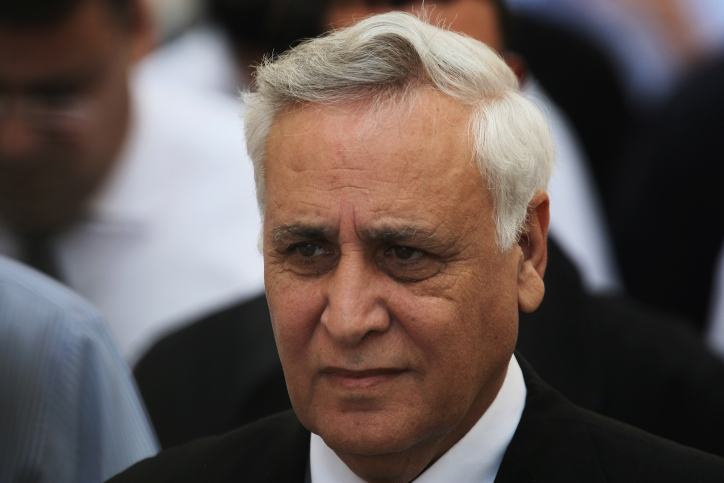
Former president Moshe Katsav’s incarceration and possible pardon from President Reuven Rivlin is at the heart of Monday’s press debate, after reports surfaced that the head of state might let his predecessor off early on account of flagging mental health.
“He’s not in a good mental state,” members of Katsav’s family told Yedioth Ahronoth on Sunday. “He took the [parole] committee’s decision hard, and he feels they’re hounding him. After he enjoyed the Seder night at home and had to return to prison, he was in a serious depression.”
Yedioth Ahronoth notes, however, that as of now the family has yet to submit a formal request of clemency to Rivlin, who met with Katsav’s brother on Sunday. Rivlin said he is awaiting the decision of the Israel Prisons Service Parole Board concerning Katsav’s mental state.
Israel Hayom headlines the response of the Israel Prisons Service to the reports of Katsav’s deteriorating mental health, saying there’s been no noted breakdown, and that it’s natural for prisoners to feel depressed.
The newspapers explain to the laymen readers that, once the president receives a pardon request, he must consult the relevant government officials, particularly the justice minister, and gain their approval before taking it forward. Last time the family requested a pardon, it was shot down by then-justice minister Tzipi Livni before it made it to the desk of then-president Shimon Peres, Yedioth Ahronoth notes.
Haaretz says the meetings between Rivlin and Katsav’s family members appear to be part of their efforts to lay the groundwork for their request for clemency and the ex-president’s early release. They also met with people from Justice Minister Ayelet Shaked’s office, who signaled that if Rivlin is disposed to approving Katsav’s pardon, Shaked would follow suit.
Most of Monday’s news coverage is locally angled. Haaretz leads off with its report on the battle for Aleppo and Syrian President Bashar Assad’s renewed use of chemical weapons, despite an agreement to hand over his stockpiles in 2013. The paper reports that government forces are suspected of using sarin gas last week against Islamic State forces east of the capital, Damascus. If confirmed, it would be the first reported instance of Assad using chemical weapons and an “escalation” in the civil war, Haaretz says.
While Israel Hayom rings in Holocaust Remembrance Day early with its profile of the six survivors who will light the torches at the national ceremony later this week, Haaretz and Yedioth delve into the discovery that two Palestinian siblings shot last week at Qalandiya were killed by private security guards, not Israeli police officers.
An internal police investigation found that the shots fired at Maram and Ibrahim Taha, who were allegedly carrying knives at the Qalandiya checkpoint, were not fired by police. In the meantime, police refuse to release the video that documents the incident, claiming it is investigation material, Haaretz reports. Yedioth Ahronoth reports that sources close to the investigation say the private security guards fired only three shots after fearing for their lives after the two ignored repeated calls to stop.
Perhaps not too surprisingly, the Qalandiya story, front-page material for Haaretz, is nowhere to be found in the pages of Israel’s most-read daily, Israel Hayom. Following in the footsteps of Joint (Arab) List MK Dov Khenin — who called for an investigation of the shooting of the Tahas — Haaretz calls on the police to release the video footage from last Wednesday’s shooting, saying the police’s refusal to do so “only increases the fear that a crime was committed at the north Jerusalem checkpoint.”
“The police claim — that the video is needed for the investigation and cannot be released — contradicts their behavior in similar instances in the past, when police spokesmen hastened to release security-camera footage when it served police purposes,” the paper’s editorial says. “The public has the right to know why and how the siblings were killed, and if it was indeed an unavoidable killing of assailants who threatened the lives of policemen and security guards at the checkpoint.”
Yedioth Ahronoth’s main story also deals with law and order, but in this case with Justice Minister Ayelet Shaked’s intention to promote a bill to apply Israeli law to settlements, effectively annexing parts of the West Bank and creating two separate legal systems for Israeli settlers and Palestinians. The paper calls her plan to apply Israeli norms “annexation through the back door.”
She said in her speech that “it’s important that the justice minister have political power and political capability,” the paper reports, and that the Supreme Court deals with matters “that it’s not supposed to deal with.”




The Times of Israel Community.