

Tearing down a coalition
Liberman’s move to join the opposition sends shockwaves through the press; more Ethiopian protests expected
 Add ToI as a Preferred Source on Google
Ilan Ben Zion is an AFP reporter and a former news editor at The Times of Israel.
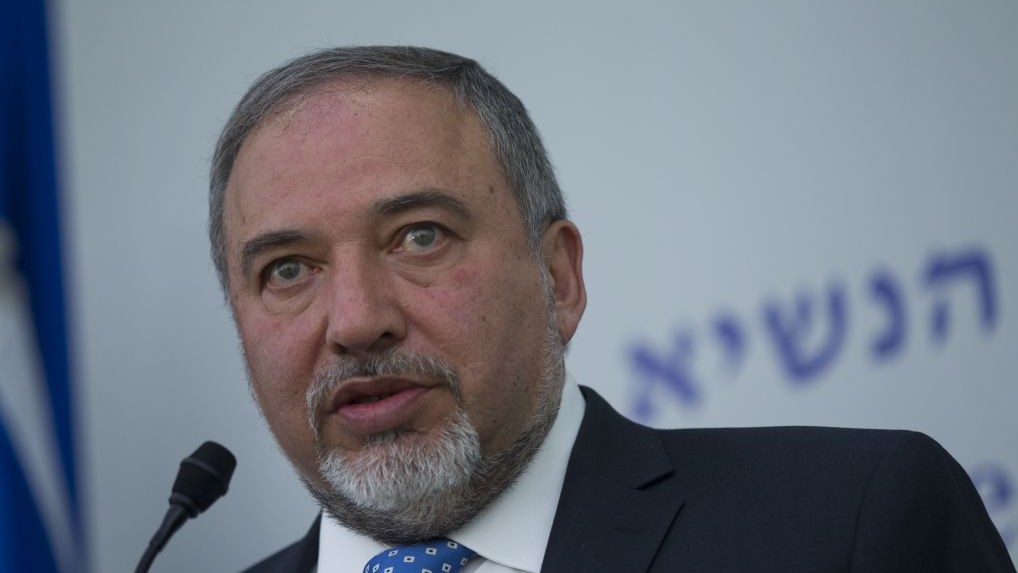
Yisrael Beytenu leader Avigdor Liberman’s decision to take his six seats and go to the opposition, leaving Prime Minister Benjamin Netanyahu in the lurch with just a 61-seat coalition, causes an uproar in the press Tuesday.
“Our dilemma was very clear: principles or seats. We chose principles and conceded seats,” he said Monday, announcing his shock decision. He called the government being formed one of “conformism and opportunism.” Israel Hayom, serving as the mouthpiece of Netanyahu’s Likud party, fires right back, quoting an unnamed source in the Likud party on its front page and in its main coverage saying Liberman is “the biggest of the opportunists.”
Liberman’s 11th hour move makes the odds of Netanyahu forming a stable coalition unlikely, with one Likud party member telling Haaretz that such a governing assemblage would be “impossible.”
“It’d be enough for [Jewish Home MKs] Uri Ariel and Bezalel Smotrich to decide to flex muscles and the government will fall,” the party source says.
With just a day remaining to build his governing coalition, Yedioth Ahronoth says that despite his gains in the election, Netanyahu discovered “that he is on his way to building a narrow government, the narrowest there is.” The paper says that Liberman’s shock move “opens the door” of a possible unity government between the Zionist Union and Likud.
Israel Hayom, in turn, says that if Netanyahu does form a 61-seat coalition, he will try to broaden it by snagging members of the Zionist Union and Yesh Atid and bringing them over to the Likud alliance.
Nahum Barnea warns about the disproportionate power Likud and Jewish Home radicals wield in a 61-seat coalition in his Yedioth Ahronoth column, saying that if they’re displeased, they may bolt and bring down the government.
“When a coalition has just 61 MKs, every slip of the tongue causes a storm, every sign forewarns a crisis,” he says. Barnea writes that Liberman had two choices: either go to the opposition or serve out his final term as foreign minister, because his party wouldn’t survive another election.
By joining the opposition, he says, “it at least has a chance: it will be the only right-wing party in the new government” and therefore enjoy virtually unchecked podium rights. His move was essentially vengeance against Netanyahu, Barnea writes.
On the opposite end of the spectrum, Moti Tuchfeld writes in Israel Hayom that “unlike previous governments, which always included elements from the left side of the map, this time a purely right-wing government stands to be formed,” which had the potential of living out a four-year term.
Liberman’s move, he says, will be remembered henceforth as that which destroyed the Israeli right.
“Every law with a right wing character which doesn’t pass, every achievement which the left-wing opposition succeeds in advancing, every early elections which bring a change in government and every party that Netanyahu forces to enter in his place in order to fill the space will be sent directly to one address: Liberman,” he writes.
After violent protests by Ethiopian Israelis, Netanyahu met with the Ethiopian soldier who was seen being beaten by a police officer on camera last week. Despite the fact that one protester told Haaretz last week that politicians’ offers to “embrace” the Ethiopian community were patronizing, Netanyahu literally did that, hugging the soldier in front of the cameras at the meeting. Netanyahu is quoted in Israel Hayom condemning the violence against Damas Pakada, calling it “leader-like” for him to take a stand against violence on both sides.
Police Chief Yohanan Danino was also at the meeting and is quoted telling Pakada that “after we saw the video we fired the policeman immediately. We usually do this in a much longer process, but in this incident we didn’t wait.”
Yedioth Ahronoth reports that after a large unauthorized protest in Tel Aviv on Sunday, the demonstrators against police brutality will again take to the streets of Tel Aviv, but in a more organized fashion. The organizers tell the paper that it will likely take place on Saturday night, and will involve singers and be nonviolent.
The protesters who filled Rabin Square on Sunday say they’re not planning to throw up their hands and quit just yet, the paper reports. “We’re not tired,” they say on social media. “It was a tough protest, but what’s that compared to 30 years of pain.”






The Times of Israel Community.