

At least 13 said killed in suicide and car bombings outside Istanbul stadium
Interior minister says target was bus of riot police deployed to soccer game at Besiktas grounds; transport minister brands it ‘terrorist attack’
 Add ToI as a Preferred Source on Google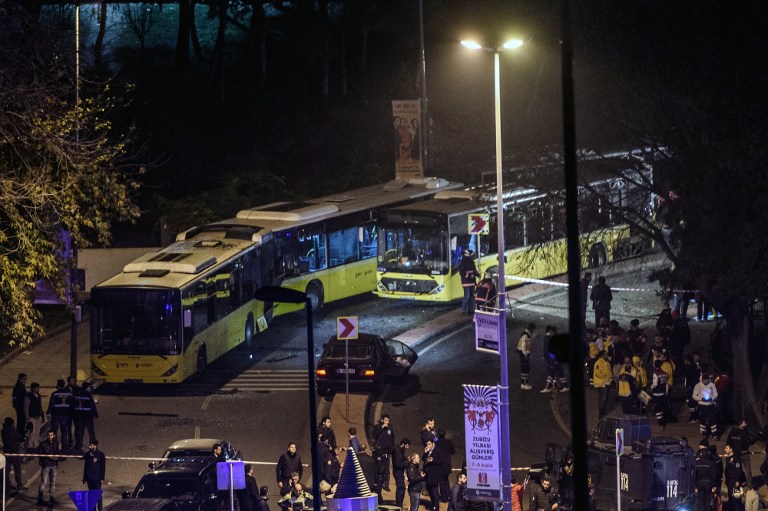
At least 13 people were killed in one of two explosions outside an Istanbul soccer stadium on Saturday evening.
The death toll was reported by Reuters, which quoted Turkish security officials.
The fatal blast struck the area outside Istanbul giant Besiktas soccer team’s stadium after a match against the Bursaspor club, targeting a bus packed with police officers, Interior Minister Suleyman Soylu said. He initially said some 20 officers were wounded in the attack.
The two explosions hit the stadium area after fans had gone home.
“Two bombings may have taken place according to our understanding: one outside the stadium… the other at Macka Park,” Soylu told reporters in Istanbul. “The explosion at Macka Park is believed to have been carried out by a suicide bomber.”
Police cordoned off the area as smoke rose from behind the newly built Vodafone Arena Stadium, known colloquially as Besiktas Stadium after the local team and neighborhood. Witnesses also heard gunfire after the explosions.
The first and larger explosion took place about 10:30 p.m. after the home team Besiktas beat visitor Bursaspor 2-1 in the Turkish Super League.
There was no immediate claim of responsibility for the attack. This year Istanbul has witnessed bombings attributed by authorities to the Islamic State group or claimed by Kurdish militants.
Israel’s Ambassador to Turkey Eitan Na’eh denounced the “hideous attack.”
I condemn the hideous attack in Istanbul, and I wish speedy recovery to the injured.
— Eitan Na'eh (@AmbassadorNaeh) December 10, 2016
Turkey’s Transportation Minister Ahmet Arslan wished a speedy recovery on Twitter to the victims of what he said was a terrorist attack.
Istanbul explosion ???? caught on tape pic.twitter.com/fdRq87RAMI
— Bassem (@BBassem7) December 10, 2016
An AFP correspondent in Istanbul heard an explosion followed by the sound of ambulance sirens rushing to the scene.
State broadcaster TRT World showed images of the wreckage of a car, engulfed in flames with emergency services swarming around the scene outside the stadium.
Other footage showed severely damaged police vehicles, while witnesses said the force of the blast had shattered the windows of several nearby homes.
https://twitter.com/illedeturan/status/807683158623879168
Bursaspor football club said none of its fans had been injured, privately-owned NTV television reported.
The Foreign Ministry in Jerusalem said that there were no Israeli casualties in the bombing. Turkey is a popular destination for Israeli tourists; three Israelis were killed in a suicide bombing in Istanbul in March.
Police cordoned off the area immediately after the blast, which occurred near Prime Minister Binali Yildirim’s office in Istanbul.
https://www.youtube.com/watch?v=TJTeB8AtDG0
Turkey has experienced a bloody year of militant attacks in its two biggest cities that have left dozens dead and put the country on high alert.
Kurdish militants have twice struck in Ankara, while suspected Islamic State group suicide bombers have hit Istanbul on three occasions.
Recent attacks
In June, 47 people were killed in a triple suicide bombing and gun attack at Istanbul’s Ataturk airport, with authorities pointing the finger at IS.
Another 57 people, 34 of them children, were killed in August in a suicide attack by an IS-linked bomber at a Kurdish wedding in the southeastern city of Gaziantep.
The country is also still reeling from a failed July 15 coup blamed on the US-based Islamic preacher Fethullah Gulen that has been followed by a relentless purge of his alleged supporters from state institutions.
Saturday’s attack came hours after Turkey’s ruling party submitted a parliamentary bill that would dramatically expand the powers and possibly the tenure of President Recep Tayyip Erdogan, a move his opponents fear will lead to one-man rule.
If approved, the 21-article constitutional change would see Turkey switch from a parliamentary system to an executive presidency, amid concerns that the country’s government is adopting increasingly authoritarian policies.




The Times of Israel Community.