

After protests, Jordan’s poor have little hope of change
Despite shelving of tax hike in wake of demonstrations, hard-hit residents of Amman fear nothing will improve
 Add ToI as a Preferred Source on Google
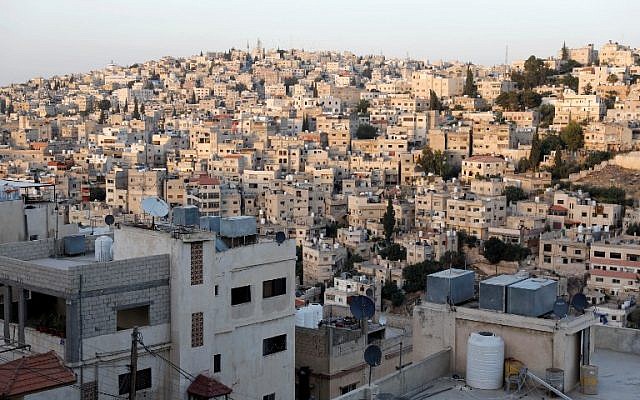
AMMAN, Jordan (AFP) — Protests over a proposed tax hike might have shone the spotlight on economic hardships in Jordan, but the poorest in the kingdom’s capital remain voiceless as they struggle to survive.
Gaunt men sit on the ground of a rubbish-strewn alley in Amman’s Nazzal neighborhood, absent the traditional lights and cheerful decorations that usually come with the Muslim holy month of Ramadan.
One the capital’s poorest areas, the breaking of the daily fast in Nazzal is far from festive.
On the top floor of a dilapidated building, Yusra Moheiddine stands timidly at the door of her apartment, her daughter clinging to the hem of her black niqab robe.
“I’m ashamed,” the mother mutters, of the impoverished conditions in which her family lives.
Mass protests against rising costs and the proposed new tax law have rocked Jordan in recent days as the cash-strapped government pushes austerity measures to slash the country’s debt in the face of an economic crisis.
The authorities shelved the tax proposals in the face of public ire — but for Moheiddine the victory for the demonstrators means little.
Her family of three survives on the five dollars (six euros) a day her sick husband makes collecting cans.
For them, their struggle has long been one of day-to-day survival.
‘Sewage and insects’
Since getting married, the 38-year-old of Palestinian origin has lived in seven different apartments — driven out each time by landlords tired of being shorted on the rent.
Holding her daughter in her arms, Moheiddine insists that the young girl “wants to be a school teacher when she grows up.”
But the hurdles she’ll have to overcome to do so may prove too much.
As the summer sun dips below the horizon in the city of seven hills, millions of people gather over sumptuous meals to break their daily fasts.
In Nazzal, this hard-up family break the fast with a yellowish porridge, garnished with a few pieces of cucumber.

Down the road, 37-year-old Rania lives with her husband and three children in a small house where “only sewage and insects dare go.”
“In the winter, when it rains, we are drowned in sewage,” she says, not giving her surname.
They’ve dug a hole in the corner of the yard to serve as a septic tank.
“I have to empty it every week, otherwise it’s a disaster,” said Rania.
In the house’s only bedroom, torn foam mattresses are arranged side-by-side and the walls are splotched with mould stains.
‘Where would I go?’
“Everyone tells me to leave, but where would I go?” she asks.
Her husband makes a pittance selling corn on the cob and the family can’t afford to live elsewhere.
On the neighborhood’s main streets, a bit more lively than the surrounding alleyways, shops reopen after dark — as is customary during Ramadan.
Children line up to buy neon-yellow sugary drinks, girls stroll arm-in-arm, and groups of elderly men sit on plastic chairs earnestly discussing the world’s problems.
Jihad, a fruit and vegetable seller in his 50s, is fatalistic.
“Our turnover has dropped by more than 50% compared to last year, but I get it… who wants to buy a melon or a watermelon when he can’t even buy bread?”

He doesn’t believe the recent demonstrations will make much of a difference.
“Nothing will change. The only one who can save us is God,” he said.
On the adjacent sidewalk, Abboud Agraba, dressed in a long beige robe, bursts into laughter.
“Don’t believe a word they’re telling you. We’re happy here, we’re not in need of anything. Rising prices? Taxes? Never heard of them,” he said sarcastically, before his grin quickly faded.
“I have a degree in engineering, but I’ve been unemployed for years,” he said.









The Times of Israel Community.