

All eyes on Gaza: 8 things to know for March 29
Israelis gear up for the Passover holiday under a cloud of apprehension as IDF girds for violent clashes along Gaza border
 Add ToI as a Preferred Source on Google
Tamar Pileggi is a breaking news editor at The Times of Israel.
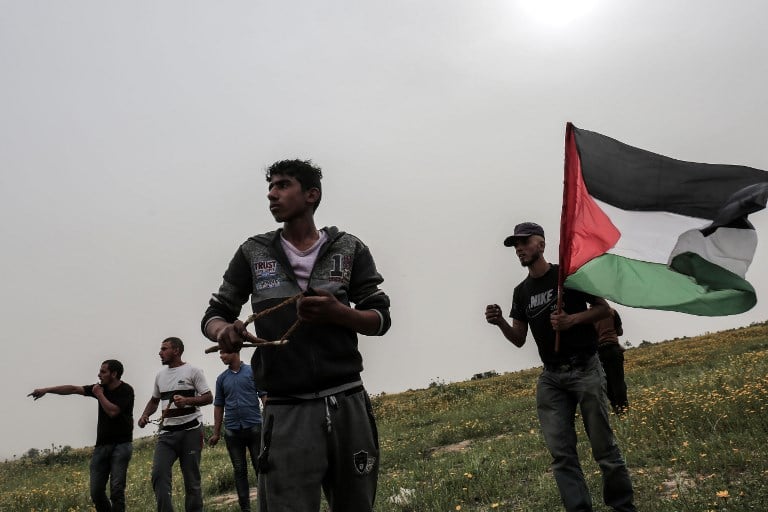
1. The IDF said Thursday it caught two Palestinians from Gaza who sneaked into Israel carrying knives, in the fourth such infiltration in as many days, ramping up concern ahead of mass protests Palestinians are planning Friday along the Israel-Gaza border.
- Earlier this week, three Gazans with grenades made it about 20 kilometers (12.5 miles) inside Israel before they were caught. No one was harmed in the infiltration but they set off great worry in southern Israeli communities already fearful that Palestinian terrorists have dug underground tunnels they could use to enter Israel to carry out attacks.
- The sense of apprehension is palatable in the Hebrew-language on Thursday. Yedioth Ahronoth’s Ariela Ringel Hoffman says Israel’s over-preparing for violent clashes is “an effort to prevent a possible bloodbath there,” and laments there is no solution to the conflict in sight. “The recent attacks and infiltrations, and especially the march tomorrow, indicate that this is not going to end soon,” Ringel Hoffman writes. “They will teach you that the answer is the military, but however good they are, it’s no more than a Band-Aid, an improvised Band-Aid at best.”
- Meanwhile, Gaza’s Hamas rulers are urging residents to gather near the fence and march toward Israeli positions. The IDF has warned it will take extreme measures if the border is breached, including opening fire on anyone who attempts to cross the border.
2. On Wednesday evening, thousands of people took part in a silent march in Paris in memory of an 85-year-old French Jewish woman, killed in a grisly attack believed to be anti-Semitic.
-
- Mireille Knoll, who escaped the mass deportation of Jews from France during World War II by fleeing abroad, was stabbed 11 times in an assault that the perpetrators apparently tried to conceal by setting fire to her apartment.
- Unsurprisingly the attack struck a chord among Israelis, with hundreds gathering in a number of cities Wednesday for solidarity rallies and to denounce anti-Semitism.

- In an op-ed, Haaretz’s Sefy Handler says that France must urgently address the resurgence in anti-Jewish violence. “This murder of a Jewish woman on the Sabbath eve is a reminder that, more than 70 years after the drama of the deportation and murder of its Jews, France still has not freed itself of festering anti-Semitism. Its appearance may have changed over the years, but it is still present and claiming victims,” he writes. “One thing is certain: If France does not urgently address the problem, it will have major implications for the whole French nation.”
3. Paris was not the only major European city to host an major rally against anti-Semitism this week. In London, over a thousand people gathered outside the Houses of Parliament on Monday to denounce what they said was the Labour party’s refusal to deal with anti-Jewish sentiment in its ranks.
- On Wednesday, UK Jewish leaders issued party leader Jeremy Corbyn a list of demands before they would agree to meet with him, including disassociating himself with controversial ex-London mayor Ken Livingstone.
- “For whatever reasons, you have not, until now, seemed to grasp how strongly British Jews feel about the situation,” Board of Deputies president Jonathan Arkush and Jewish Leadership Council chair Jonathan Goldstein told Corbyn in the letter. They said Monday’s rally was the result of “cumulative anger and despair in the Jewish community at repeated, numerous cases of antisemitism in the Labour Party and failures to deal with them in a decisive, swift and public manner.”
4. El Al filed a lawsuit against the government on Wednesday for allowing Air India to fly over Saudi airspace on its New Delhi-Tel Aviv flights, a move the national carrier says puts it at an unfair disadvantage.
- Riyadh and Jerusalem have no diplomatic ties. The kingdom’s decision to allow the Indian carrier to fly through its airspace en route to Tel Aviv reflected a recent, behind-the-scenes warming of ties between Saudi Arabia and Israel.
- But El Al says it has been harmed as a result. It currently has the only flights connecting Mumbai to Tel Aviv but is forced to bypass Saudi Arabia on that route. The new Air India route significantly shortens travel time and airfare costs.
5. Jordan has approved Amir Weissbrod as Israel’s new ambassador on Wednesday, seemingly ending a diplomatic standoff sparked by the shooting deaths of two Jordanians by an Israeli security guard at the Amman embassy last year.
6. The international boycott, divestment, and sanctions movement, known as BDS, is threatening to take legal action against Netflix if it doesn’t pull the first season of the Israeli hit show “Fauda” from its service.
- According to the Haaretz daily, the campaigners wrote that “Fauda” serves as “racist propaganda for the Israeli occupying army and displays aggression towards the Palestinian people, and the process it is leading for freedom and independence.”
- The letter claims the hit TV show “encourages violating international law and human rights — which could lead us to take legal actions against Netflix.’
7. And finally, as Israel prepares to observe the eight-day Passover holiday, retired Supreme Court justice Elyakim Rubenstein pens an impassioned plea for equality and freedom for the African asylum seekers in Israel.
- “It falls under the Jewish ethos of ‘not betraying a slave to his master,’ and the history of the people of Israel and its persecution — even if it does not obligate us to absorb everyone who comes through our gates — it does oblige us to show compassion beyond the normal standards…We must fight against any manifestations of racism among our people, toward Jews and non-Jews alike, toward every human being.”









The Times of Israel Community.