

Amnon Rubinstein, ‘the father of Israel’s constitutional law,’ dies at 92
Former lawmaker and Israel Prize winner played key role in shaping Israel’s legal and political landscape during 25-year Knesset career, before retiring to write novels
 Add ToI as a Preferred Source on Google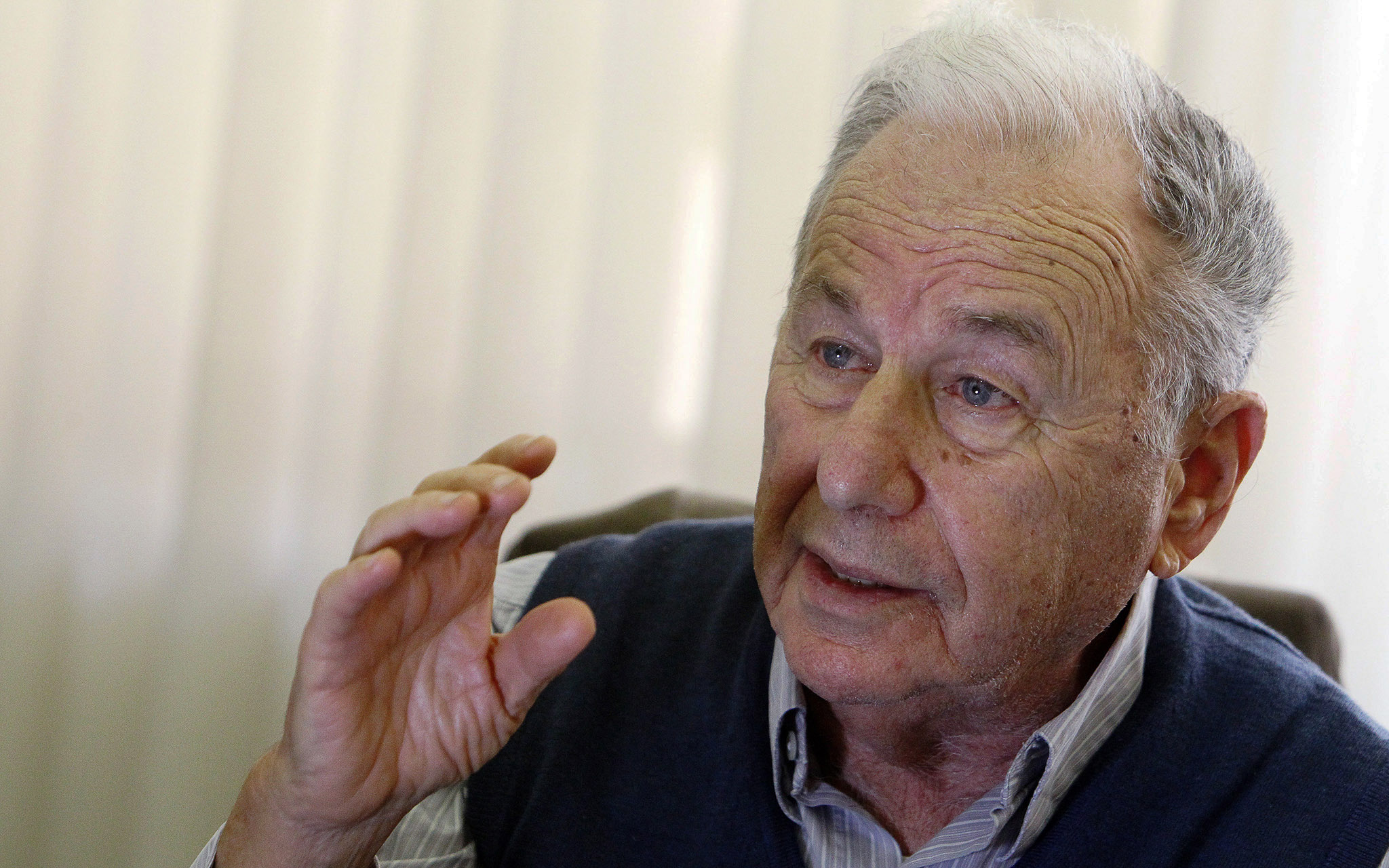
Amnon Rubinstein, a former Israeli lawmaker and Israel Prize recipient who played a key role in shaping Israel’s prevailing legal and political landscape, died on Thursday at the age of 92.
Rubinstein, who was born in 1931 to Polish immigrant parents in Tel Aviv, is considered the closest thing Israel has to a constitutional founding father despite the country’s lack of a constitution. During his career, he authored two of Israel’s key rights-based laws — the Basic Law: Human Dignity and Liberty and the Basic Law: Freedom of Vocation.
After serving as the first dean of Tel Aviv University’s law school between 1963 and 1970, Rubinstein entered politics. In the wake of the 1973 Yom Kippur War, he founded the Shinui party along with Yosef “Tommy” Lapid, the father of current Opposition Leader Yair Lapid.
Shinui was a secular-liberal centrist party focused on fighting corruption in government, establishing a separation of religion and state and writing up a constitution. It maintained an active presence in the Knesset until 2006.
Rubinstein held several ministerial portfolios during his long political career, most notably serving as communications minister between 1984 and 1987 and as education, culture and sports minister from 1994 to 1996.
In 1992, Shinui merged with left-wing allies Ratz and Mapam to form Meretz, with Rubinstein credited as one of the party’s founders. Shinui later broke away, however, and was re-established as an independent party in 1997.

One of the more bizarre incidents in Israel’s political history occurred in 1999, when then-Knesset speaker Avraham Burg received a fake message purporting that Rubinstein had passed away.
Burg eulogized Rubinstein, who had only been hospitalized for a minor issue, fondly recalling him as “one of the founders of the state after its establishment.”
לפני 25 שנה הכריז ח"כ אברהם בורג שאמנון רובינשטיין נפטר, בשעה האחרונה הוא אכן נפטר וזכה לאריכות ימים pic.twitter.com/GJuOtiuhtc
— חדשות המוקד (@hamoked_il) January 18, 2024
In an interview with Ynet in February 2023, Rubinstein said that even at the time, he found it amusing to hear his own eulogy on live television.
Rubinstein retired from the Knesset in 2002, after serving continuously for 25 years. Following his retirement, he turned to literature and published several novels. His last novel was published in 2022.
He won the Israel Prize for legal research in 2006 for his work focusing on Israel’s constitutional law.
In the committee’s decision, they determined that Rubinstein was “the father of Israel’s constitutional law,” and praised him as someone who “promotes the values of democracy, equality and human rights.”

The news of Rubinstein’s death on Thursday prompted an outpouring of gratitude and appreciation from left-wing and centrist politicians, both past and present, for his impact on Israeli society.
“He was a man who loved his country and never stopped working for it. To fix it. To change it,” Yair Lapid wrote on X, formerly Twitter. “His legacy and his books will continue to accompany us for many years to come.”
Former Meretz leader Zehava Galon eulogized Rubinstein as “an honest, pleasant and brilliant man.”
“It hurts that he is no longer with us and it hurts even more that he went during these days, which are the last that he saw of the State of Israel that he loved and served all his life,” she added.










The Times of Israel Community.