

Antisemitism charge kicked around as Maccabi Tel Aviv fans barred from UK match
While Birmingham police say they blocked ticket sales to Israelis for Thursday’s game at Aston Villa over concerns for fans’ security, many believe the reason is more insidious
 Add ToI as a Preferred Source on Google
Zev Stub is the Times of Israel's Diaspora Affairs correspondent.
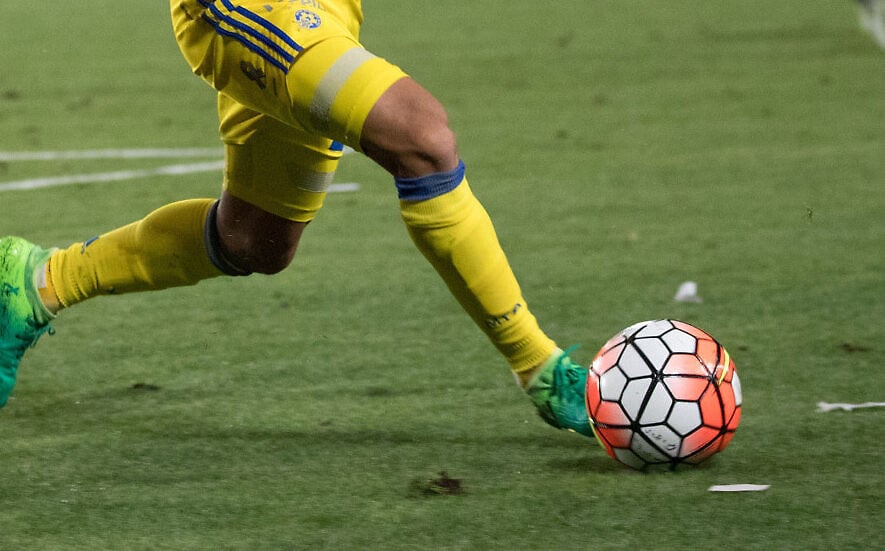
Thursday’s UEFA Europa League soccer match between UK team Aston Villa and Israel’s Maccabi Tel Aviv will proceed in Birmingham without visiting fans from Israel after a strange and politically charged saga.
Many in Israel have accused officials in Birmingham, where Aston Villa is based, of blatant antisemitism, weaponizing soccer ticket sales as a tool to isolate Israel at a time of growing anti-Jewish sentiment around Britain. Police in the city say the decision was a necessary security measure as racist incidents at soccer games soar in Israel and across Europe.
The controversy began when Birmingham’s Safety Advisory Group, which works with local police, advised Aston Villa not to allow Maccabi Tel Aviv fans to attend the November 6 fixture at Villa Park. West Midlands Police classified the match as “high risk,” citing “current intelligence and previous incidents,” including a violent riot in which local gangs attacked Maccabi supporters after a friendly match in Amsterdam last November.
In European soccer, teams typically allocate a portion of their tickets to be sold by the visiting team, usually in a separate section of the stands. This is in contrast to most major American sports, where fans of the visiting team can usually buy tickets anywhere in the stadium.
After the safety advisory group gave its report, Aston Villa said on October 16 it would bar Maccabi fans from the game.
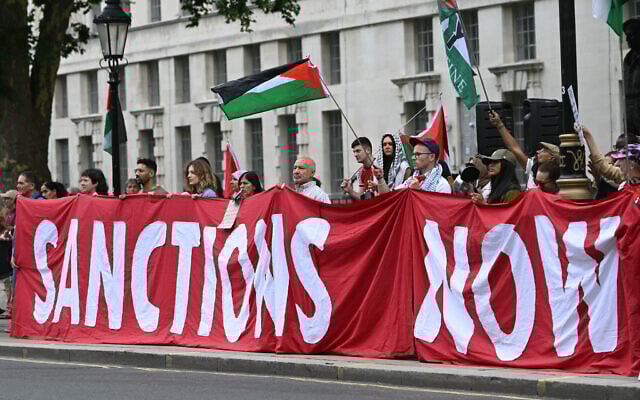
Jewish and Israeli officials, along with released Hamas hostage Emily Damari, a British citizen, immediately slammed the decision. The Board of Deputies of British Jews charged that the ban created the “harmful notion of ‘no-go’ zones” for Jews and Israelis in the UK at a time when rising antisemitism was already causing Jews to think twice before leaving their homes.
Foreign Minister Gideon Sa’ar described the ban as “shameful” and “cowardly,” and called on UK authorities to reverse it.
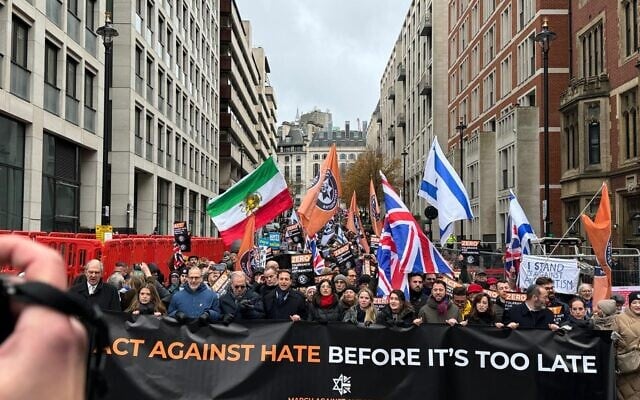
The ban was met with “deep sadness” by the UK government, which said it respected the decision nonetheless. “It is completely unacceptable that this game has been weaponized to stoke violence and fear by those who seek to divide us,” a government spokesperson said.
“This is the wrong decision. We will not tolerate antisemitism on our streets,” British Prime Minister Starmer said on X. “The role of the police is to ensure all football fans can enjoy the game, without fear of violence or intimidation.”
Maccabi fears for fans in UK’s ‘toxic atmosphere’
Attempting to rebuild bridges, Deputy Head of Mission at the British Embassy in Israel Thomas Phipps — an avowed Aston Villa fan — met with the Maccabi team on Tuesday before their trip to the UK and was presented with a Maccabi jersey with his name on it.
“Football should not divide us,” said Phipps, who quipped that he wished the team a good journey — and a resounding loss of 0-3.
But the damage was done. On October 20, Maccabi Tel Aviv said it would not accept any tickets for the game even if local authorities reversed the decision. The row had created a dangerous tension that could threaten the security of its fans, the team said.
“The well-being and safety of our fans is paramount and, from hard lessons learned, we have taken the decision to decline any allocation offered on behalf of away fans, and our decision should be understood in that context,” the club said in a statement. “As a result of the hate-filled falsehoods, a toxic atmosphere has been created, which makes the safety of our fans wishing to attend very much in doubt.”
Maccabi Tel Aviv denied that its fans behave badly, and made a thinly veiled accusation of antisemitic intent.
“It is clear that various entrenched groups seek to malign the Maccabi Tel Aviv fan base, most of whom have no truck with racism or hooliganism of any kind, and are exploiting isolated incidents for their own social and political ends,” the statement said.
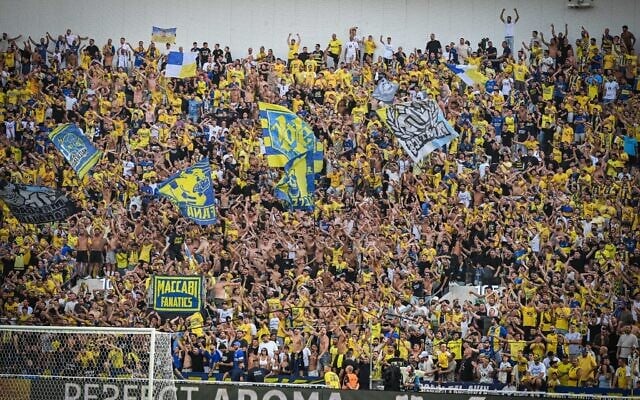
Last weekend, The Times reported that the Board of Deputies of British Jews had proposed to distribute 500 of the tickets to British Jewish soccer fans. While West Midlands police were initially receptive to the idea, Aston Villa never acted upon it, the report said.
Despite the barring of Israeli fans, police will deploy more than 700 officers around the game to prevent crime and disorder, the BBC reported.
Accusations of antisemitism
While Aston Villa insists that its decision was based solely on security considerations, many saw it as an antisemitic move by officials in a city that has been the scene of numerous anti-Israel rallies since Hamas invaded Israel on October 7, 2023. About 30% of the city’s population is Muslim, according to a 2021 census.
The decision came just two weeks after an antisemitic attack on Yom Kippur in the nearby city of Manchester killed two people and injured four. That briefly pushed antisemitism to the top of the national agenda as government officials took steps to crack down on hatred.
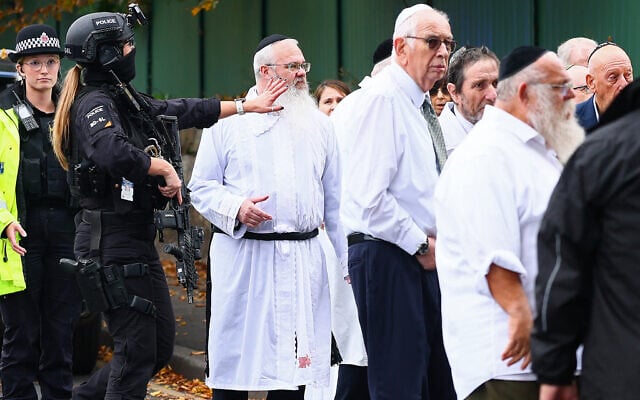
Following Aston Villa’s announcement of the ban, British Culture, Media, and Sport Secretary Lisa Nandy expressed alarm that the risk assessment appeared to be “based in no small part on the risk posed to those fans that are attending who support Maccabi because they are Israeli, and because they are Jewish.”
Eliot Pollak, head of Aston Villa’s Jewish Supporters Club, known as the Jewish Villans, disagreed, saying he thought the decision to ban the Maccabi fans was both justified and worrying at the same time.
“It’s very depressing, very worrying, but I think if you spoke to anyone Jewish, I don’t think they would be surprised or particularly puzzled,” Pollack told The Times of Israel this week. He said he’s attended Aston Villa games for more than 30 years, wearing a kippa without any problems.
“It’s very difficult to police off that entire area, and fans would be coming in for the entire day. So the security concerns are very valid. But why have we got to this point where thousands of Jews can’t safely congregate in our city?” Pollack asked.
Why have we got to this point where thousands of Jews can’t safely congregate in our city?
Pollack said he was not yet sure if he would attend the game, due to fears of unrest, but added that he knew other Jews who would. The Jewish Villans club was formed two years ago, and currently has 30-50 members, Pollack said.
However, other Jewish organizations such as the Jewish Leadership Council charged that punishing Jewish and Israeli fans because police could not guarantee their safety was “perverse,” making them victims of exclusion twice over.
This comes amid growing levels of antisemitism throughout the country against the backdrop of the two-year Israel-Hamas war in Gaza. In the first half of 2025, more than 1,500 antisemitic incidents were recorded in the UK, the second-highest total on record, according to the Community Security Trust (CST), a nonprofit providing security protection to British Jews.
The risk of rowdy fans
Much of the Birmingham Safety Advisory Group’s risk assessment centered on riots that involved Maccabi Tel Aviv fans after a Europa League match in Amsterdam in November 2024, which caused injuries to at least 10 Maccabi fans and led to dozens of arrests.
While Israeli inquiries have concluded that the riot was coordinated by local Arab and Muslim gangs, police also focused on racist activities committed by Israeli fans before the riot. Specifically, there were reports of Maccabi fans shouting racist anti-Arab chants such as “Death to Arabs,” removing Palestinian flags from buildings, and vandalizing property.
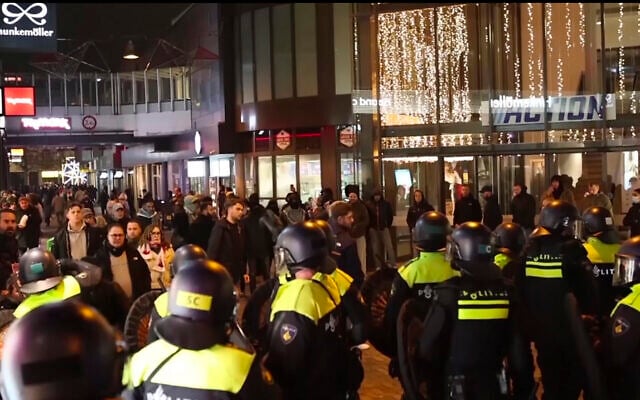
More recently, pro-Palestinian protests surrounded Israeli national team matches in Norway and Italy, with police deploying tear gas to disperse violent groups.
The Birmingham safety group’s report noted that some Maccabi fan groups, known as “ultras” and including far-right elements, have a history of involvement in racist incidents. That, combined with the geopolitical climate and threats of protests by the Palestine Solidarity Campaign and other groups, made hosting the Israelis too much of a security risk, police concluded.
Rising racism throughout the sport
The problem of racism in soccer is widely recognized in European leagues, even as research shows it is on the rise in Israel.
In Europe, Kick It Out, an English nonprofit fighting racism in soccer, found that discrimination has been rising steadily in recent years. It recorded nearly 1,400 incidents targeting any group in the 2024/25 season, a record high and more than double the number of reports four seasons earlier.
The Fare Network, another anti-discrimination group, recently said that racist abuse hurled at Black players had doubled in the early weeks of the current season.
In Israel, racist chants rose 64% during the 2024-25 season, according to Kick It Out Israel, which is not directly affiliated with the UK organization of the same name.

According to a report it published at the end of the 2024-2025 campaign, the organization counted 367 racist chants over the course of the season. Maccabi Tel Aviv fans were responsible for 118 of these, while Beitar Jerusalem, often referred to as Israel’s most racist team, came in second with 115.
However, that doesn’t necessarily mean that Maccabi is more racist than Beitar, noted Kick It Out Israel director Matan Segal.
“Our approach is based on the understanding that we never hear everything that happens in the stands, so the numbers themselves don’t tell the whole story,” Segal said. In other words, the significance of the survey is the overall trend, not the data itself, he clarified.
Tensions related to the Gaza war were a factor contributing to the overall rise, Segal pointed out. The most frequently heard chant was: “Let the IDF win, f* the Arabs,” which was recorded 73 times over the season, while others called individual players “terrorists.”
Political affiliations have been baked into Israeli soccer since before the state was founded, Segal noted, with most teams named for movements popular in the 1930s and 1940s. Teams named Hapoel were originally associated with the country’s socialist workers’ union, while Beitar was linked with the Revisionist Zionist youth movement founded by Ze’ev Jabotinsky. Maccabi was associated with a movement of Jewish sporting clubs that gained popularity at the beginning of the 20th century.
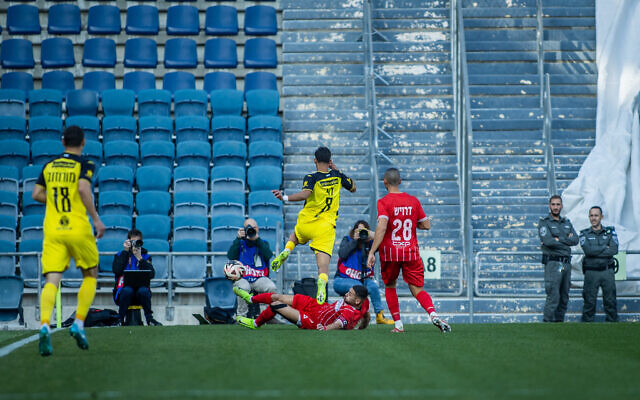
Meanwhile, Bnei Sakhnin, the country’s most successful Arab-Israeli club, is a source of pride for Arab youth even as it endures attacks from Beitar Jerusalem and other clubs, Segal said.
Kick It Out Israel, which is funded by the coexistence center Givat Haviva, counted 165 violent incidents last year, including thrown objects and pitch invasions, and two matches that were canceled due to unruly fans.
It’s not clear how that compares to the situation in Europe, Segal said. None of the watchdog organizations has sufficient data to compare racist activity at soccer games across countries, but there is no reason to think things are worse in Israel, he said.
However, Segal added, the ubiquity of racism in soccer is a symptom of larger societal problems.
“If something as pure as football, whose purpose is to connect people from different backgrounds, leads to this kind of behavior, you have to ask what is wrong,” he said.


The Times of Israel Community.