

Arab media puts the blame for canceled gas deal on Israel
Kofi Annan is running out of patience with Bashar Assad, and Iran’s vice president suggests uniting with Iraq
 Add ToI as a Preferred Source on Google
Elhanan Miller is the former Arab affairs reporter for The Times of Israel
A surprising Egyptian announcement that it is stopping the sale of natural gas to Israel is being widely covered by Arab news outlets Monday.
Saudi-owned daily A-Sharq Al-Awsat features the story on its front page, leading with the Israeli point of view. “Israeli sources: Egypt notified Tel Aviv it is canceling the gas deal,” reads the headline, but quickly quotes an anonymous military official in Egypt who says that the agreement was not canceled, but only that ‘a number of clauses regarding gas prices were changed, adapting the prices to global gas rates.’ The source said he did not understand where the Israeli publication got its information to the contrary.
But the Egyptian establishment daily Al-Ahram confirmed in its headline Monday that the deal was indeed canceled. “Egypt ends its deal to supply gas to Israel due to noncompliance with financial commitments,” reads the headline of Al-Ahram. The daily quotes Mohammad Shoeb, head of the Egyptian Gas Holding Company, as saying that the deal was halted for “purely economic reasons,” due to a debt of nearly 100 million dollars owed to his company and Egypt’s national petroleum authority.
The article widely quotes the worried statements of Israeli politicians Avigdor Lieberman and Shaul Mofaz regarding the ramifications for the future of the peace treaty with Israel.
Independent Egyptian daily Al-Masry Al-Youm turns the tables on Israel, claiming in its headline that “Israelis are blaming their government for shirking responsibility and stating: The gas halt is political.” The daily quotes Israeli news outlets such as Ynet, Channel 10 news and economic daily Calcalist as arguing that Israel, not Egypt, bears the brunt of responsibility for the collapse of the deal, either for economic or political reasons.
Arab nationalist daily Al-Quds Al-Arabi unsurprisingly leads its front page with the story, stating in its headline simply that “Egypt cancels its gas export deal to Israel.” The article notes that “the decision is considered a new nail in the coffin of Egyptian-Israeli relations, which are at their worst since the signing of the peace treaty between the two states 31 years ago.”
Editorials on the subject have not emerged yet in the Arab press.
Annan running out of patience with Assad
Syria is still the lead story in the Arab press Monday, and it seems that international envoy Kofi Annan is running out of patience with Syrian President Bashar Assad.
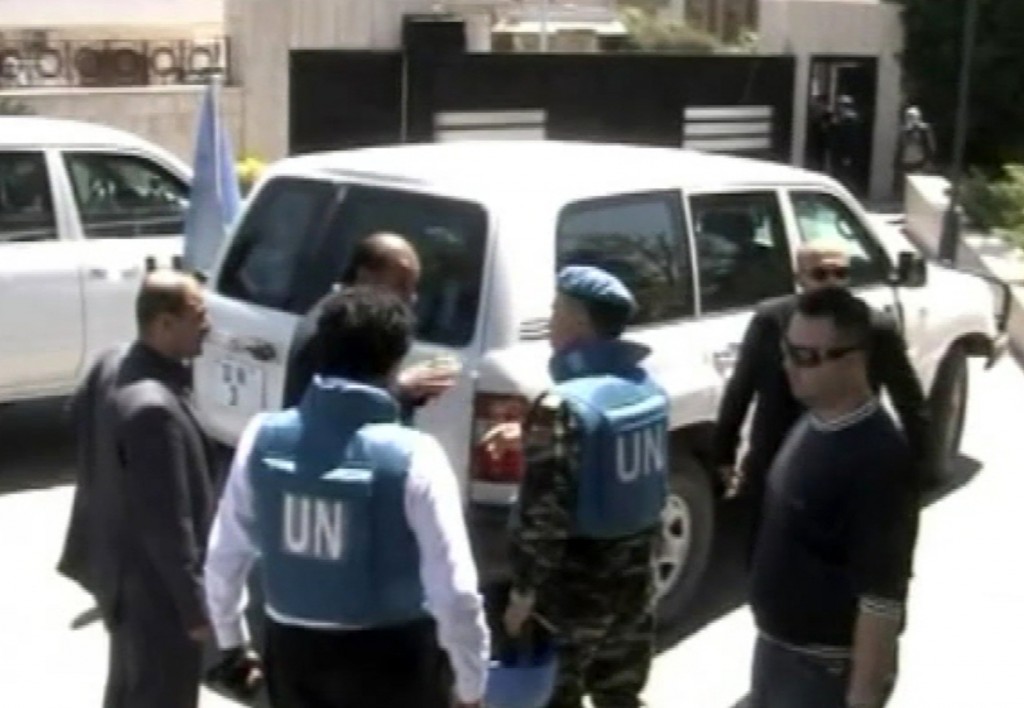
“Annan demands that Damascus ‘completely stop’ using heavy weapons,” reads the headline of liberal London-based daily Al-Hayat. The daily features the photo of a UN soldier surrounded by opposition forces belonging to the Free Syrian Army in the city of Rastan.
Qatar-based news channel Al-Jazeera reports that the head of the Syrian opposition, Syrian National Council leader Burhan Ghalioun, will meet the Egyptian foreign minister in Cairo Monday and demand an increase in the number of UN observers.
A-Sharq Al-Awsat, generally the harshest in its treatment of the Assad regime, begins its news coverage of Syria by stating that “the Syrian regime continued to ignore its commitment to the international community on the ceasefire and withdrawing its military machinery from the cities, shelling the city of Duma with artillery.”
“Rather than the international monitor delegation observing the ceasefire by the Assad regime… we find that the Free Syrian Army is the one protecting the international monitors,” writes A-Sharq Al-Awsat editor Tareq Homayed in an editorial mockingly titled “The international frightened delegation in Syria.”
“It is clear that the ‘frightened’ delegation is changing nothing in Syria, especially with these [low] numbers,” adds Homayed. “Everyone must realize that Assad only understands the language of force, and anything else is a license to kill, a waste of time, and a deepening of the Syrian crisis.”
However Al-Jazeera columnist Omar Kosh, a resident of Damascus, welcomes the international monitors as “the only political international alternative” that might end the violence in Syria.
“There does not seem to be another alternative in the political horizon,” writes Kosh, “after it was endorsed by the UN Security Council, despite the opposition of various international players.”
Iran and Iraq — to be one?
Iraqi Prime Minister Nuri Al-Maliki is visiting the Iranian capital of Tehran, and during a meeting with Iranian Vice President Muhammad Reza Rahimi, he was told by his Iranian host that “the two countries should be completely united, to form a large force on the international stage,” London-based Al-Hayat reports.
Arab fears regarding the strengthening ties between Iran and the Shiite-led Iraq have long been debated in the media, highlighted during the recent Arab summit in Baghdad.
Surprisingly, the Iranian statement did not appear in other major Arab news outlets Monday.





The Times of Israel Community.