

At AIPAC, Clinton bludgeons Trump, but also shows she’s no Obama
Democratic front-runner batters her rival’s ‘evil’ campaign, subtly signals a will to reset the tone of relations with Israel

 Add ToI as a Preferred Source on Google
David Horovitz is the founding editor of The Times of Israel. He is the author of "Still Life with Bombers" (2004) and "A Little Too Close to God" (2000), and co-author of "Shalom Friend: The Life and Legacy of Yitzhak Rabin" (1996). He previously edited The Jerusalem Post (2004-2011) and The Jerusalem Report (1998-2004).
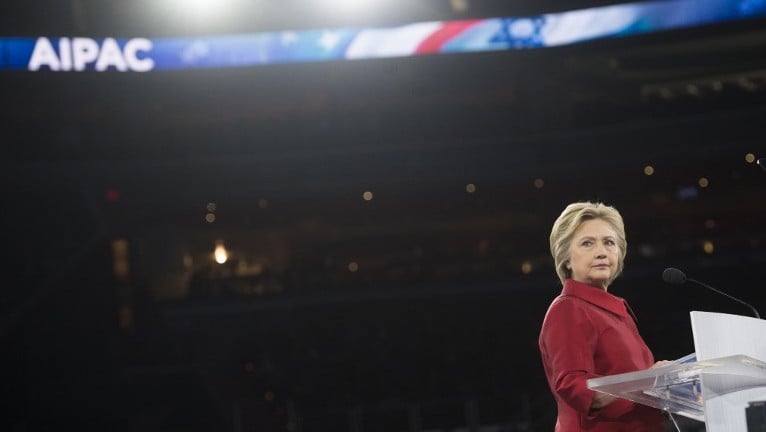
WASHINGTON — Some of the loudest cheers for Hillary Clinton’s speech at AIPAC Monday came toward the end, when she rounded on her Republican rivals for the presidency and invoked the Purim story of Esther, “who refused to stay silent in the face of evil.”
The evil to which the Democratic front-runner was referring, she made plain, was that which she sees being perpetrated on the campaign trail by Donald Trump.
Political differences are nothing new, Clinton allowed, but what America was seeing this year “is something else entirely: (a candidate) encouraging violence, playing coy with white supremacists, calling for 12 million immigrants to be rounded up and deported, demanding we turn away refugees because of their religion, and proposing a ban on all Muslims entering the United States.”
Every session at this year’s AIPAC conference has been preceded by a host or moderator reminding the audience to hear out speakers respectfully, not to catcall, or boo, or otherwise intrusively protest. Those warnings reflected the organizers’ concern that Trump, set to speak later on Monday, would be given a rough ride by this crowd, precisely because of the sense Clinton referenced that he is taking America into another of what she called its “dark chapters.”
The United States, said the former secretary of state, “should be better than this. And I believe it is our responsibility as citizens to say so.” And therefore, “if you see bigotry,” she urged, “oppose it.” The audience roared. “If you see violence,” she insisted, “condemn it.” The applause grew louder. “If you see a bully,” she demanded, “stand up to him.” The Verizon Center fairly trembled.
That peak passage was, unsurprisingly, not the only part of her speech during which the candidate focused angrily on her opponents, and especially on Trump.
On issues of critical importance to Israel, she argued, the United States simply could not afford to be cavalier, or superficial, or lacking in credibility — in short, it could not afford to be led by Donald Trump.
Later Monday, she noted, this same crowd would hear alternative foreign policy approaches presented by her Republican rivals. If elected, she warned, these were politicians who would “insult our allies, not engage them, and embolden our adversaries, not defeat them.” For Israel’s sake, and America’s, the US needed to remain “a respected global leader… able to block efforts to isolate or attack Israel.” The alternative, said Clinton, “is unthinkable.”
And rounding directly on the Republican front-runner, she asserted the need for “steady hands” in the White House, “not a president who says he’s neutral on Monday, pro-Israel on Tuesday, and who knows what on Wednesday, because everything is negotiable.”
Again, the applause in the stadium was fierce and long. “Well, my friends,” she said, “Israel’s security is non-negotiable… America can’t ever be neutral when it comes to Israel’s security or survival… We can’t be neutral when civilians are stabbed in the street.” And “anyone who doesn’t understand that has no business being our president.”
But if the candidate’s effective strategy of distancing and differentiating herself from Trump and the other Republican challengers was unsurprising and brutal, perhaps the more unexpected and nuanced parts of her speech were those in which she sought to distance and differentiate herself from the Obama presidency in which she once served.
Former secretary of state Clinton could not completely disown the Iran nuclear deal, which she supports. But she did her best to assert a determination to ensure that Iran holds to its terms or is heavily punished for violations.
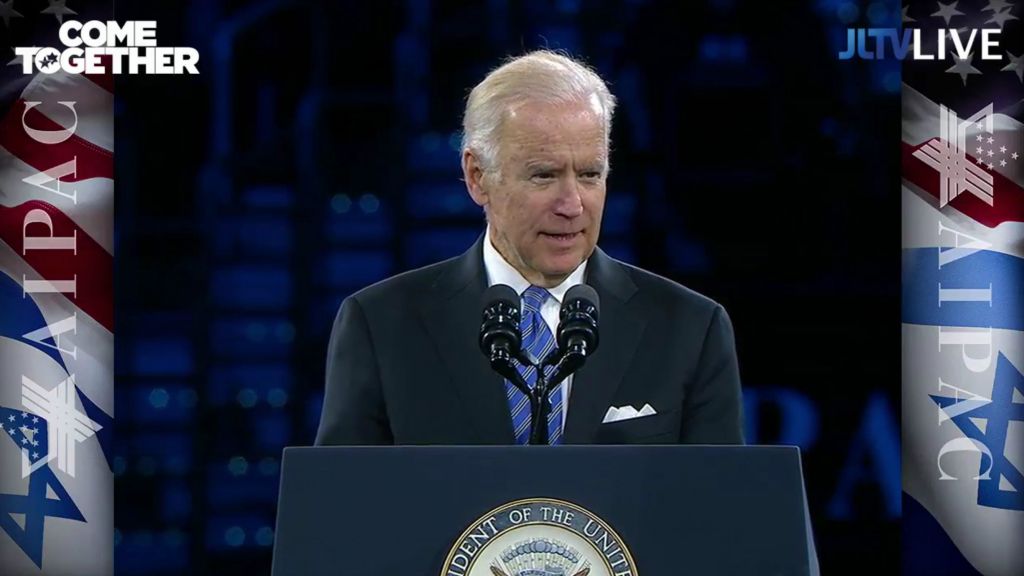
President Barack Obama’s representative at this conference on Sunday, Vice President Biden, told the audience that he hoped they were “as happy about this as I am” that the Iran deal was done and Tehran so much further from the bomb — this in a speech made minutes after AIPAC’s CEO Howard Kohr had declared from the very same stage that the struggle to prevent a nuclear Iran “is far from over.”
Bizarrely and self-defeatingly, Biden also acknowledged that the shared concern over the threat posed by a newly emboldened Iran had changed the Middle East dynamic in the past year, creating common ground between Israel and several Arab states. “Everyone in the region agrees that Iran’s behavior continues to pose a problem… The joint view of the threat posed by Iran,” he said, had created “an opportunity for cooperation across the Arab-Israel divide.” Biden mused: “My mother would say, ‘Out of bad things, good things happen if you look hard enough.'” It almost sounded as though the Iran deal was that “bad thing.” Surely not.
Clinton was more empathetic to Israeli concerns, stressing that “it’s not good enough to trust and verify.” Rather, “our approach must be distrust and verify.” And she promised vigorous enforcement, strong monitoring, and real consequences for violation. The recent missile tests were “unacceptable.” They required a firm and quick response. Additional sanctions should be imposed as needed.
On the Palestinian front, too, her tone was substantially different from Biden’s schoolmasterish award of a “very disappointing” grade for the absence of “political will among Israelis and Palestinians to move forward.” Biden said he knew it was “hard to take risks for peace,” but made clear this was exactly what he thought Israel should be doing.
Clinton, however, framed her commitment to Israeli-Palestinian progress in more constructive terms, highlighting America’s need to ensure Israel is “strong enough to take bold steps in the pursuit of peace.” The US needs to ensure the new 10-year military aid package takes the alliance “to the next level,” that Israel maintains its qualitative military edge, and that US assistance meets “Israel’s security needs far into the future,” she said. That means giving Israel “the most sophisticated military technology” — quite the contrast to Biden’s paternalistic assurance that Israel might not get everything it wants in that package, but would get everything it needs.
Biden was witheringly critical of settlement building: “To be frank, Israel’s governments’ steady and systematic process of expanding settlements, legalizing outposts and seizing land is eroding, in my view, the prospect of a two-state solution,” he said. “Bibi (Netanyahu) doesn’t think so. Bibi believes it can be accommodated. I don’t.”
Clinton was briefer and gentler. Mentioning settlements after she had protested the poisonous teaching of hatred in Palestinian schools, she stressed that “everyone has to do their part” to rebuild hope and trust, “by avoiding damaging actions including with respect to settlements.”
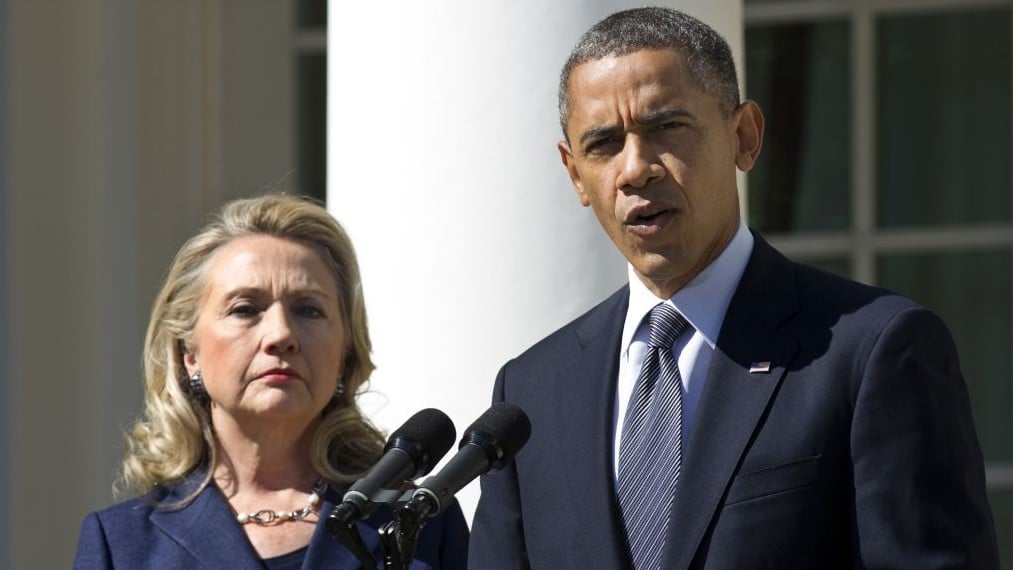
But perhaps her most significant move away from the Obama administration’s stance on Israel came in a little-noticed passage in which she dealt with the tone and conduct of bilateral relations, after two terms of often public tension and bickering between Washington and Jerusalem.
“If I am fortunate enough to be elected president,” she promised, “… we will never allow Israel’s adversaries to think a wedge can be driven between us. When we have differences, as any friends do, we will work to resolve them quickly and respectfully.”
Could Obama and Netanyahu characterize their relationship in those terms? Certainly not. And has the often blinding daylight between the two leaderships troubled supporters of the alliance and encouraged those who wish it harm? Absolutely.
At AIPAC on Monday, Obama’s former secretary of state, would-be president Clinton, promised a reset.







The Times of Israel Community.