

Fires sparked in south by balloon-borne incendiaries from Gaza
Fresh arson attacks come amid threats by terror groups in the Strip to renew border violence if Israel does not deliver on ceasefire agreement
 Add ToI as a Preferred Source on Google
Judah Ari Gross is The Times of Israel's religions and Diaspora affairs correspondent.
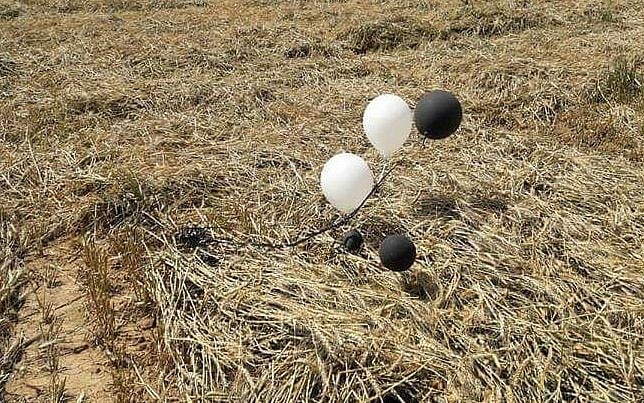
Two small fires were started in southern Israel by balloons carrying incendiary devices from the Gaza Strip on Monday, the local fire department said.
The blazes were quickly extinguished by firefighters.
The arson attacks came amid a period of relative calm along the Gaza border, but also as terror groups in the Strip threatened to renew their violent activities on the security fence if Israel does not abide by an unofficial ceasefire agreement brokered by Egypt last month.
One of the fires was located in a grassy area outside Kibbutz Be’eri, east of Gaza. The other was outside the nearby community of Shokeda.
Once the fires were extinguished, investigators inspected the scenes to determine what caused the blazes.
“The investigation found that the fires were caused by balloons,” the department said.
For the past year, Palestinians in the Gaza Strip have been launching balloons carrying explosives and incendiary devices into southern Israel, sparking fires that burned thousands of acres of agricultural fields, forests and grasslands. This spring, farmers in southern Israel were encouraged to harvest their wheat early in order to prevent their fields from being burned in such attacks.
Recent weeks have seen a significant decrease in the level of violence along the Gaza border with the start of the Egyptian-brokered ceasefire, under which Israel agreed to ease some of its restrictions on the movement of people and goods into and out of the coastal enclave in exchange for calm.
Israel says the limitations on movement aim to prevent Hamas and other terror groups from transferring into Gaza weapons and materials used to construct tunnels and fortifications.
In recent weeks, as the unofficial ceasefire began to take effect, the number of balloon-borne explosives and incendiary devices flown over the border dropped, though attacks have not stopped entirely. Nightly riots have ended, and the weekly protests along the border have been held farther from the security fence.
On Sunday, the Israel Defense Forces said it was standing down the extra forces deployed to the Gaza border region during an uptick in violence last month.
Terror groups in the Strip have threatened to renew the violence along the border if Israel does not continue to deliver on its promises.
Jerusalem has thus far reopened its two crossings with Gaza and significantly expanded the permitted fishing area around the coastal enclave.








The Times of Israel Community.