

Getting mobbed by far-right teens at Flag March was distressing, but no surprise
Flag March in Muslim Quarter, once a fringe event, now casts a bleak shadow over Jerusalem Day as increasingly violent parade eclipses other festivities

 Add ToI as a Preferred Source on Google
As a working adult who hasn’t set foot inside a middle school for years, I found it surreal and a bit ridiculous to suddenly become the subject of curses and insults hurled by preteen boys, about a dozen of whom encircled me Thursday in the Muslim Quarter of Jerusalem’s Old City, taking swipes at my phone and kicking me in the shins.
I had come into their crosshairs a few moments earlier when I pulled out my phone to record a large group of religious Zionist youth dancing gleefully while chanting “death to Arabs” under the arch of the Damascus Gate.
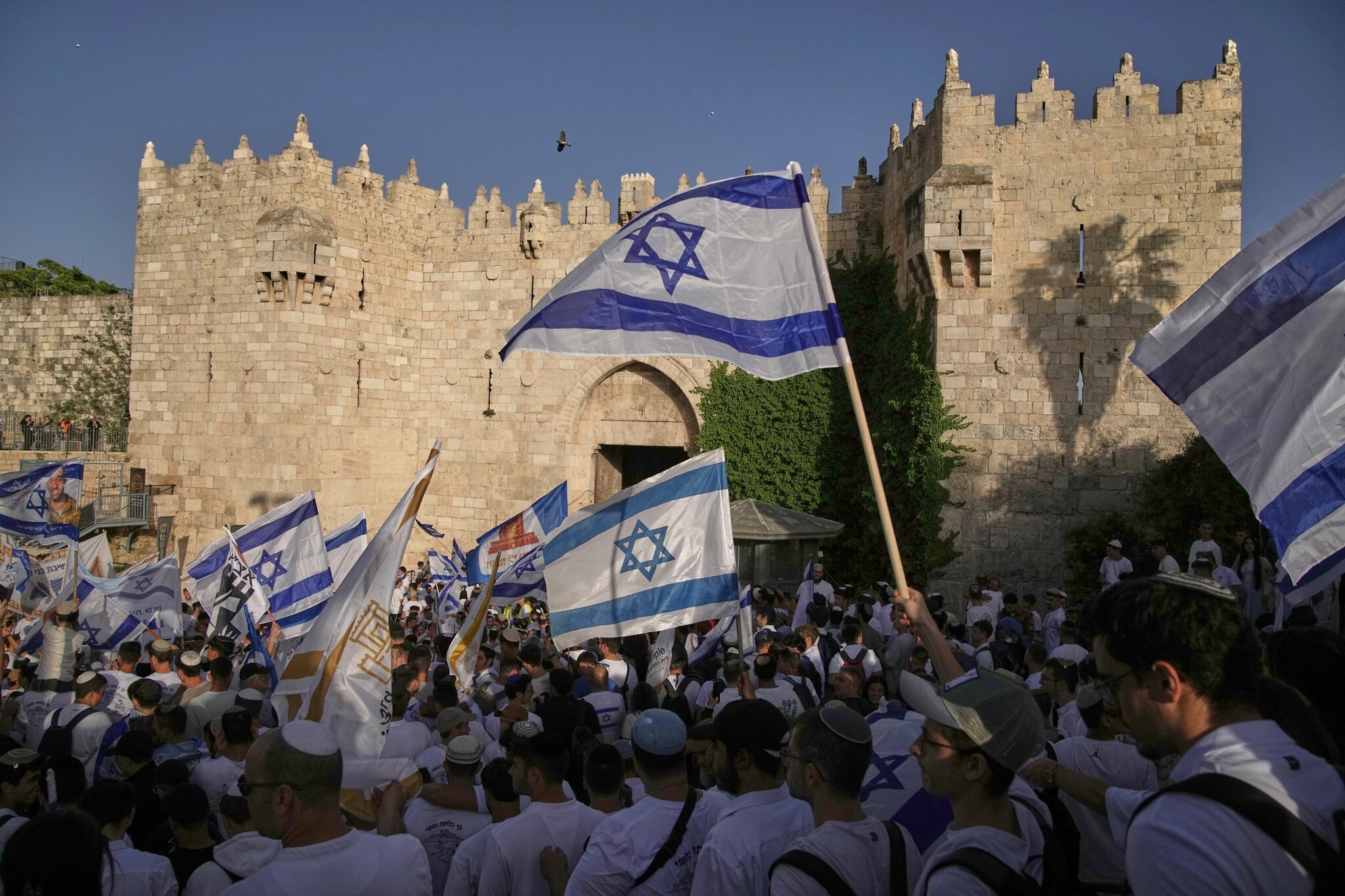
This scene was familiar to me from the past two times I’ve covered the annual Flag March through the Old City, meant to mark the reunification of Jerusalem under Israeli rule during the Six Day War, but which has increasingly become a display of anti-Arab racism and far-right ultranationalism.
By now, the scene felt like a set piece, with the same players putting on the same performance and hitting the same cues as in previous years. I’d had a similar sense of déjà vu upon entering the Old City earlier that morning as I passed old Arab men hunched outside shuttered businesses while Jewish teens roamed around the area.
As in years past, the march was led through the Damascus Gate and into the heart of the Muslim Old City by adolescents primed for trouble. Behind them were ultranationalist politicians such as National Security Minister Itamar Ben Gvir and Finance Minister Bezalel Smotrich, their bodyguards, and organized groups of teenage boys flying the banners of their yeshivas.
Trailing behind were parents with young children, who entered the Old City as the sun began to set.
Related: Chants of ‘death to Arabs’ at Jerusalem Day march as Ben Gvir flies Israeli flag on Temple Mount
Violence at the march isn’t an especially new phenomenon, and year after year there are attacks on the press. Participants evidently view journalists as legitimate targets; the press tags handed out by police are really nothing more than “kick me” signs.
But this was the first time such violence was directed at me. The march had yet to even begin when several boys with long sidelocks and knee-length tzitzit noticed I was filming the racist chant, clocked me as a reporter from my press lanyard and camera, and quickly became furious.
“Get out of here,” one sneered, covering my phone lens with his kippah. I tried to pay them no mind, behaving as if they weren’t there, but it soon became impossible to film, so I retreated to an awning near other reporters.
A handful of youths from the same group approached me as I continued recording. One boy, without so much as peach fuzz on his baby face, rammed into me with his entire weight. Being scrawny and just half my height, his shove didn’t do much except cause me to wonder aloud, “What would your parents say?”
My question seemed to irk him. He shoved me again.
What started as a handful of young hellions became a mob within seconds. Any trace of humor I could find in this bizarre scene gave way to disgust when they began spitting on me.
After minutes of struggling to protect my phone from the mob, one boy reached from behind, snatched the device with both hands and threw it to the pavement.
The mob wasn’t particularly frightening. I was left with nothing more than faint bruises on my legs and gobs of spit in my hair and on my face, and was frankly more worried about whether I’d be able to finish the news update I had been hurriedly typing on my phone.
I was reunited with the device thanks to a fellow reporter, who grabbed it from off the ground and kept it in his pocket until the crowd lost interest and left.
Though the violence briefly directed at me wasn’t life-altering in any way, it disturbs me to reflect on the readiness with which these youth mobs attack complete strangers, spurning basic human decency with the tacit acceptance of authorities.
Police never do much to rein in the hooligans. Their deconfliction strategy usually consists of ejecting anyone targeted by the marchers, including journalists or left-wing activists who pop up around the Old City seeking to protect Arab residents from violent parade-goers.
Hate holiday
Jerusalem Day wasn’t always inextricably tied to this fraught parade through the Muslim Quarter, but recent years have seen the Flag March eclipse all other festivities, turning the national holiday into a distinctly right-wing one.
Palestinians who happen to live near the parade’s route through the Muslim Quarter are the primary object of the teens’ hatred, underlined by the frequent racist chants.
Each year, the march forces Old City locals to put their lives on pause, shut their businesses and lock themselves in their homes by mid-afternoon.

The marchers also decamp to the public square outside Damascus Gate and the market just inside the Old City walls that make up one of the main centers of Palestinian life in Jerusalem.
On a normal weekday afternoon, Arab teenagers can be found hanging out on the steps or grassy area surrounding the Old City entrance after school, among vendors selling produce and baked goods.
That all comes to a halt on Jerusalem Day, though, with the square being taken over by flag-waving Jewish Israelis from across the country who come through on their way to the Western Wall.
By the next day, life around the gate and in the Muslim Quarter generally returns to normal, though now with stickers slapped up by parade-goers marking their route.
An annual mainstay, the stickers are distributed by different groups espousing various right-wing or racist ideas. Some laud the ultranationalist rabbi Meir Kahane or call for the mass expulsion of Palestinians from Gaza.
Ben Gvir’s Otzma Yehudit party focuses its stickers on different themes each year. This time, they celebrated the death penalty law championed by the party leader, himself a former terror convict, featuring the minister’s face next to a noose and the words “death to terrorists.”
A different Jerusalem Day
Each year after covering Jerusalem Day, I’m accustomed to hearing that the holiday “hasn’t always been like this,” from friends decades older than me. They reminisce about the years when there was still decorum, and the festivities were more about celebrating Jerusalem’s reunification than flexing Jewish supremacist muscle.
Though I’m too young to have been there myself, it seems clear that there used to be a wider consensus around Jerusalem Day, with different types of celebrations by various groups, not just right-wing nationalists. The Flag March, today practically synonymous with Jerusalem Day, wasn’t always the hallmark event.
In the Government Press Office archive, one can find a trove of photographs depicting Jerusalem Day celebrations outside the Old City. From the late 1980s to early 2000s, the holiday’s focal point appeared to be Jaffa Road, where a parade was held annually. Among the groups that marched in the procession were secular youth movements and agricultural communities from across Israel.

There were also processions around the Old City walls, and a state ceremony on Ammunition Hill, a military post captured by Israeli forces during the Six Day War. But there was also the Flag March through the Muslim Quarter, which grew steadily over the years.
The first year that I covered the Flag March, I spoke to one of its founders, Meir Indor. According to him, the parade had its start in 1968 as a relatively small march to the Western Wall by students at the Mercaz HaRav Yeshiva, led by Rabbi Zvi Yehuda Kook, and expanded over the years.
Following the Six Day War, Kook emerged as one of the preeminent leaders of the settlement movement. Indor said that he and Yehuda Hazani, who both studied under the rabbi, were among those who turned the march into what it is now: a massive event attended by countless religious Zionist youth groups, yeshivas and seminaries.
Yehudah Mirsky, a scholar of religious Zionism who studied at the Har Etzion Yeshiva, recalled twice partaking in the Flag March when it was still a nascent event. The first time he went, in 1979, they entered the Old City through Dung Gate, which leads almost directly to the Western Wall.
A year later — amid the Camp David negotiations that saw Israel relinquish control over the Sinai — the march was more raucous. Mirsky told me he went through the Muslim Quarter at night, when shops had already closed, as the group sang songs about Yamit, a since-evacuated Israeli settlement in the territory, now under Egyptian control.
Some young men on the fringes rattled the shutters of storefronts. Feeling slightly uneasy, he was one of many marchers who kept their heads down and proceeded quietly through the alleyways.
Though the march wasn’t violent, Mirsky recounted sensing tension in the air.
A Jerusalemite friend of mine, who grew up in the 1970s and 80s in an established religious Zionist household, recalled the holiday as something he celebrated solely at synagogue and school.
Each year, his class would make a pilgrimage around the block to a playground in the Katamon neighborhood, where a memorial stands in honor of the Israeli soldiers who fell while capturing the area during the War for Independence. “That was our march,” he said.
Despite growing up firmly rooted in the religious Zionist movement, he only became aware of the Flag March around a decade ago.
In 2016, the march became the subject of sizable controversy when the High Court heard a petition seeking to reroute the march away from the Muslim Quarter.
A three-judge panel rejected the petition but, in the same breath, urged police to arrest anyone who dared chant “death to Arabs,” according to Kol Ha’ir, a local Jerusalem paper, at the time.
Former High Court vice president Elyakim Rubinstein said in the 2016 decision that “anyone who says ‘death to Arabs’ needs to receive an indictment and punishment. It is not freedom of speech, it is freedom to incite.”
Now, this chant and other anti-Arab slogans have become the soundtrack of the parade through the Old City.
A ‘respectable’ event
After getting away from the mob that had attacked me, I left the Old City for a momentary breath of fresh air and headed toward the gathering point where the Flag March would kick off.
Traipsing uphill, I crossed the invisible line into what had marked no-man’s land between East and West Jerusalem from 1949 to 1967 and reached Tzahal Square. There, two teenage boys recognized me from within the walls.
The pair, who looked to be 16 to 18 years old, jeered at me as I passed them by and soon managed to catch me at an intersection. As I waited at the crosswalk, they threatened me, again trying to knock my phone out of my hands.
The taller boy made vulgar remarks and kicked me several times more. He threatened to punch me in the face. I told him that he could if he wanted, but that it would land him behind bars.
I said this with confidence, but second-guessed myself after taking a look around and realizing that, despite the large crowds gathering in the area — parents with baby strollers and families taking group photos near the “I love [<3] Jerusalem” sign on the backdrop of the Old City walls — no one seemed to notice the pair of thugs threatening to assault a reporter in broad daylight.
The shorter teenager was less fired-up than his friend. He stood on my right-hand side and said calmly in my ear: “You have to die. We won’t be the ones to do it, but you have to die.”
I quickly crossed the road, abandoning them and hastening to the spot where young men were gathering before the official march. Religious music roared from loudspeakers; sweat-drenched teenagers danced in circles under a beating sun.
Suddenly, shouts erupted from the crowd. I asked someone what was going on. It was a brawl between two rival yeshivas — Dimona and Chitzim — one of the revelers told me. The mass of teenagers standing shoulder-to-shoulder began to sway wildly, and angry shouts erupted from the center of the skirmish.
The emcee interjected from a stage in nearby Independence Park: “Gentlemen, we are asking: no conflicts, no fights between yeshivas, we want a respectable event.”
After witnessing the havoc in the Old City earlier in the day, I had to chuckle at the remark.






The Times of Israel Community.