

Golden-age glitterati return on canvas to old Lebanon hotel
Paintings of Arab world’s famous past leaders and culture icons playing poker adorn walls of Sofar Grand Hotel, recently opened to the public for first time
 Add ToI as a Preferred Source on Google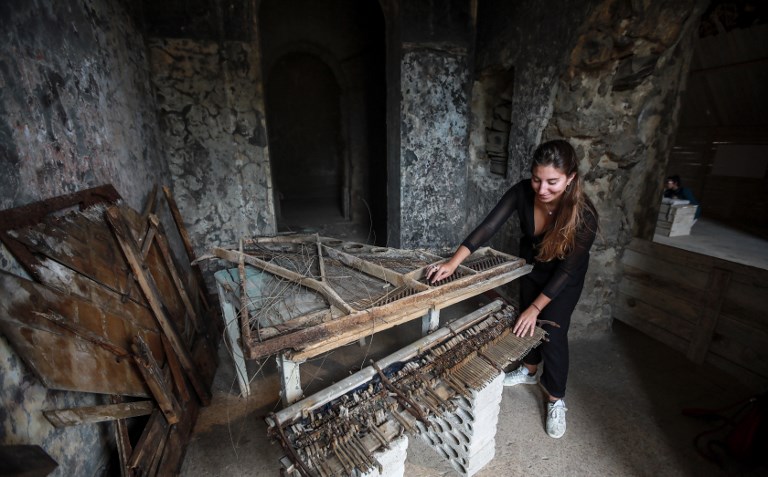
SOFAR, Lebanon (AFP) — Inside an abandoned century-old hotel near Lebanon’s capital, paintings of the Arab world’s once powerful and famous hang around a worn poker table, testimony to its glamorous past before the civil war.
Arab diplomats, French and British officers, but also Egyptian film stars all flocked to the Sofar Grand Hotel before the 1975-1990 conflict forced it to close down.
This month, the hotel opened its doors to the public for the first time in decades to exhibit dozens of works celebrating the hotel’s past by British artist Tom Young.
“This place is just full of history,” says the 45-year-old painter, who researched the building’s past for the project.
“It was once one of the greatest hotels in the Middle East,” explains the blond artist, who has been living in Lebanon for 10 years.
“It was where kings and princesses and emirs and generals used to meet — also the most famous singers of the day.”
Built in 1892 under Ottoman rule by Lebanon’s wealthy Sursock family, the forgotten hotel today lies near a disused train station in the village of Sofar some 30 kilometers (20 miles) east of Beirut.
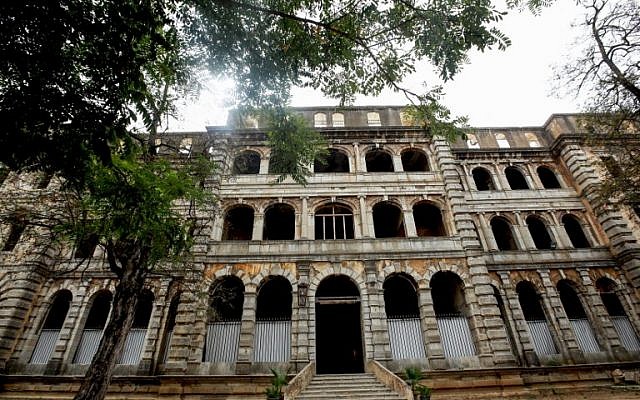
(AFP PHOTO / ANWAR AMRO)
Despite the war, the Middle East’s first casino has maintained its impressive facade. Sunlight spills into the deserted galleries and halls on its ground floor.
On its peeling walls, Young’s paintings evoke a livelier, more cosmopolitan past when high society came to party and secret political meetings took place in the garden.
In the main hall, a painting in green and turquoise blue hues celebrates the stars of Egypt’s golden era, once patrons of the hotel.
‘Latest Parisian fashion’
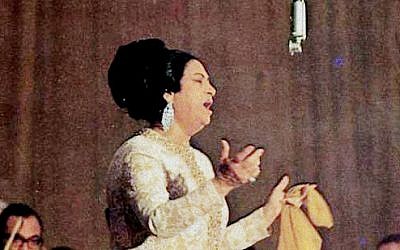
Crooner Abdel Haleem Hafez serenades belly dancer Samia Gamal in the foreground, while singer Um Kulthum appears in her trademark cat-eye sunglasses seated at a table in the back.
In another painting, at the bottom of the hotel’s sweeping staircase, smartly dressed men lead their female partners in billowing long dresses around the ballroom floor.
The scene is inspired by the writings of Lebanese-American author Ameen Rihani, who described attending a party there during his travels to Lebanon from 1907.
“My friend and I stood in the big lobby and watched the male dancers, mostly in formal attire, and the female dancers dressed in the latest Parisian fashion. All dresses were low-neck ‘Decollete,'” he writes.
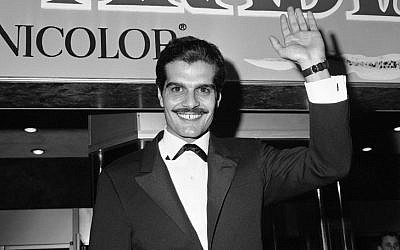
In another painting, late Egyptian actor Omar Sharif — who starred in “Doctor Zhivago” — appears to be absorbed in a card game.
His portrait hangs near an octagonal poker table, dimly lit by an overhead beige lampshade. Turned over playing cards and colorful poker chips lie on its faded green felt surface.
“We tried to curate the exhibition so that visitors enter and feel that nothing has changed,” says curator Noor Haydar.
“In the poker room, there are still cards on the table, the light is on in the kitchen and there are still cups inside,” she says.
“We tried to get people to imagine everything that used to happen in this hotel.”
But Young’s paintings also reflect the region’s political history.
In one, he portrays the leaders who attended an Arab League meeting in Sofar in 1947, including Lebanon’s first premier after independence Riad al-Solh.
‘Sense of identity’
Inspired by an early AFP photograph, Young paints them in a hall, silhouetted against the outside light as they convene to discuss the Palestinian issue, the year before the founding of Israel.
Even the nearby Sofar train station, now defunct, features in Young’s work, in a scene of passengers crowded on a platform.
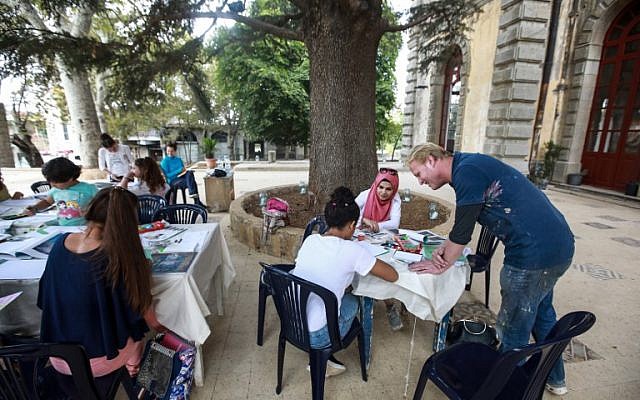
Lebanon’s first railway track was completed in the late 19th century to ferry people and goods between Beirut and Damascus.
The exhibition also includes an old train schedule, old posters and vintage postcards.
By re-opening the Sofar hotel to the public, the exhibition’s organizers are seeking to give new life to the historic building, turning it into a space for art and education.
The show, which runs to October 14, is also to include music and dance performances, as well as workshops for children and art students.
During his time in Lebanon, Young has worked on other similar projects.
In 2014, he exhibited work at the Rose House, an Ottoman-era mansion now surrounded by new apartment buildings, perched above the Beirut seafront.
In a tiny multi-confessional country where accounts of the 15-year war are still deeply divisive, Young’s work seeks to preserve collective memory.
“The people of Lebanon are cut off from their history,” he says, partly due to “rampant modern development and the unwillingness to perhaps face the past.”
Yet conserving the past is crucial, says Young, who was invited to become an artist-in-residence by one of the hotel’s owners, Roderick Sursock Cochrane.
“Memories and cultural roots give you a sense of identity,” he adds.







The Times of Israel Community.