

Goose bumps: 12,000-year-old figurine from Israel shows surreal woman-bird mating scene
Tiny clay sculpture unearthed at Nahal Ein Gev in the Galilee is the earliest known figurine depicting human-animal interaction, as documented by study in prestigious PNAS journal
 Add ToI as a Preferred Source on Google
Rossella Tercatin is The Times of Israel's archaeology and religions reporter.
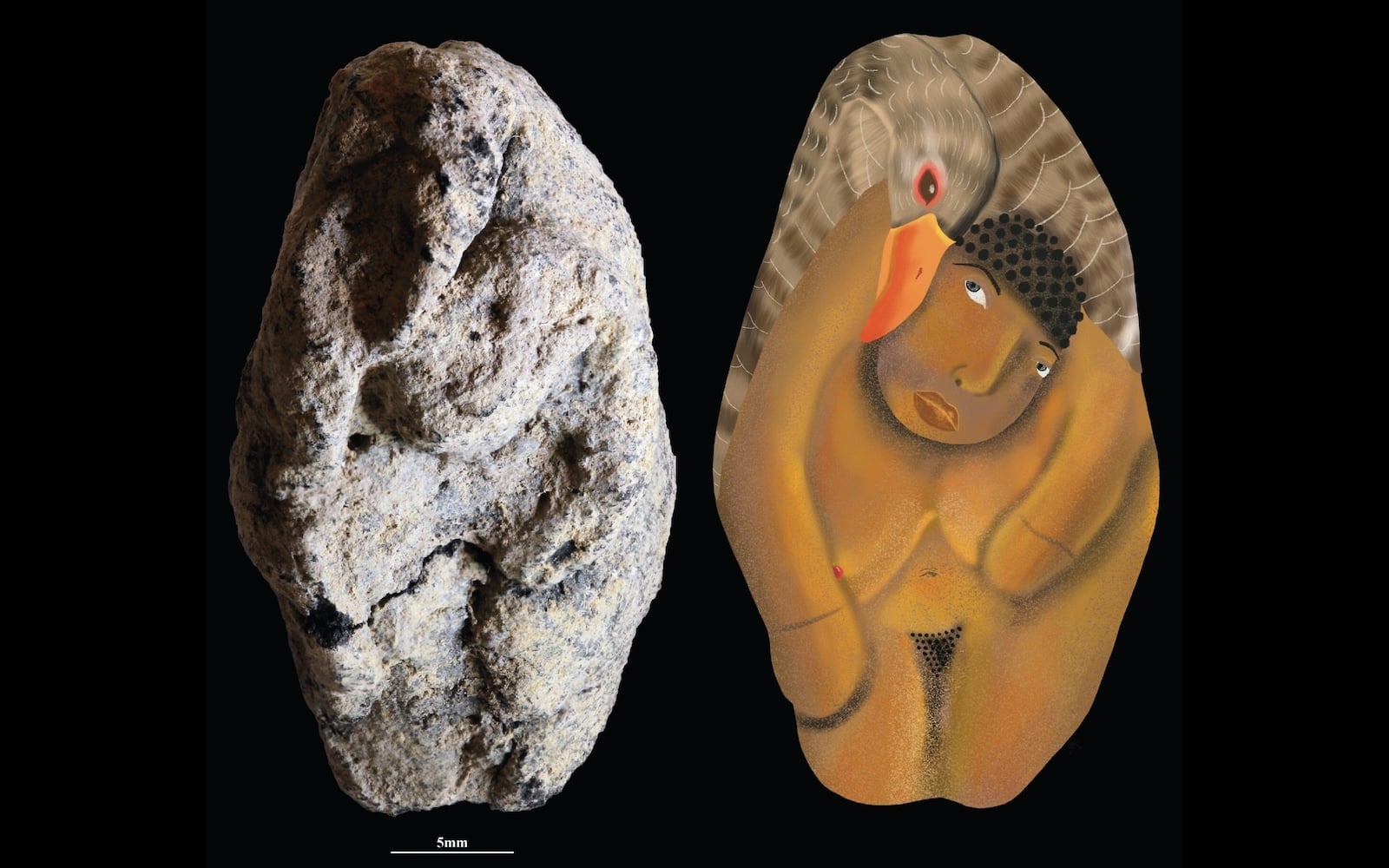
Some 12,000 years ago, a young hunter-gatherer living on the shores of the Sea of Galilee modeled a small clay figurine portraying a woman and a goose, one of the most common species in the area. The prehistoric artist delicately shaped the beak, the wings, and the female traits of the human figure, leaving the clay to dry before firing and painting it.
Fast forward millennia, and the unique artifact has recently been rediscovered by a group of Israeli archaeologists at the Nahal Ein Gev II site, making it the earliest figurine ever recorded to depict an interaction between humans and animals, according to a new study published in the prestigious PNAS journal on Monday.
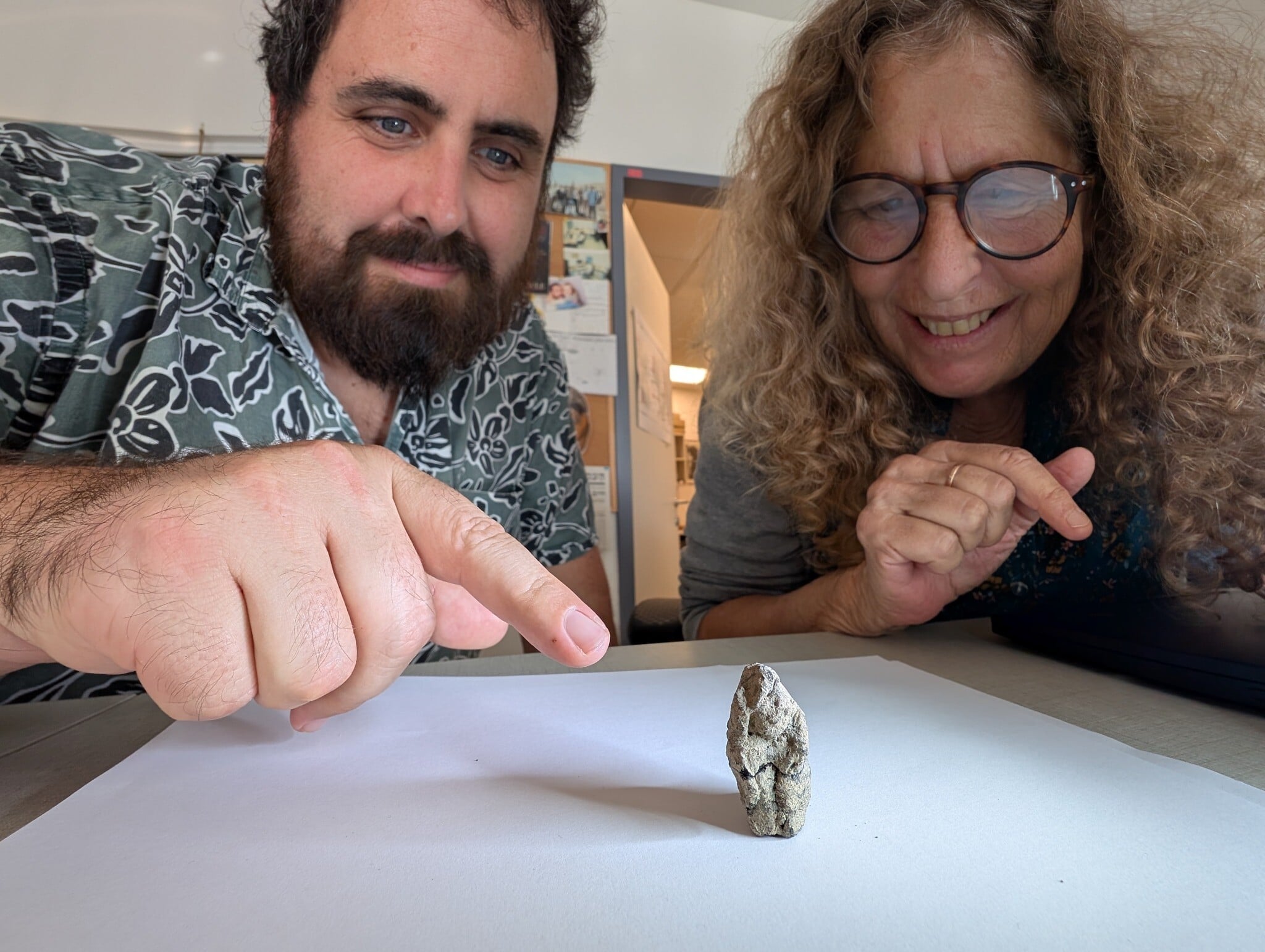
To make the find even more unique, the researchers believe that in light of the pose held by the woman and the goose, the figurine, circa 3.7 centimeters high, does not simply depict a hunting scene or a behavior that the artist could have witnessed in nature. Instead, they say the subjects are mating, an imaginative interpretation consistent with animistic beliefs that have been held among human societies for thousands of years.
“A real goose would not adopt this kind of position on a woman, and therefore we understand that this is an imaginary scene, rather than a real one,” said Dr. Laurent Davin from the Hebrew University of Jerusalem, one of the study’s authors.
In the figurine, the bird is positioned behind the woman, who can be identified by the distinctive shape of her breasts and female pubic area. The head of the goose, with its discernible beak, appears to rest on the woman’s shoulder. The wings envelop her in a form of embrace.
“The posture and the neck of the goose are those of a living animal,” Davin told The Times of Israel in a phone interview. “We also know that the hunters would remove the head and the feet of the geese after they hunted them, so a goose carcass transported to the village would not have looked like a complete goose. In addition, the woman is leaning forward, which would not be necessary to transport a bird only weighing two or three kilos [4.5 to 6.5 lbs].”
The researchers noted that the idea of animals and humans pairing is very common in societies with animistic beliefs (the belief that animals and objects possess spirits) to this day, as well as in many ancient cultures.
“It can happen in erotic dreams, in shamanistic visions, in storytelling, and more,” Davin said.
For example, according to a Greek legend, Zeus, the king of the gods, took the form of a swan to seduce Leda, the queen of Sparta, who then gave birth to twins: one fathered by Zeus and the other by her mortal husband, Tyndareus.
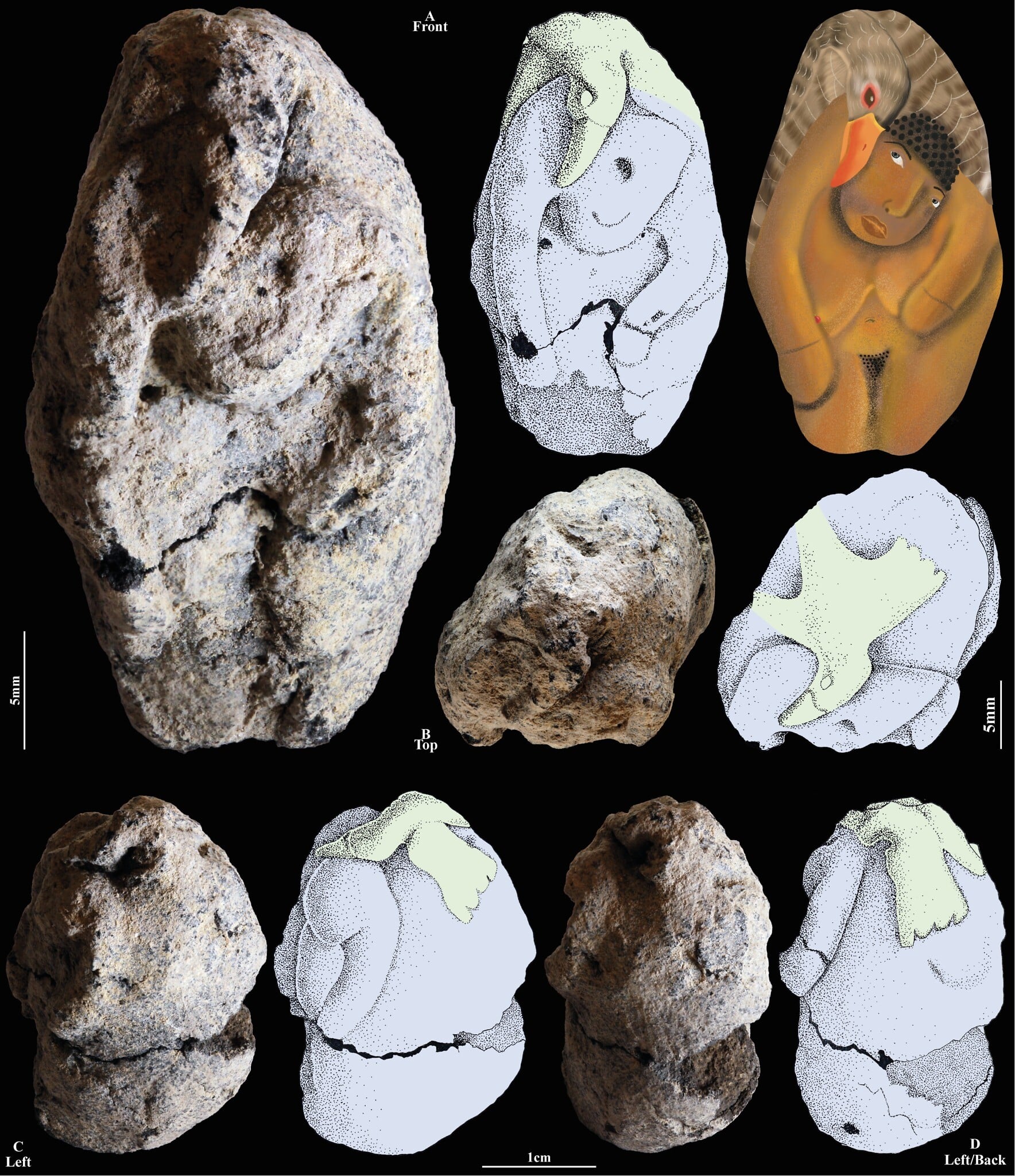
“In light of how the figures are positioned, we believe this is an image representing a male goose mating with a woman,” Davin stressed.
A handful of earlier depictions of interactions between humans and animals have been found on wall graffiti in other sites in the world, but “most representations of such interactions appeared only later in the Neolithic period, which witnessed the domestication of plants and animals,” Davin noted.
These graffiti include a painted scene of a communal hunting of wild pigs in Sulawesi, Indonesia, dating to approximately 51,000 years ago, and another featuring a speared bison, a bird-headed man, and a bird-headed shaft in the Lascaux Cave in France from around 18,000 years ago.
A site of ‘firsts’
The goose-woman figurine is one of several figurines discovered at the Natufian site located approximately two kilometers (1.2 miles) from Kibbutz Ein Gev, on the banks of the Ein Gev spring. It has been excavated under the direction of Prof. Leora Grosman from the Hebrew University in Jerusalem since 2010.
A critical link between the last Paleolithic hunter-gatherers and the first Neolithic farmers, the Natufians lived in the Levant at the very end of the Paleolithic period (approximately 15,000 to 11,700 years ago).
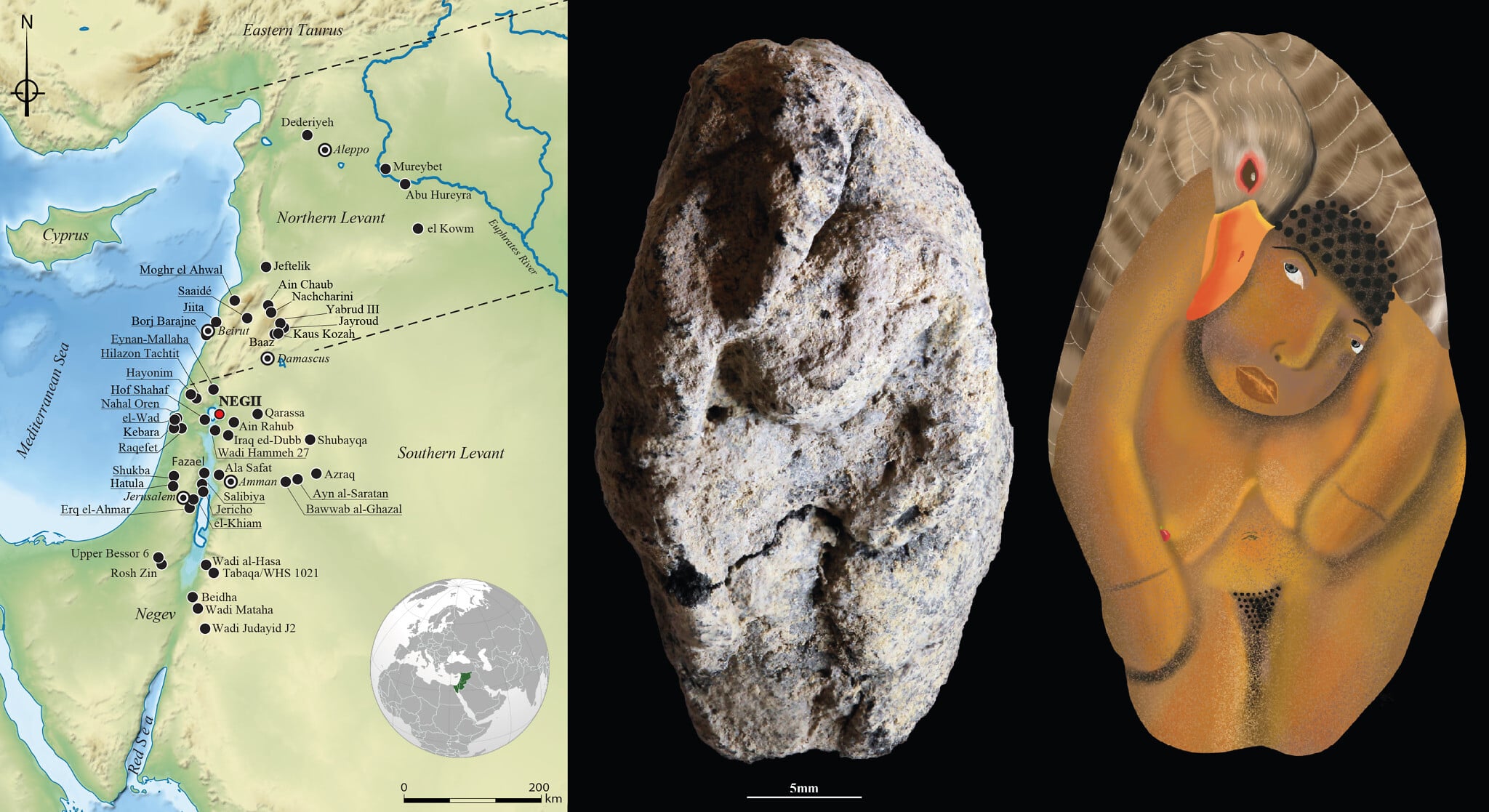
This is not the first time archaeologists have recorded groundbreaking discoveries at Nahal Ein Gev, including the first evidence of wheel technology and plaster production.
“The Natufians [built] the first villages of humanity,” Davin said. “They were still hunter-gatherers, they were not producing their food, but they created circular or semi-circular stone structures where they lived.”
The site extends for at least 1,000 square meters (over 10,000 square feet), and the archaeologists have uncovered the remains of at least six buildings.
“One of the buildings was used to bury people,” Davin said. “We found the remains of at least 20 individuals buried under a layer of lime plaster. Later, the building was abandoned, but after a while, people came back to it and buried other items here, including these figurines.”
In addition to the figurines, the archaeologists found a cache of human teeth and a child burial.
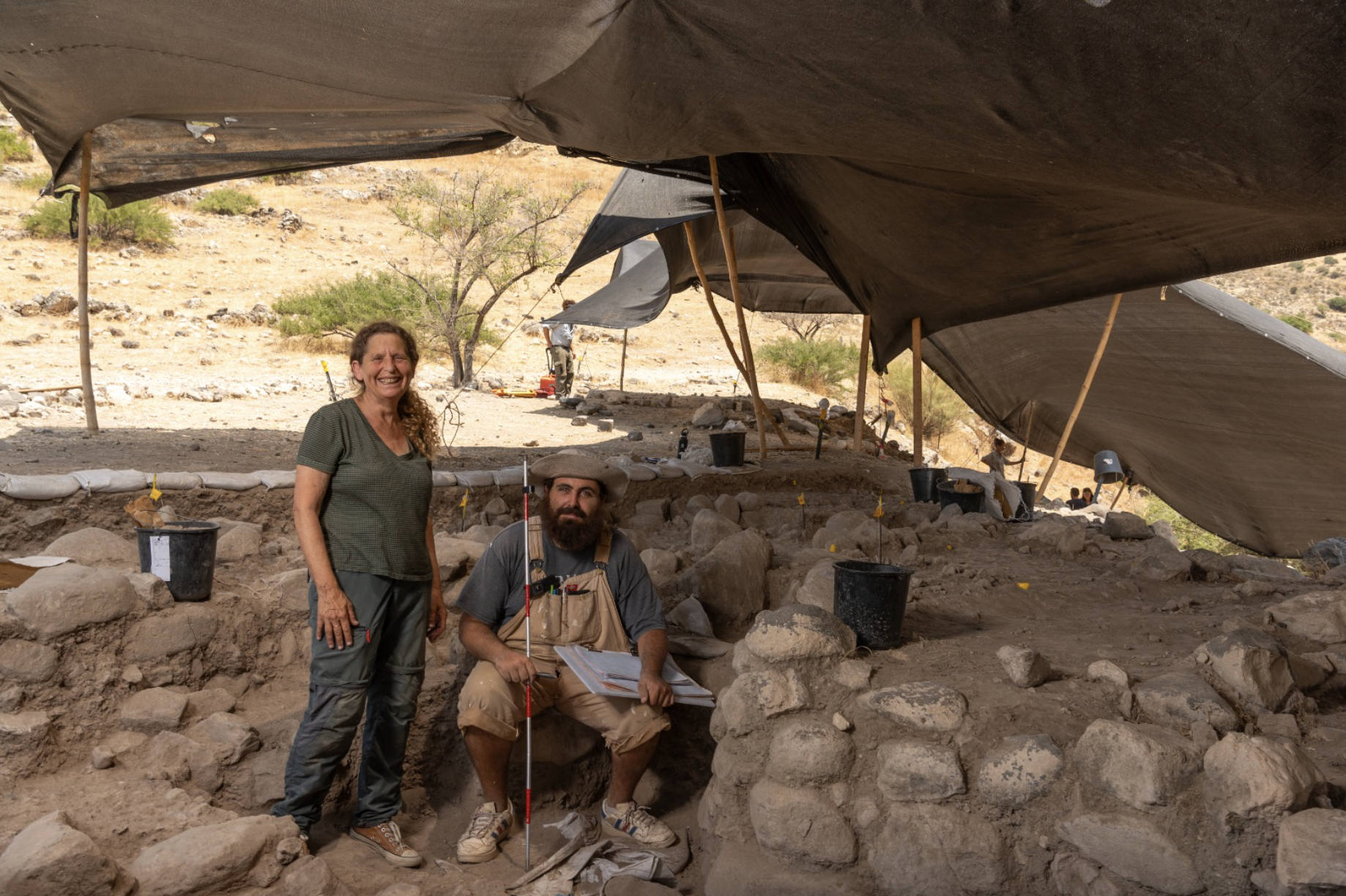
A piece of charcoal from one of the burials was dated between 12,630 to 12,041 years ago using radiocarbon dating. The artifacts were discovered some 90 centimeters (35 inches) higher than the layer of plaster, suggesting that they were deposited there at least a few decades later, according to Davin.
“Probably someone came to bury the figurines and the other items in that specific spot as a form of offering or gift,” he said. “They maintained a memory of what this special building was.”
The scholar said that the other figurines they found either depict humans or animals, but not them together.
(Not) a wild goose chase
Geese were a staple in the diet of the Nahal Ein Gev community, as evidenced by the numerous bones found across the site.
“We knew that Natufians were hunting geese, but while in other villages geese were only one of the species that their inhabitants were pursuing and eating, at Nahal Ein Gev they were a dominant species,” Davin said. “We know that they were also plucking the feathers, probably to use them for ornamentation, and this shows us that there was a symbolic connection with the geese, which emerges also in the figurine.”
The Natufians are, in fact, known for their engagement in unprecedented rituals and symbolic behaviors.
“They marked a big change in the Levant because there was an explosion of symbolic practices associated with the Natufian culture,” Davin said. “They made a lot of ornaments, beads, and jewelry compared to what happened in previous periods. They also introduce new funerary practices, for example, burying their dead under the floor of the houses, and then collecting human skulls from the burials.”
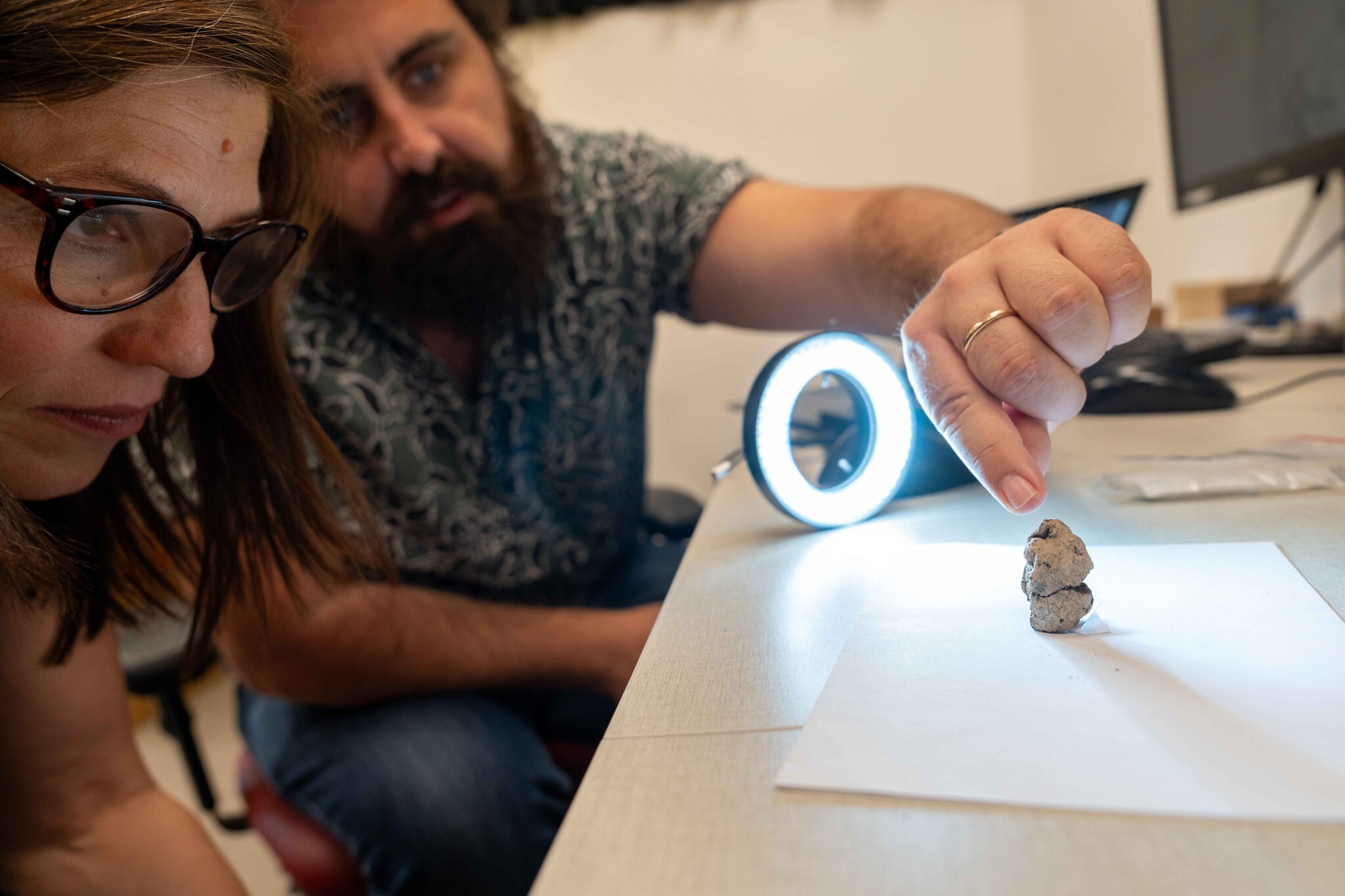
The figurines are part of these practices, according to Davin, but it took the researchers a while to understand it. For several years, the researchers thought the figurines were just rocks.
“They were first excavated in 2019, but only last year, as I re-examined the findings, looking for clay objects as part of my PhD, we identified them,” he said.
The artist’s signature
The researchers also found a fingerprint on the figurine.
“The fingerprint was left on the clay when it was still wet, so it likely belonged to the manufacturer,” he said. “By measuring the ridge of a fingerprint, it is possible to identify whether the person was a child, a young adult, a woman, or an adult man. In this case, we understand that the person was either a young adult or a woman, not a child or an adult male.”
Like the others found at the village, the figurine was fired to harden it, offering some of the earliest examples of firing clay for this purpose.
“We knew that the Natufians were using fire for other purposes, such as producing lime plaster or heating flints to change their color, but we did not know that they were also firing clay to make ceramics,” Davin said. “It’s a new phenomenon. We believed they must have used a simple fireplace because it was fired at just below 450 degrees [Celsius, or 842 degrees Fahrenheit].”

The researchers also found traces of pigments on the surface of the figurine.
“We did not clean the figurine, which is still covered in dirt, because we wanted to check if there were any traces of colorant, and we actually found several residues of ochre, both on the goose and on the woman, which probably means that the artifact was totally or partially colored in red,” Davin said. “We also found traces of another organic material that we have not been able to identify.”
Davin hopes that further research will shed additional light on the figurine.
“There is more to understand about it,” he said.










The Times of Israel Community.