

High Court freezes AG’s ouster until further notice, decries minister’s call to defy ruling
Judge Noam Sohlberg issues interim order a week after coalition voted to fire Baharav-Miara; tells Minister Shlomo Karhi that government is ‘obligated’ to respect court decisions
 Add ToI as a Preferred Source on Google
Jeremy Sharon is The Times of Israel’s legal affairs and settlements reporter

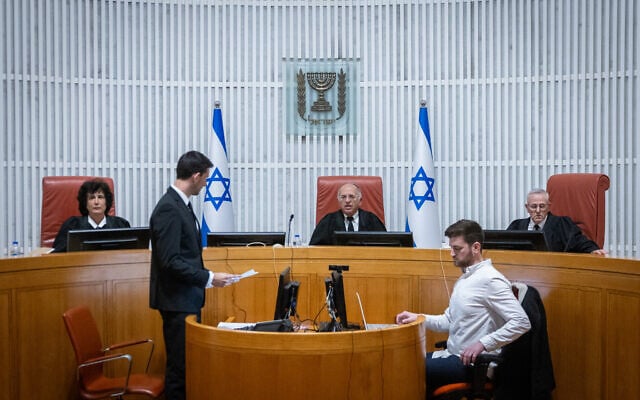
The High Court of Justice on Sunday turned the temporary order it issued freezing the dismissal of Attorney General Gali Baharav-Miara into an interim order, ruling that the government’s decision to fire her will be suspended until further notice from the court, and repeating that Baharav-Miara’s authorities as attorney general remain unchanged.
Judge Noam Sohlberg also issued a strong criticism of Communications Minister Shlomo Karhi, who, in a letter, told all employees in his ministry to ignore any instructions from the Attorney General’s Office following the cabinet vote on Baharav-Miara’s dismissal last week.
“What was said in the letter is regrettable. Everyone is obligated to respect decisions and rulings of the court,” wrote Sohlberg, and, quoting from a 2023 ruling, said that such respect is all the more expected from state officials.
“Needless to say, the conduct of the communications minister in this case is serious; it contradicts fundamental concepts of the rule of law,” the judge continued, saying Karhi’s letter was even more egregious since he instructed his employees to defy the court.
As well as citing High Court rulings, Sohlberg also referenced a quotation from the works of the 14th-century Talmudic scholar Rabbeinu Nissim about the crucial importance of adhering to the rule of law.
Sohlberg nevertheless rejected requests for a contempt of court ruling against Karhi, saying the court has yet to decide if the state’s agencies are subject to contempt of court rulings and, regardless, such a measure would be a last resort.
The judge said he hoped that Karhi’s letter would be “clarified.”
He reiterated that the attorney general’s legal position papers remain binding on the government, and that Karhi had no legal basis to tell ministry employees to ignore them.
Nevertheless, Karhi later doubled down on his rejection of the court order, saying the High Court was acting “in direct opposition to the law.”
“The law explicitly states that the government has the sole authority to appoint and dismiss the attorney general, and that is how the government acted. The judge’s order that the government’s decision is not valid until judicial review deviates from the law and contradicts the express language of the law,” he said.
Despite Karhi’s comments, the High Court has exercised the power of judicial review over administrative decisions by the government since the 1950s.

Karhi’s letter was widely denounced by the opposition last week,who warned of a constitutional crisis.
The government voted unanimously last Monday to dismiss Baharav-Miara from office, following months of confrontation with her, in a decision that will have deep legal and political reverberations given the government’s long-running efforts to weaken the judiciary.
In a statement after the vote, Baharav-Miara called her dismissal “unlawful” and vowed that she and her office would remain faithful to the law and continue to act professionally and honestly.

The government has accused the attorney general of serially thwarting its will over policy, appointments and legislation, and asserted that it can no longer work effectively with her, while Baharav-Miara has argued she has simply been demarcating what the government can and cannot do under the law.
Firing the attorney general is a highly controversial step, since the role is considered one of the key positions safeguarding the rule of law in Israel, owing to its power to determine whether the government’s actions comply with the law, and due to the attorney general’s role as head of the prosecution service.









The Times of Israel Community.