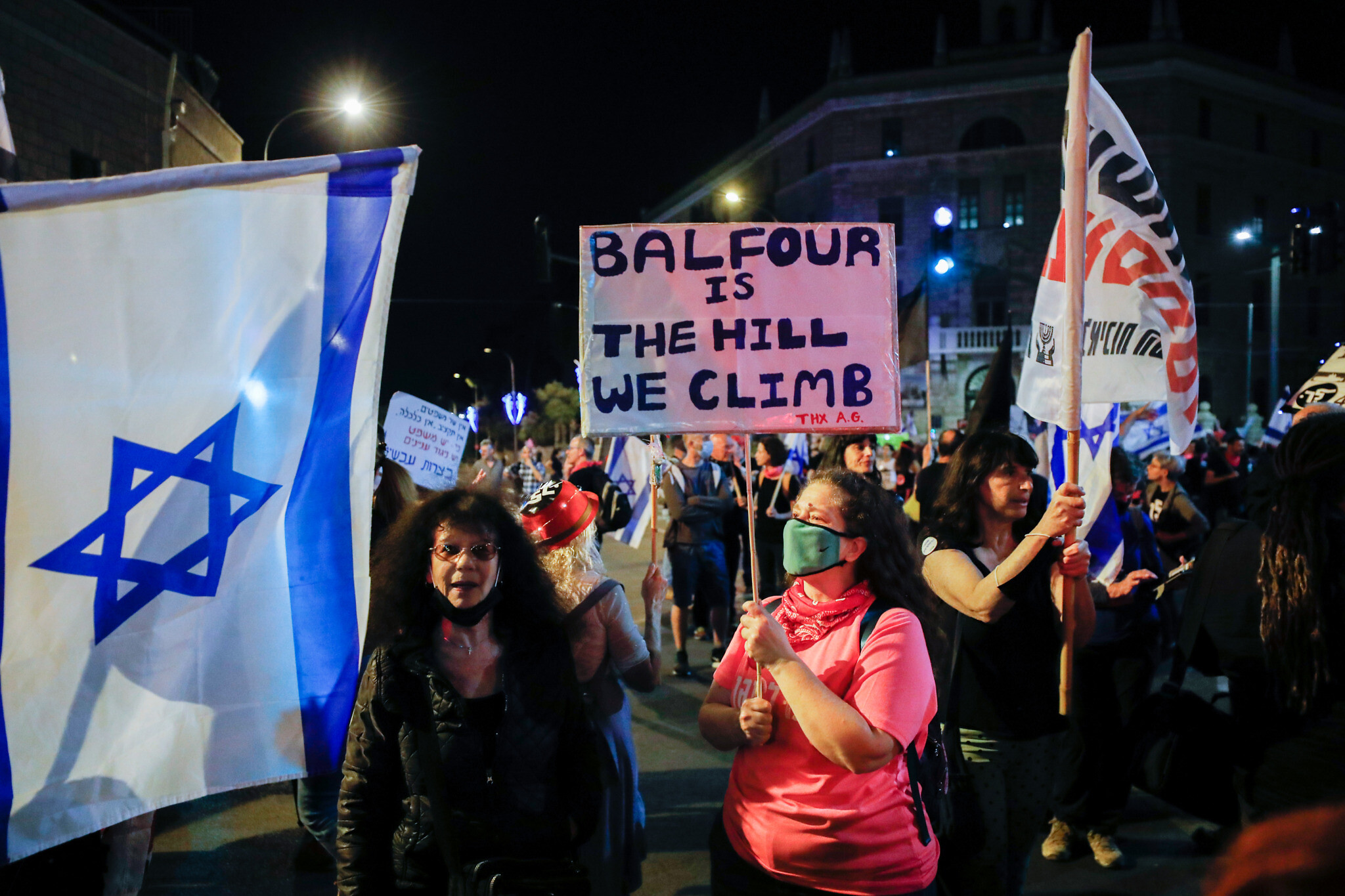
Israelis protest against Prime Minister Benjamin Netanyahu outside the prime minister's official residence in Jerusalem on April 17, 2021. (Olivier Fitoussi/Flash90)
Hundreds of people gathered outside Prime Minister Benjamin Netanyahu’s official Jerusalem residence on Saturday night to rally against the premier on trial for corruption charges.
Police closed several roads as protesters tried to block traffic.
The protest was held as Netanyahu’s corruption trial kicked into high gear, with three hearings per week, and as the Likud leader struggles to form a government after four consecutive elections in two years.
With the March election results continuing the political deadlock of the past three elections, it is unclear whether either the bloc that supports Netanyahu or the bloc that opposes him will be able to form a government.
Israelis walk past a poster depicting Israeli PM Benjamin Netanyahu during a protest against the PM, outside his official residence in Jerusalem on April 17, 2021 (Olivier Fitoussi/Flash90)
Demonstrators have been holding regular protests for months against Netanyahu, demanding he resign over his trial on charges of bribery, fraud, and breach of trust.
Get The Times of Israel's Daily Editionby email and never miss our top stories
Netanyahu denies wrongdoing and claims the indictments are part of an effort by political rivals, the media, police, and prosecutors to remove him from office.
At its height in mid-summer 2020, the anti-Netanyahu protest movement saw tens of thousands take to the streets in Tel Aviv and Jerusalem, with thousands more at bridges and intersections across the country.
One of the largest demonstrations so far was held on March 20, in what was the final mass protest before the latest Knesset elections. Tens of thousands of demonstrators gathered in Jerusalem on that Saturday evening.
Advertisement
Protesters have also criticized his government’s handling of the coronavirus pandemic.
Help us report truthfully on social media
As a multimedia journalist, my job is to take the quality, fact-based journalism produced by The Times of Israel newsroom and make it accessible across every platform — from Instagram posts to podcasts to short-form videos.
This is how many, especially young people, consume news these days. But misinformation is rampant on social media. Our team at ToI produces accurate, responsible short-form reporting on Israel and the Jewish world.
If you believe in the importance of factual social media journalism, please consider joining our reader support group, The Times of Israel Community. Your financial support is essential to sustain responsible multimedia reporting.
We’re really pleased that you’ve read X Times of Israel articles in the past month.
That’s why we started the Times of Israel - to provide discerning readers like you with must-read coverage of Israel and the Jewish world.
So now we have a request. Unlike other news outlets, we haven’t put up a paywall. But as the journalism we do is costly, we invite readers for whom The Times of Israel has become important to help support our work by joining The Times of Israel Community.
For as little as $6 a month you can help support our quality journalism while enjoying The Times of Israel AD-FREE, as well as accessing exclusive content available only to Times of Israel Community members.
Thank you, David Horovitz, Founding Editor of The Times of Israel


 Add ToI as a Preferred Source on Google