

Hurly-burly over early elections: 10 things to know for March 11
Netanyahu is seen as pushing the government into collapse, but there’s plenty of finger-pointing to go around as a snap poll can be called as early as Sunday
 Add ToI as a Preferred Source on Google
Joshua Davidovich is The Times of Israel's Deputy Editor
1. What was a few days ago barely more than a rumor is by Sunday morning an open secret in the Israeli press — Prime Minister Benjamin Netanyahu is the one who wants early elections, and will call for them, as early as today, unless his coalition partners agree to back him even if he is indicted.
- “Netanyahu is demanding that all coalition heads declare publicly their intention to stay in the coalition until November 2019 elections as a condition to continue the current government. Netanyahu’s gambit is meant to keep coalition partners from bolting should charges [against him] come down,” Haaretz reports, citing sources in Likud.
- The coalition, though, isn’t necessarily playing along, with Jewish Home leader Naftali Bennett and Kulanu head Moshe Kahlon linking hands to stop early elections, according to Yedioth Ahronoth, citing “coalition sources.” “We won’t agree to elections at a time Netanyahu finds convenient,” the paper quotes a senior coalition source saying.
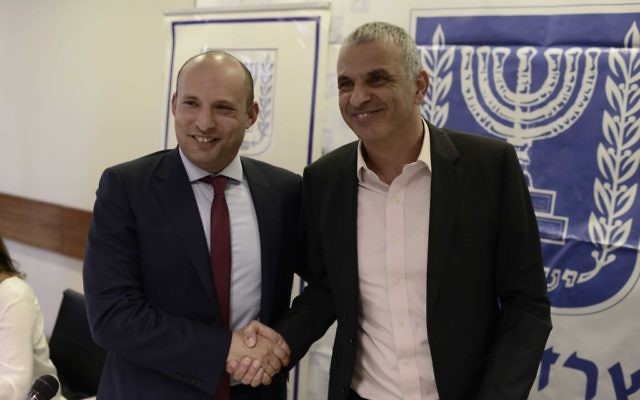
Finance Minister Moshe Kahlon and Education Minister Naftali Bennett shake hands at a press conference at the Ministry of Education in Tel Aviv on March 19, 2017.(Tomer Neuberg/Flash90) - Analysts believe the two parties have among the most to lose should early elections take place, as they will essentially be seen as a referendum on Netanyahu, with people either voting for the prime minister’s Likud faction or the opposition, and smaller parties getting left in the dust.
- Bennett has since broached the subject of running directly against Netanyahu — and not as a potential ally — should the prime minister call for elections despite the backing he’s given him throughout his legal troubles. “He’s dragging the whole country to elections over personal reasons. That’s not okay … and after they are asking me to commit to him, with or without an indictment. There’s a limit,” he tells Army Radio.

2. Israel will likely get its best indication if early elections are going to happen by early Sunday afternoon, as coalition heads meet after a cabinet meeting in a last-ditch effort to keep the government intact.
- Everyone but Netanyahu is interested in avoiding a snap poll, writes Ben Dror Yemini in Yedioth Ahronoth: “What do we need waste billions of shekels for? If it happens it will be in the service of one man only,” he writes, referring to Netanyahu.
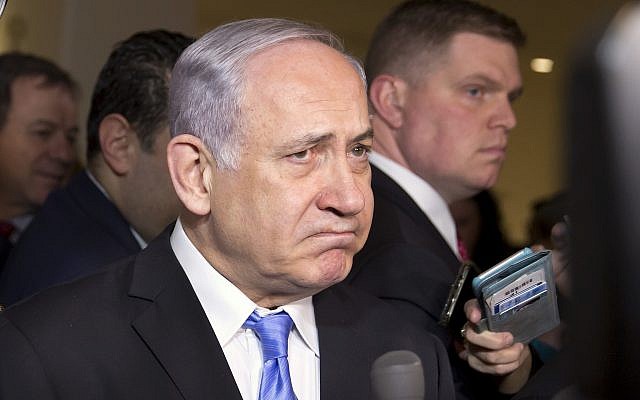
Prime Minister Benjamin Netanyahu ponders a media question after he visited the “3000 years of history: Jews in Jerusalem” exhibit at United Nations headquarters, March 8, 2018. (AP Photo/Richard Drew) - Even Moti Tochfeld in Netanyahu-backing Israel Hayom writes that early elections will be the PM’s doing exclusively: “The decision to go to elections is his alone. He cannot blame the ultra-Orthodox, [Defense Minister Avigdor] Liberman or [Finance Minister Moshe] Kahlon.”

3. The crisis came to a head as an overnight effort by Netanyahu and ultra-Orthodox coalition parties to solve a dispute over legislation regarding the drafting of Haredi men into the army fell apart after Likud let loose with a list of conditions for ending the standoff — full agreement from the ultra-Orthodox for a new bill which Liberman would have to commit to letting pass while Kulanu chairman Moshe Kahlon would have to vote in favor of — leading to speculation that Netanyahu wants elections.
- It’s Liberman, though, who is being portrayed by many as the main roadblock to a deal, as he has been adamant that he will not support any version of the bill that isn’t drafted by his own ministry. A Saturday tweet confirmed that he was unwilling to budge: “In life, there are moments when you need to follow your beliefs and not what is convenient or advantageous. This is exactly that moment.”
4. Seemingly addressing those who may point out that Liberman alone can’t bring down the government, as his exit would leave the coalition with 61 seats (out of 120), Netanyahu tells ministers Sunday morning that he can’t run a government on such a small margin. (Though he did manage to run his government for over a year with just 61 seats, before bringing Liberman in.)
- The comment significantly ups the stakes. “The next day will be decisive,” Likud Minister Ofer Akunis says.
5. With elections possibly coming in the next few months, some outside the Knesset looking in are getting their ducks in a row, including former defense minister Moshe Ya’alon, who told Channel 10 news Saturday night he would lead his own party and try to take down former boss Netanyahu.
- Ya’alon has launched a crowd-funding page. Among his first donors is Meni Naftali, the housekeeper who sued the Netanyahu’s and has led the anti-corruption rallies against the prime minister.
6. Far from election talk, US President’s Donald Trump’s decision to meet with North Korean dictator Kim Jong Un is met with skepticism in Israel’s press.
- Headlines in both Yedioth Ahronoth and Haaretz use the term “fear summit.”
- “Given that it’s Trump we’re dealing with here, within a very short time, hope has been replaced by anxiety and the vision of swords into ploughshares gave way to Comedy Hour. The Kim and Donald show could bring success or failure, but will certainly end with a bang,” Chemi Shalev writes in Haaretz.
- In Yedioth, former diplomat Alon Pinkas says the summit sounds like “the start of a joke.”
7. Trump’s willingness to meet Kim contrasts with his saber-rattling against Iran, which Israel Hayom columnist Avraham Ben-Tzvi says may be the point: “His unbending presidential policies toward the Iranian regime seemingly also influenced Pyongyang’s thinking,” he writes.
- With the search on for a suitable summit venue, neutral sites like the DMZ and Geneva are the most likely candidates, the AP reports, though the news agency notes that setting foot in enemy territory can also speak volumes, as Egypt’s Anwar Sadat did on his visit to the Knesset in 1977: “The visit set the tone for the Camp David peace summit and treaty in 1979. The Egyptian-Israeli agreement has remained intact and laid the groundwork for other Mideast summits.”
8. Another White House summit may not happen, with Palestinians turning down an invitation to discuss the Gaza humanitarian crisis.
- “The US knows very well that the cause of the tragedy of the Gaza Strip is the unjust Israeli siege, and what is needed is political treatment of this issue,” PLO official Ahmad Majdalani tells Voice of Palestine radio.
9. With all the election talk, attention has shifted away from fears of war on Israel’s northern front, but they are still there.
- On Saturday, Hezbollah deputy leader Sheikh Naim Qassem gave a speech projecting his group as a vanguard against Israeli and US meddling in Lebanon, Russia Today reports.
- And in Haaretz, Amos Harel notes that Israeli security experts still think a confrontation is probably in the offing sooner rather than later: “The underlying conditions on Israel’s northern front remain unchanged… The decided advantage of the pro-Assad axis in the Syrian civil war gives its forces security and bolsters their drive to win, in compensation for their efforts invested in saving the Syrian tyrant back when his chances looked slim.”
10. Lastly, Israel’s Kan broadcaster is set to unveil the country’s entry to the Eurovision song contest Sunday night. The ditty, “Toy” by singer Netta, leaked onto the internet early, but we won’t spoil the fun. Anyway, this preview is probably all you need.
בוקר טוב עם הצצה בלעדית לקליפ של TOY, השיר איתו נטע ברזילי תייצג אותנו באירוויזיון הקרוב בליסבון. הקליפ המלא ייחשף במהדורת @kann_news הערב ב-20:00, ובדיגיטל.
לאיזור האירוויזיון באתר כאן: https://t.co/zdQejVuuMF#toy #teamnetta @nettabarzi pic.twitter.com/SCINaMBbxd
— כאן (@kann) March 11, 2018







The Times of Israel Community.