

IDF demolishes home of Palestinian-American suspect in West Bank terror attack
Despite legal challenges, troops destroy house belonging to family of Muntasir Shalabi, accused of killing Yehuda Guetta and injuring 2 others in May; clashes reported at scene
 Add ToI as a Preferred Source on Google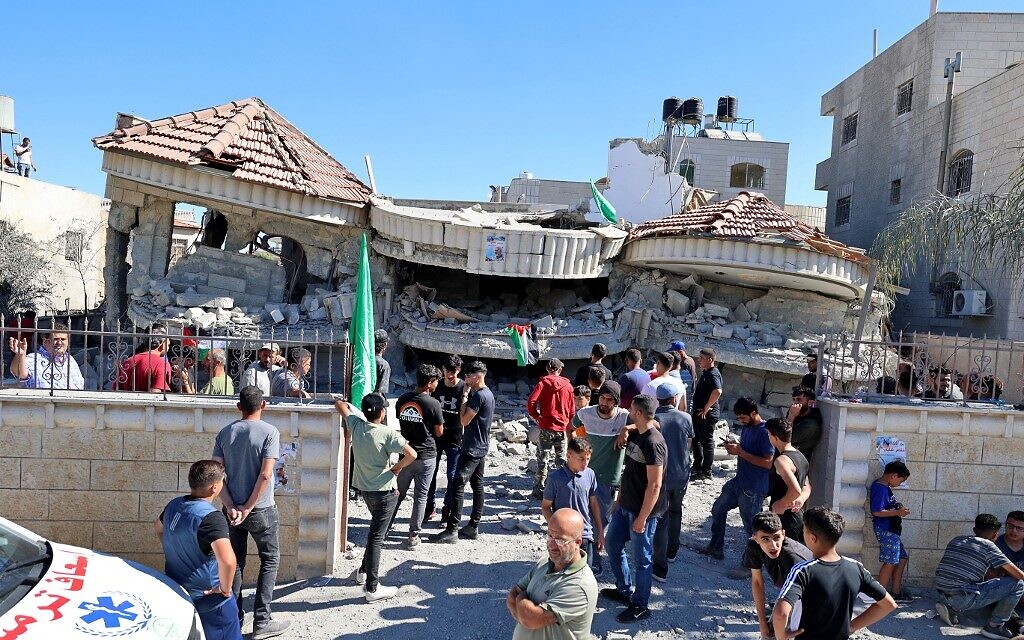
Israeli security forces early Thursday demolished the family home of a Palestinian accused of killing an Israeli student, despite Washington apparently asking for the move to be stopped.
“Overnight… troops demolished the residence of the terrorist [Montasir] Shalabi, in the village of Turmus Ayya, northeast of Ramallah,” an army spokesperson said.
The army said that during the demolition “approximately 200 rioters hurled rocks and launched fireworks” at troops, who responded with “riot dispersal means.” There were no reports of injuries.
Home demolitions are a controversial punitive measure that the Israeli security establishment maintains can deter future terror attacks.
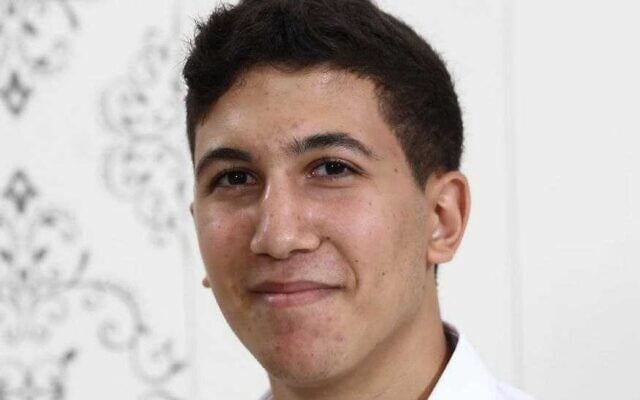
Shalabi has been charged with killing Yehuda Guetta, 19, at the Tapuah Junction in the northern West Bank on May 2. The shooting attack also injured two other Israeli teenagers, one of them seriously.
His wife, Sanaa Shalabi, 40, told AFP troops arrived at 1 a.m. to place explosives around her home. She said the demolition lasted through the night. “This is our life. What happened to us is normal. We were prepared for it,” she said, calling her husband a “hero.”
הבוקר נהרס הבית בו התגורר מונתסר שלבי, שביצע את הפיגוע בו נרצח יהודה גואטה בצומת תפוח בחודש מאי@nurityohanan pic.twitter.com/tmFn32ORbC
— כאן חדשות (@kann_news) July 8, 2021
Muntasir Shalabi was charged at the Judea Military Court with intentional homicide, three counts of attempted homicide, possession and use of an unlicensed weapon, and obstruction of justice.
The 44-year-old is suspected of driving to the Tapuah Junction and opening fire at a group of Israeli students from a yeshiva in the nearby Itamar settlement. The shooting fatally wounded Guetta, seriously injured a second teenager and lightly wounded a third.
Shalabi was eventually arrested following a three-day manhunt, an hour after Guetta succumbed to his injuries.
Shalabi, a father of seven, is not believed to have any affiliation with Palestinian terror groups, the Shin Bet security service has said.
The demolition came despite a number of legal challenges against the decision.
Hamoked human rights organization filed a petition against the demolition, noting that Shalabi suffered from mental illness, had been prescribed anti-psychotic medications and had spent time in a psychiatric facility in recent years. Mental illness has in the past been used as grounds by the High Court to cancel planned demolitions.

Moreover, Hamoked noted that for 11 months of the year, Shalabi does not live in the Turmus Ayya home, as he is estranged from his wife and only stays in a separate room during an annual one-month visit. During the rest of the year, he resides in the US where he also has citizenship, along with a large percentage of Turmus Ayya residents. Proof of consistent residential ties in the past has been required for Israeli force to move forward with a home demolition.
Hamoked argued that Shalabi’s estranged wife and children should not lose their home as state prosecutors provided no proof that they had any knowledge of his plan to carry out an attack.
For its part, the state prosecution argued that Shalabi still owned the house and had even renovated it recently. As for the family’s claims of the demolition order being collective punishment, prosecutors said the need to provide a deterrent against future attacks was weightier than the need for consideration of the relatives who may have been uninvolved in the attack.
The court in June ruled unanimously against the petition, though it did not respond directly to any of the arguments presented by Hamoked.
The US, which opposes punitive home demolitions, sent representatives from its embassy to the High Court hearings on the matter, and Israeli sources told Channel 13 that they had passed along their concerns to the Israeli government.
In addition to Shalabi, the rest of his family also holds US citizenship, a fact noted in the Hamoked petition.
A spokesman said Thursday that the US embassy was “following” reports of the demolition.
“The home of an entire family should not be demolished for the actions of one individual,” the spokesman said.
Judah Ari Gross and AFP contributed to this report.








The Times of Israel Community.