

Iranians rail against Israel at funeral for soldier beheaded by IS
Blaming creation of jihadist group on Jewish state, cleric urges, ‘Prepare your missiles for annihilation of Israel,’ as crowd chants, ‘Death to Israel’
 Add ToI as a Preferred Source on Google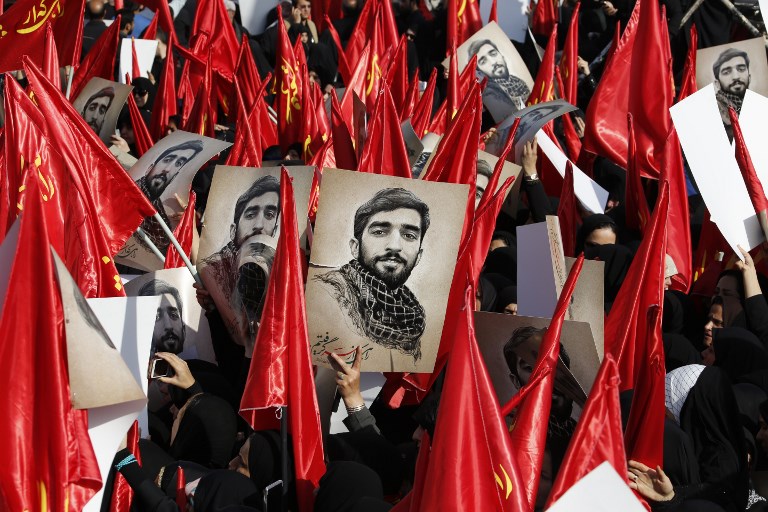
Thousands of Iranians called for Israel’s destruction at a funeral Wednesday for a young member of the Iranian Revolutionary Guard Corps beheaded by the Islamic State jihadist group in Syria, a killing that has struck a nerve within the Islamic Republic as its forces continue to suffer casualties in Iraq and Syria.
The slaying of 25-year-old Mohsen Hojaji captured the imagination of many in Iran, a Shiite-ruled nation whose national religion holds sacred acts of mourning and the acknowledgement of sacrifices. Since his death, artists and others have memorialized Hojaji in videos and paintings, while discussion of his slaying has muted domestic criticism of Iran’s foreign military operations, especially in Syria.
A cleric at the funeral alleged that Israel and the US were behind IS, drawing cries of “Death to Israel” and “Down with the US” from the audience.
“We swear on blood of Hojaji we will not rest until destroying Israel,” cleric Ali Reza Pahanhian said from the podium. “Israel, we swear on the head of Hojaji that we will behead your leaders. Guards! Prepare your missiles for annihilation of Israel.”
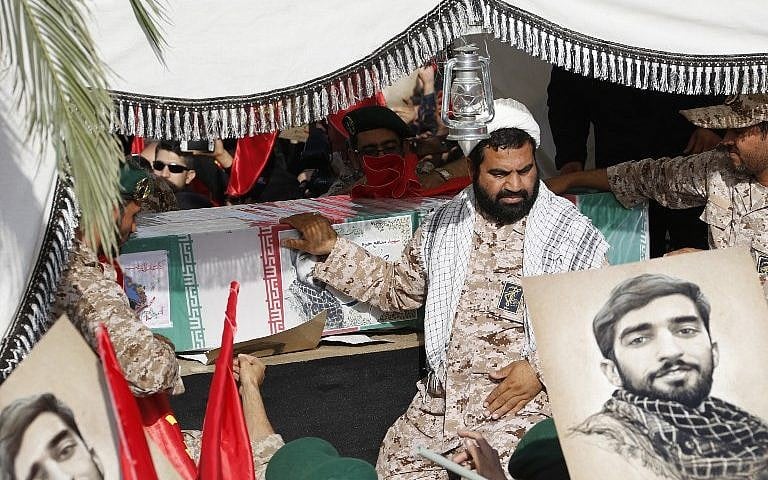
Hojaji’s funeral in Tehran brought Supreme Leader Ayatollah Ali Khamenei, who prayed near his Iranian-flag-wrapped casket. Many current and former government officials, including parliament speaker Ali Larijani and former president Mahmoud Ahmadinejad, were also in attendance.
Mourners lay flowers atop his coffin, while on the street soldiers with the paramilitary IRGC mixed with men wearing black and women in long black chadors. Many carried drawn portraits of Hojaji, while others unfurled the black flags common during Muharram, a Shiite mourning period.
Hojaji is one of many IRGC members and volunteers to be killed in Iraq while advising Shiite militias battling IS or in Syria, where Iranian forces backed embattled President Bashar Assad.
But while IS group tried to use Hojaji’s capture and subsequent beheading as propaganda, many in Iran saw it differently. An image of Hojaji from an IS video, showing him stoically standing after his capture with smoke rising behind him in the Syrian desert, inspired a sense of patriotism in an Iran in which some have grown tired of its military operations abroad.
“Look at the photo, there is no sign of weakness despite him being shot and captured,” his 23-year-old widow Zahra Abbasi earlier told Iranian media. “There is no fear in the eyes. It is all bravery, courage. He is like a mountain.”
Graphic artist Hassan Rouholamini took the frame and reimagined it with Hojaji being welcomed by the third Shiite saint, Hussein, the grandson of the Prophet Muhammad. Hussein himself was beheaded at the Battle of Karbala in present-day Iraq in the 7th century, an event Iranians will mark with this week’s coming Ashoura commemoration.
Khamenei himself even referred to Hojaji as a “dear martyr” in a speech.
“God emboldened Hojaji as an evidence of numerous young people” willing to fight and be killed defending Islam, the supreme leader said.
A few hours before Martyr #Hojaji's funeral, Ayatollah Khamenei attended the Martyr's body to recite Fatiha & ask God to elevate his status. pic.twitter.com/l3llPV4MUo
— Khamenei.ir (@khamenei_ir) September 27, 2017
Iranian President Hassan Rouhani, a so-called moderate cleric who himself criticized the IRGC in his re-election campaign, also praised Hojaji for showing how Iranian people are ready to sacrifice themselves for the greater good.
Hojaji’s death has caused a rare unity across hardliners, moderates and reformists within Iran. Many activists, artists, athletes, celebrities and politicians, including Foreign Minister Mohammad Javad Zarif, have offered condolences and expressed sympathy.
His death also has silence some criticism of Iran’s foreign military operations, especially in Syria. In May, Tehran’s former reformist mayor, Gholamhossein Karbashchi, said in a public speech that diplomacy rather than military presence can solve the problems in Syria.
Hojaji’s body was first taken to Iran’s holy city of Mashhad for a blessing in the shrine of Imam Reza, the eight Shiite Imam. He will be interred Thursday his hometown of Najafabad, some 400 kilometers (250 miles) south of Tehran.








The Times of Israel Community.