

‘Learn your lesson’: Inscribed 2,100-year-old sling bullet found in the Golan
Artifact was possibly used by the Greek defenders of the city of Hippos against the Hasmonean army of King Alexander Jannaeus in 101 BCE
 Add ToI as a Preferred Source on Google
Rossella Tercatin is The Times of Israel's archaeology and religions reporter.
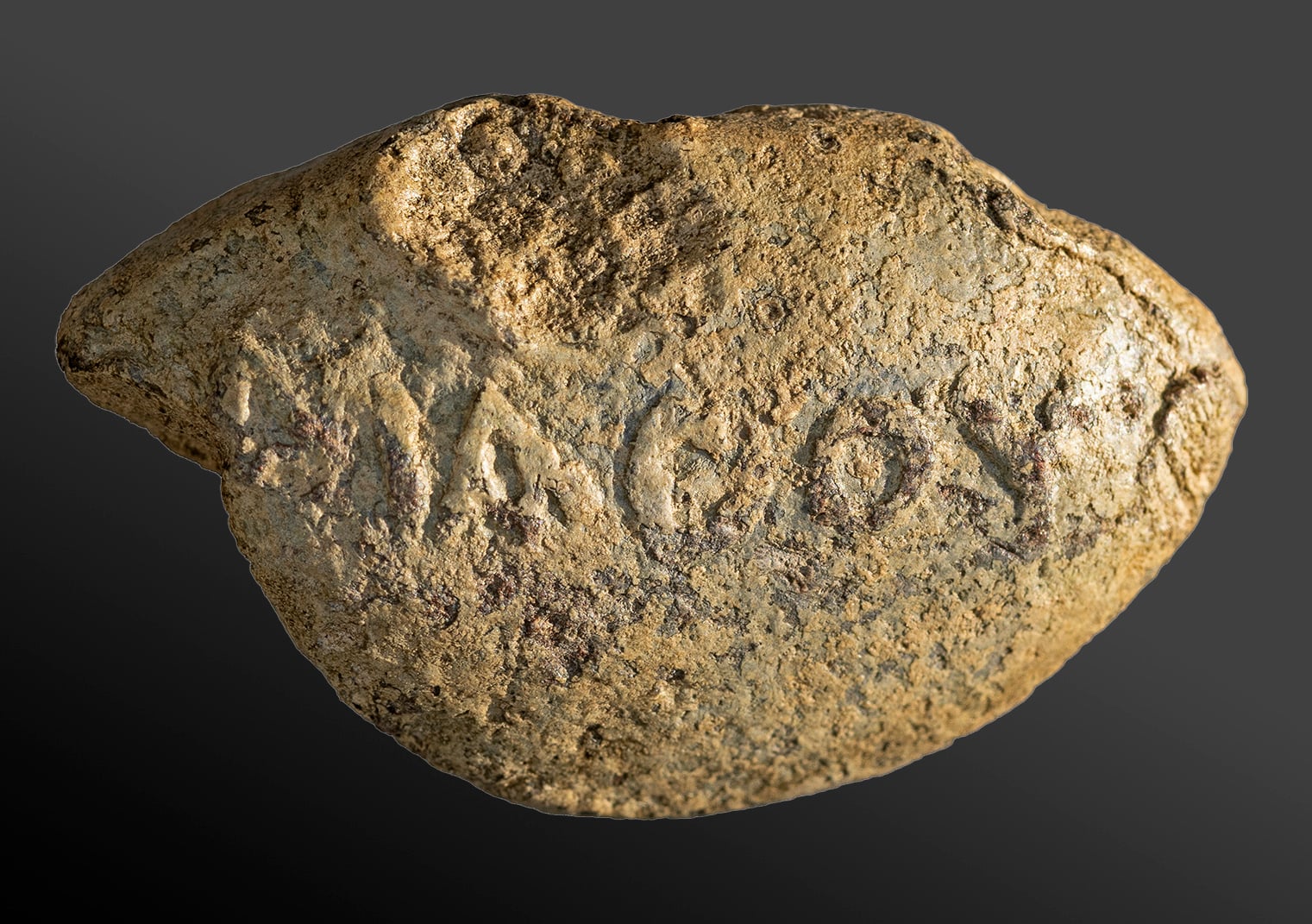
A circa 2,100-year-old sling bullet inscribed with the word “Learn” in Greek has been unearthed during archaeological excavations at the Sussita (Hippos) National Park on the eastern shore of the Sea of Galilee, the University of Haifa announced Sunday.
The bullet, measuring 3.2 x 1.95 centimeters and weighing 38 grams, was possibly used by the Greek defenders of the city against the Hasmonean army of King Alexander Jannaeus in 101 BCE.
A paper on the artifact was published in the peer-reviewed journal “Palestine Exploration Quarterly” last week.
Its discovery marks the first time that this specific inscription has been found on a sling bullet, according to Haifa University’s Michael Eisenberg, co-director of excavation at the site and one of the authors of the study.
“Sling bullets were made of lead, and were the most common munitions in the Hellenistic world,” Eisenberg told The Times of Israel over the telephone. “They were the cheapest ones, simple and very effective.”
He explained that most bullets were unadorned. Still, it was not uncommon for bullets to carry decorations, such as a symbol of power or an inscription.
“In the larger Israel-Syria region, many times you will see a group of thunderbolts tied up together as the ultimate weapon of Zeus, the head of the Greek pantheon, sometimes a trident, the weapon of [god of the Sea] Poseidon,” Eisenberg said. “There are very rare cases when the bullets carry an inscription.”
Inscriptions often included names of cities or of military commanders. However, at times, archaeologists have also discovered artifacts bearing a sarcastic message, such as “catch.”
Eisenberg and his fellow authors believe that this is also how the word “learn” should be interpreted.
“It uses a very strange structure that only exists in Greek,” he said. “It’s like the sling tells itself, ‘I’m learning my job by hitting the enemy.’”
“Perhaps the idea was [to tell the enemy], ‘Learn your lesson,’ or ‘Next time, you should learn not to come here,’” he added.
According to Eisenberg, this is the first time such an inscription has been found on a sling bullet, not only in Israel but worldwide.
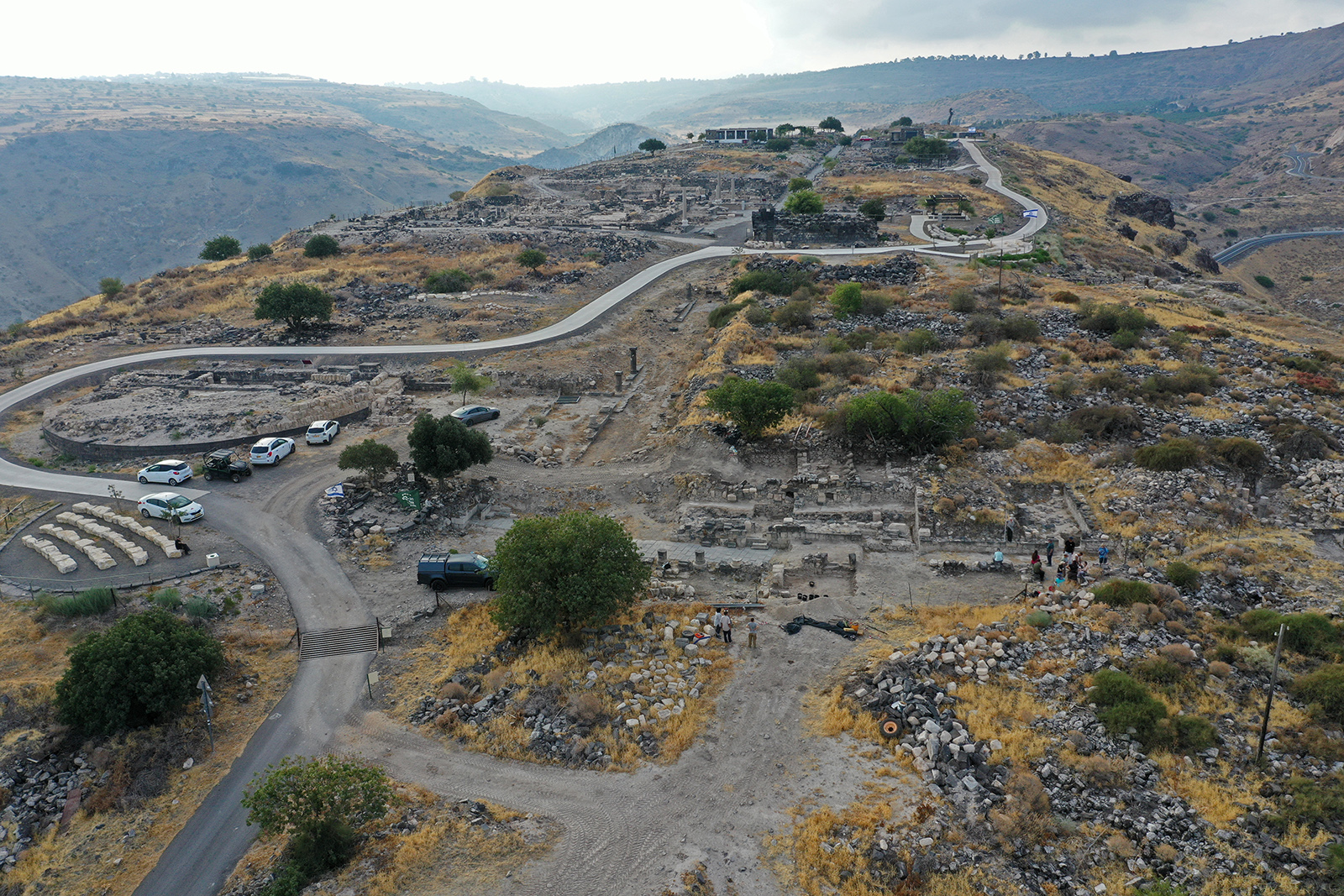
The bullet was found in excavations in the area of the city’s Roman necropolis (cemetery). Recently, the team also unearthed another artifact engraved with a scorpion, yet to be published. The archaeologists have found several dozen bullets in the same area.
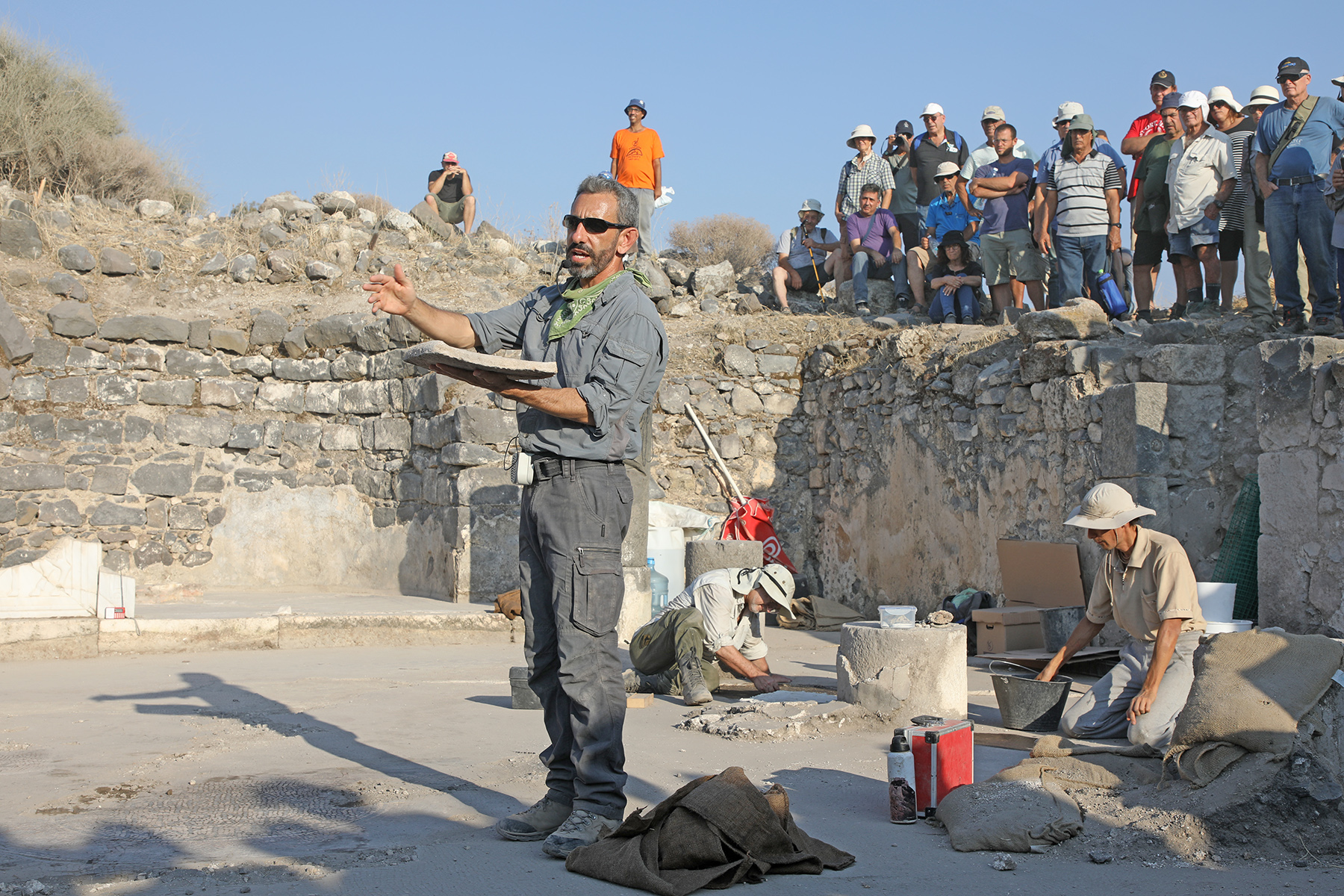
Eisenberg and his team believe the “Learn” bullet precedes the cemetery and dates back to the Hellenistic period.
“Hippos was founded as a Greek city in the 2nd century BCE,” he said. “It was established by one of two kings, either Antiochus the Great or Antiochus IV Epiphanes, the villain of the Hanukkah story.”
Based on its typology, the archaeologists dated the artifact to the second half of the 2nd century or the beginning of the 1st century BCE.
“Perhaps the bullet was used during the battle between the Jewish Hasmonean kingdom expanding toward the Galilee and the Golan,” Eisenberg said. “In 101 BCE, we see Alexander Jannaeus trying to conquer Hippos and this region. He was very successful in conquering it, though he could not keep it.”

He said other scenarios are also possible, including that the slingshot was launched in earlier confrontations between different Greek kingdoms or that it was used in training.
The archaeologists believe that the area where the artifact and many other bullets were found corresponds to the ancient Hellenistic and then Roman road that led to the city from the Sea of Galilee, marking a place where it would have made sense for the besieging army to be ascending to reach Hippos and for its defenders to shoot at them.
For sure, the bullet shows it hit something.
“We don’t know if it was a rock or a person, but there was definitely an impact,” Eisenberg said.










The Times of Israel Community.