

Roman-era gold jewelry found at Hippos testifies to wealth of city likely visited by Jesus
Although found out of context, unearthed ring and earrings shed light on ancient Galilean affluence in the first centuries of the Common Era
 Add ToI as a Preferred Source on Google
Rossella Tercatin is The Times of Israel's archaeology and religions reporter.
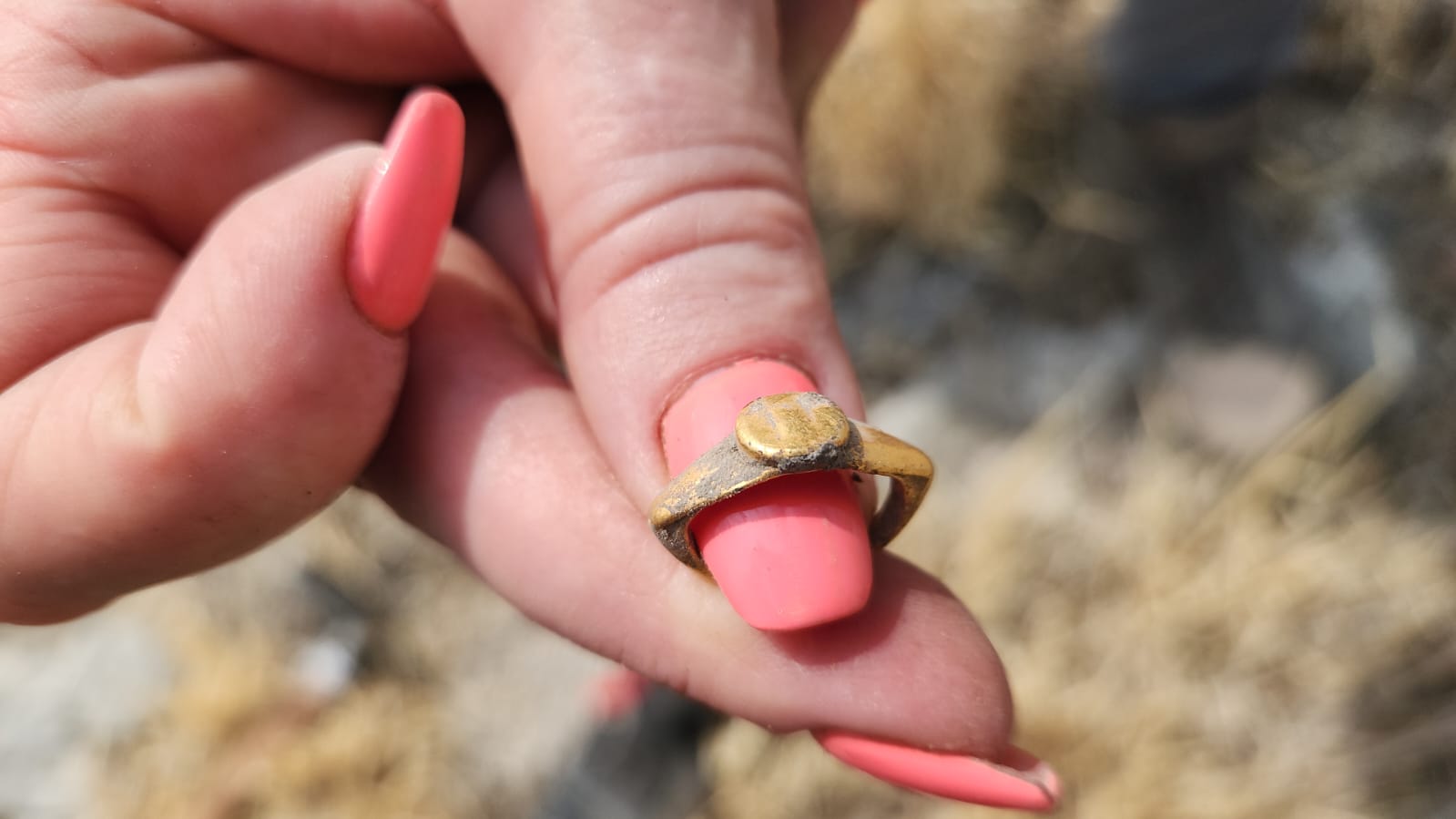
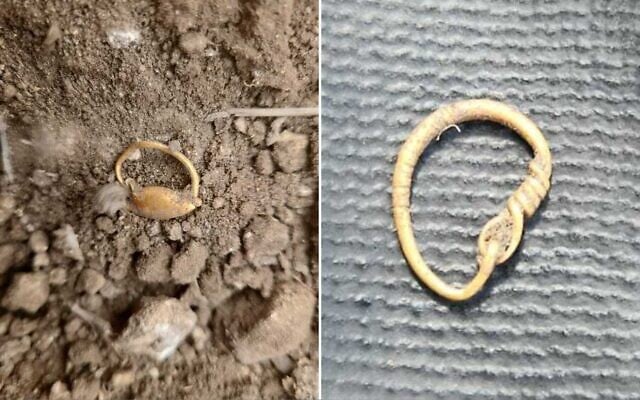
An exquisite golden ring and a pair of earrings dating to the Roman period (1st-3rd centuries CE) have recently been unearthed during archaeological excavations at the Sussita (Hippos) National Park, the Israel Nature and Parks Authority announced Thursday.
The artifacts help shed light on the affluence that once defined this ancient city overlooking the Sea of Galilee – one of the 10 cities of the Decapolis alliance where, according to the Gospels, Jesus preached, Dr. Michael Eisenberg told The Times of Israel in a phone interview.
“The ring was found a few days ago, while the earrings were uncovered a few months ago,” said Eisenberg, co-director of the Hippos (Sussita) Excavations Project with Dr. Arleta Kowalewska, both from the University of Haifa.
Founded by the Greek Seleucids on the eastern shore of the Sea of Galilee in the 2nd century BCE, Hippos flourished as a major urban center during the Roman and Byzantine periods. It endured even after the Arab conquest in the 7th century, until a devastating earthquake in 749 CE leveled the city, which was then permanently abandoned.
The earrings were discovered in the area of the Hippos’ Roman necropolis (cemetery).
“This is one of the most complete, beautiful, and diverse Roman-period necropolises in Israel,” Eisenberg said. “It included burials of the most simple, poorest people, who dug a small pit and buried their relatives, and of the wealthiest aristocrats, who built enormous basalt mausolea.”
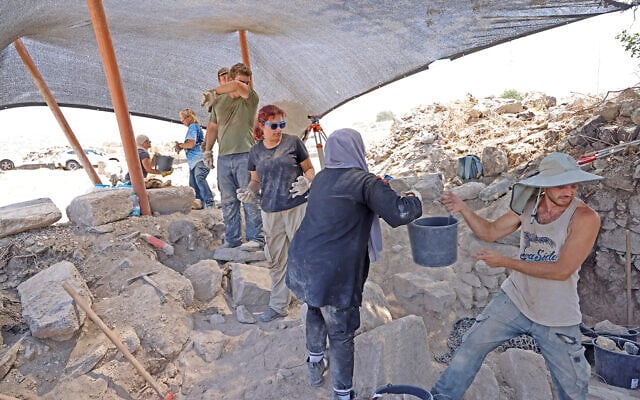
The necropolis is one of the key areas currently under excavation.
“We’re trying to learn more about burial customs — how people laid their dead to rest,” Eisenberg said.
The earrings were likely intended as burial offerings, but they weren’t found inside a grave. Instead, they were uncovered just outside several tombs.
“Because the earrings were found out of context, we have no way of knowing anything about who owned them,” Eisenberg said. “They were just lying there—we’re fortunate that antiquities robbers didn’t get to them first.”
The ring was uncovered in a different part of the city, currently under excavation — a residential neighborhood.
“We’re currently excavating both the cathedral and residential quarters in what was the heart of Hippos,” Eisenberg said. “Progress is relatively slow — we’re dealing with thousands of basalt blocks that collapsed into the houses, and most of them have to be removed by hand. The ring was found right next to one of them.”
“In light of its size, the ring must have belonged to a little girl, who probably lost it,” he speculated. “I hope she was not punished for it,” he added.
Both the ring and the earrings were dated to the Roman period based on their stylistic features.
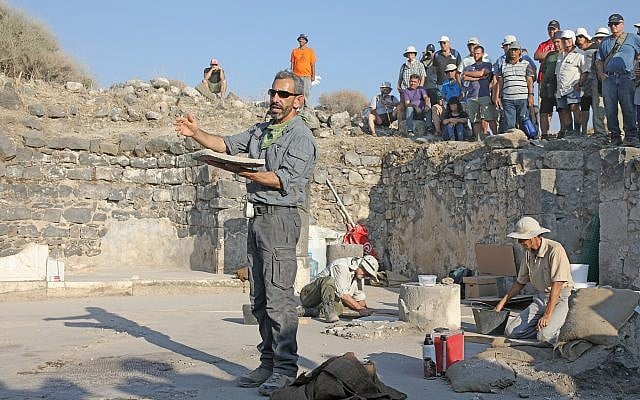
Eisenberg noted that the presence of gold, along with other discoveries — such as the elaborate architecture of some buildings — attests to the considerable wealth Hippos once possessed.
“The Roman period was characterized by a peak of wealth in Hippos and many other cities of the region,” he said. “We can see it not only because they had enough money to buy gold, but also based on the impressive building materials they used: massive monolithic shafts of granite and marble imported from Egypt, Asia Minor, the Greek islands, and beyond.”
The dwellings also revealed dozens of fragments of finely crafted stucco, painted in vibrant colors.
According to Eisenberg, two mausolea unearthed by the expedition rank among the most luxurious from the period in the region.
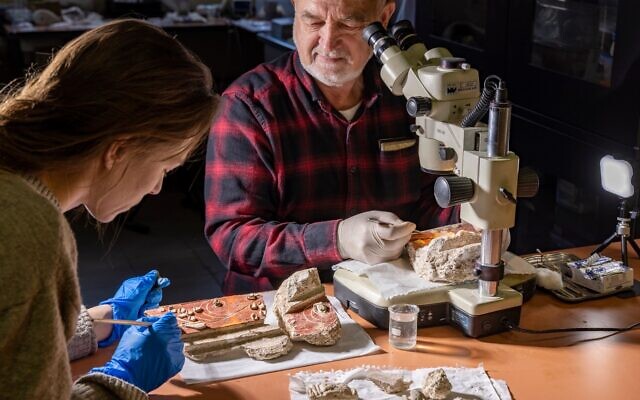
“They are a few stories high, with magnificent decorations, sculptured flowers, the best artisanship in basalt that we have in the land of Israel,” the archaeologist said. “This gives us a lot of information about the financial abilities of the deceased.”
While the Gospels do not explicitly mention Hippos, they refer to Jesus visiting the Decapolis.
“Jesus went throughout Galilee, teaching in their synagogues, proclaiming the good news of the kingdom, and healing every disease and sickness among the people,” reads a passage in Matthew. “Large crowds from Galilee, the Decapolis, Jerusalem, Judea, and the region across the Jordan followed him.” (Matthew 4:23-25)
Eisenberg said that in recent years, his team has determined that the main streets of the settlement, paved with basalt blocks, date back to precisely the time of Jesus.
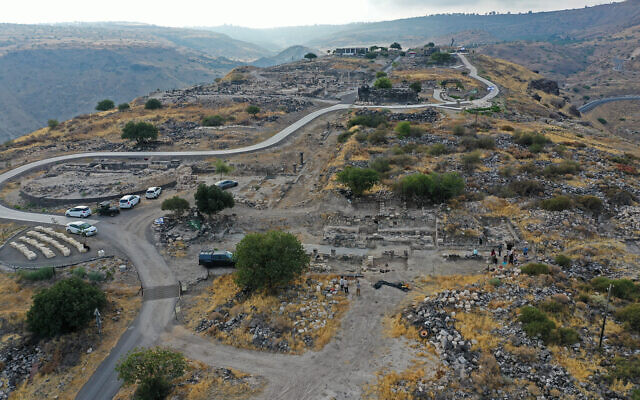
“Based on pottery, coins, and stratigraphy, the main plaza, or what we call the forum, the main axis that crosses the city east to west, or the Decumanus Maximus, and the other main street crossing it, the Cardo, that we are now excavating from both sides, are dated not later than the middle of the 1st century CE,” Eisenberg said. “There is another street, plastered, not paved with basalt, which was built around the year 0.”
“Without exaggerating, Jesus probably walked on those basalt slabs, and if not on the slabs, on the plaster under them,” he added.
According to Eisenberg, this connection with Jesus likely made Hippos a very exciting site for early Christians.
While archaeological evidence suggests that the city experienced a decline toward the end of the 3rd century CE, by the 6th century Hippos had again become an important center, with at least seven churches, including the cathedral.
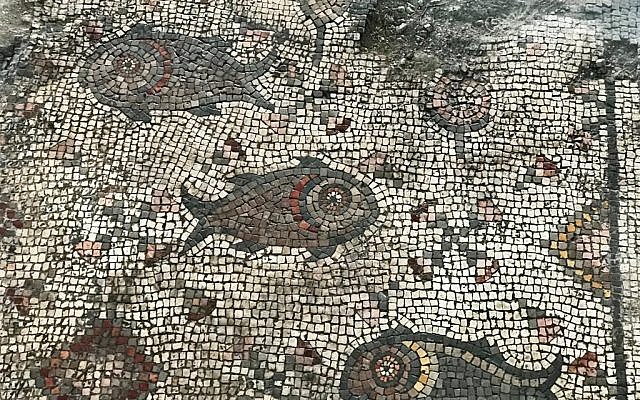
“Many people today are not aware that Hippos was a main Christian city in Byzantine times, with the best panoramic view of Jesus’ ministry,” Eisenberg said.
The Israel Parks Authority opened the site to the public in 2023, and Eisenberg, who has been excavating there since 2000, hopes that this will bring more attention to Hippos.
The archaeologist noted that the Hippos (Sussita) Excavations Project has recently been awarded a government research grant to continue excavations at the necropolis.
“This is what we are going to do in the next few years,” he said.

Meanwhile, the current excavation season will continue until July 31, also thanks to the work of volunteers from both Israel and abroad, some of whom make it a point to return every year, including this year, despite the war.
Coincidentally, both the ring and the earrings were discovered by the same person, Eddy Lipsman, an Israeli volunteer who also often joins the team when it excavates on select Fridays throughout the year.
“Michael [Eisenberg] assigned me a specific excavation area,” Lipsman said, according to the Parks Authority’s statement. “I walked the area with a metal detector, and suddenly I heard a distinctive beep, the kind that usually differentiates between regular and special metals. I started digging and suddenly saw something golden. I continued digging and saw this small, special gold ring. I was stunned.”










The Times of Israel Community.