

Bennett holds lengthy meeting with Netanyahu, blindsiding allies
Opposition lawmaker, who denounced PM during campaign, meets him without informing partners; Likud, B’Yachad say discussion was only on security; sources close to Bennett insist he won’t ditch Eisenkot’s bloc
 Add ToI as a Preferred Source on Google
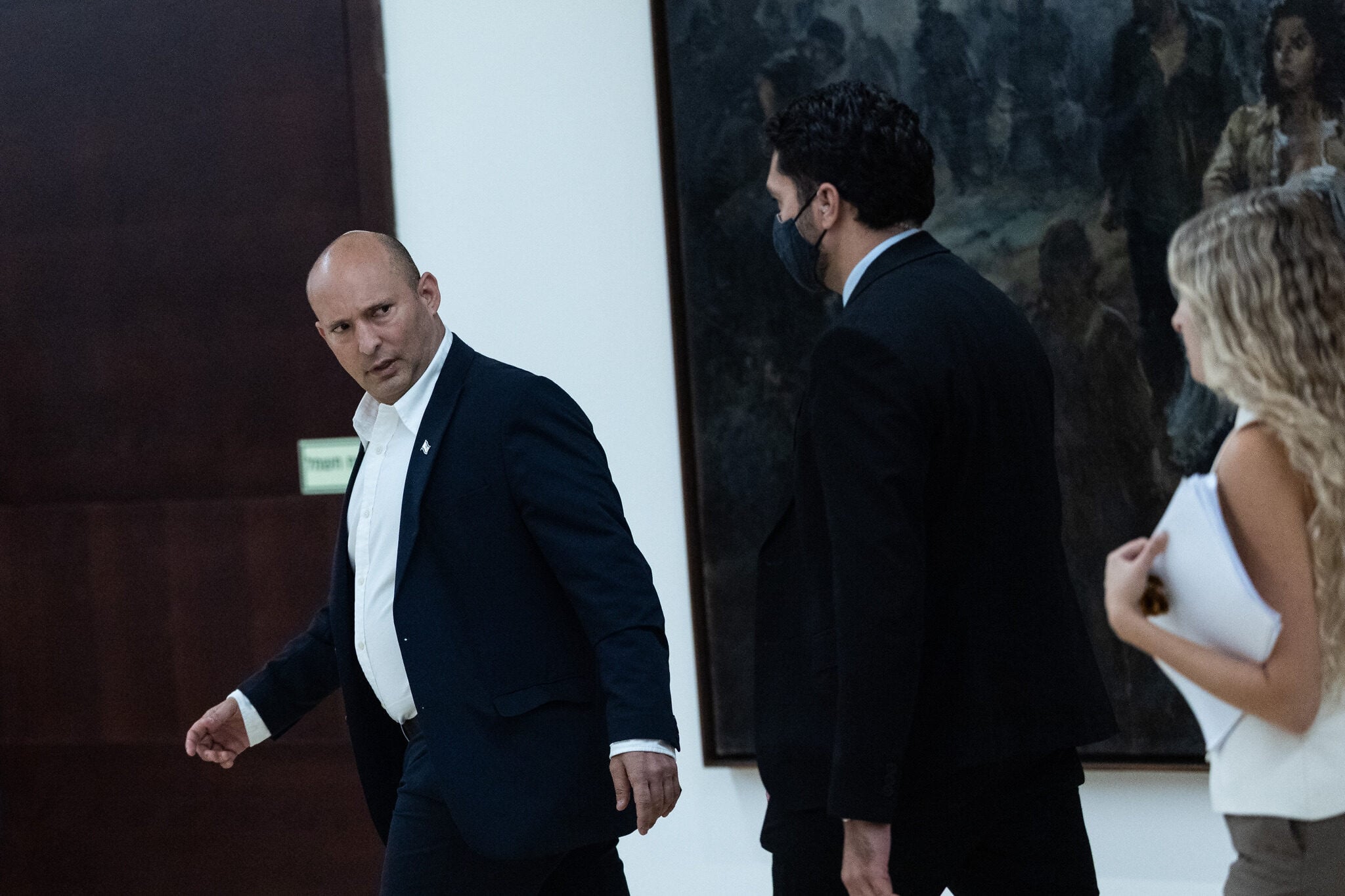
In a move that blindsided his allies, Naftali Bennett met for over two hours with Prime Minister Benjamin Netanyahu at the Knesset on Wednesday, raising fears of a major political defection in the midst of sensitive coalition talks.
Netanyahu’s and Bennett’s parties claimed the meeting was a security briefing. But sources in the anti-Netanyahu camp led by Gadi Eisenkot — in which Bennett is seen as a key partner — portrayed it as a betrayal, because Bennett reportedly did not inform Eisenkot of the meeting in advance.
One source called it a “strategic terror attack,” according to the Ynet news outlet, and another accused Netanyahu of using Bennett to try to scuttle a potential coalition of the parties that aim to unseat him. Bennett had earlier reportedly pledged to Eisenkot that he would remain mum during coalition talks so Eisenkot could take the lead.
Sources in Bennett’s circle insisted that he has no intention of defecting to the side of the prime minister. But the very fact of the meeting, which also reportedly included lunch, was a shock given the depth of bad blood between the two men. Bennett blasted Netanyahu throughout the campaign and called him unfit for office, including repeatedly accusing Netanyahu’s aides of treason.
The two were seen entering Netanyahu’s office in the Knesset building for what Ynet reported was their first meeting in over five years, since a curt handover in 2021, when Bennett broke a years-long partnership with Netanyahu to helm a coalition that briefly unseated the longtime premier. Since then, Netanyahu and his allies have tried to torch Bennett, calling him a fraud and a grifter.
But the meeting may have indicated that Bennett’s political calculus is changing again. He is reported to prefer forming a unity government with Netanyahu’s Likud over alternatives that would see the Eisenkot-led bloc partner with Arab parties.
Bennett and his B’Yachad party’s No. 2, Yair Lapid, subsequently met with fellow leaders of the Eisenkot-led bloc, a meeting that was postponed due to Bennett’s talks with Netanyahu. After the meeting, those leaders — including the Democrats’ Yair Golan and Yisrael Beytenu’s Avigdor Liberman — reaffirmed that forming a national government and replacing Netanyahu were top priorities, according to a joint statement.
“All party leaders agree that their highest priority is to form a national emergency government led by Gadi Eisenkot and to replace Benjamin Netanyahu as prime minister as soon as possible,” the statement said, referring to the parties as standing for “change and reform.”
The leaders said they also discussed “the genuine emergency Israel is facing — in security, social and international affairs — and the sensitivity of the coming days.”
They added that “the parties will continue working together, in coordination and at speed, toward this goal. This is what the moment demands.”
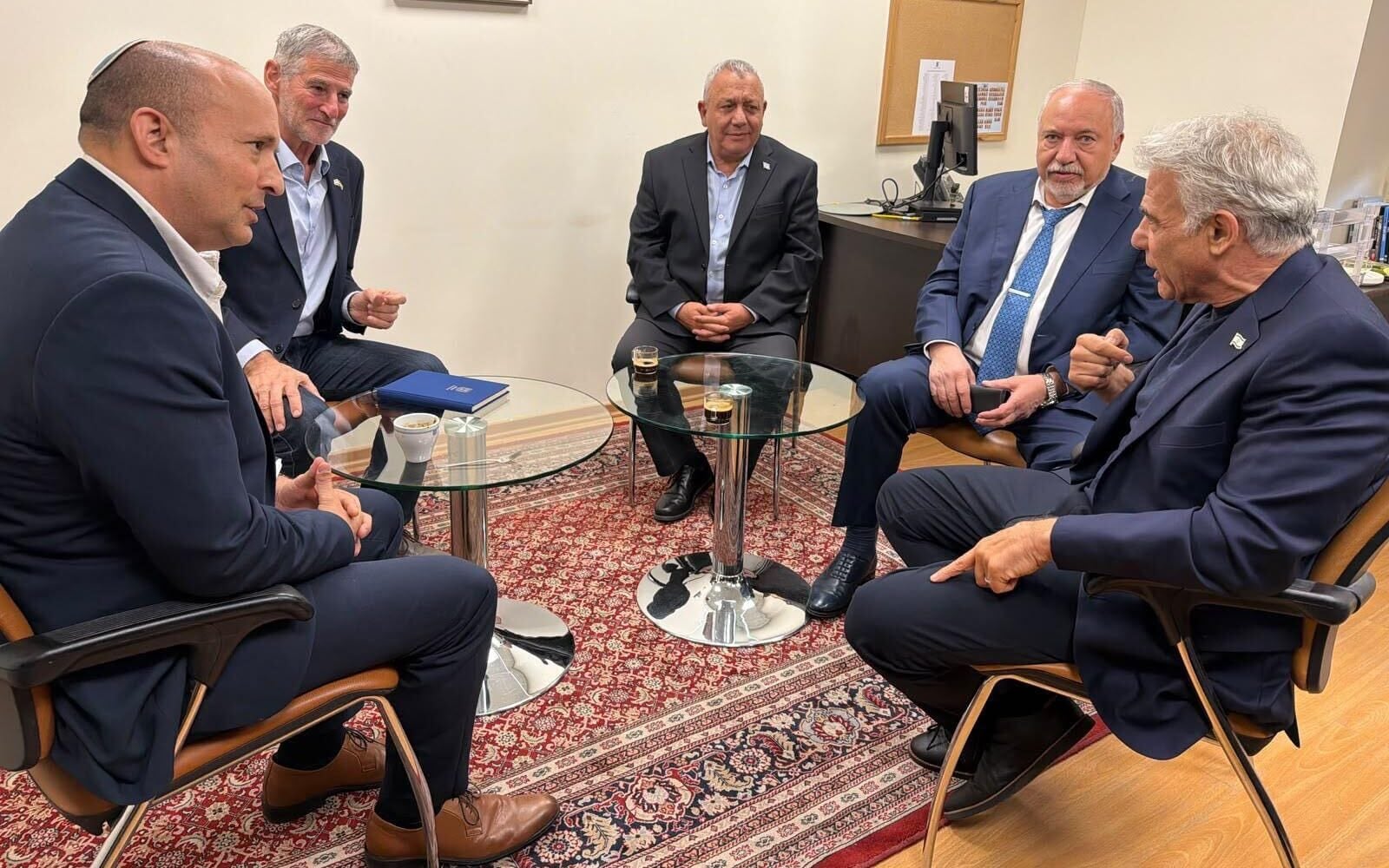
But that opposition meeting also showed signs of tension, as Yair Golan, chair of the left-wing Democrats, reportedly refused to answer when asked whether he trusts Bennett. Golan told reporters afterwards that “we all understand the magnitude of the moment and need to form a government.”
Eisenkot was also seen in the Knesset corridors in a tête-à-tête with Lapid.
Both Bennett’s and Netanyahu’s circles said the meeting concerned security. National Security Council Chief Shmuel Ben Ezra also attended the meeting, according to reports. The group was later joined by the prime minister’s military secretary, Maj. Gen. Guy Markizeno. However, Channel 12 reported that for half an hour of the meeting, Netanyahu and Bennett were alone.
According to Ynet, protocol required that as soon as Markizeno was in the room, attendees at the meeting were barred from discussing political matters.
Bennett-allied sources quoted by Hebrew media outlets described the meeting as a security update and said Bennett wouldn’t serve in a government helmed by Netanyahu. They added that Bennett told Eisenkot he’ll only back a unity government with Netanyahu if Eisenkot serves as prime minister first.
But the sources also hinted that Bennett was taking coalition negotiations into his own hands.
“Bennett isn’t ruling out other scenarios,” they said. “Bennett is acting to bring about a good Zionist government. His moves are keeping all options open, unlike others who are only reducing them.”
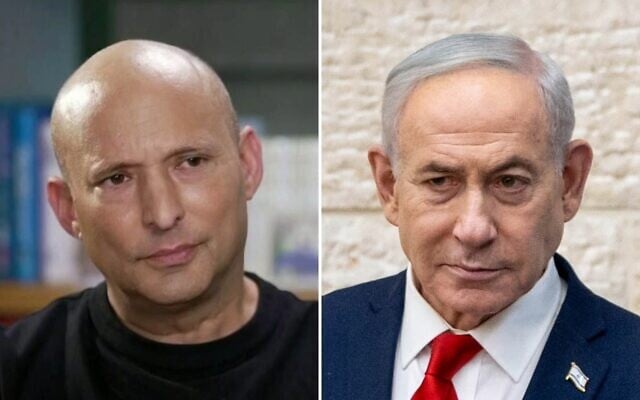
The Kan public broadcaster reported that Bennett told faction members on Tuesday that action must be taken “for unity. A Zionist government is the best option. [A repeat] election would be terrible for the country.”
Sources told the outlet that, nonetheless, Bennett is unlikely to agree to a unity government in which Netanyahu gets first turn as prime minister.
(The clip below shows Bennett entering Netanyahu’s Knesset office, and the photo below shows Lapid and Eisenkot conferring.)
בנט לא עדכן את אייזנקוט ….. אפילו לא את לפיד? pic.twitter.com/Cy3HHw9O12
— yafa Azulay (@YphZwl) November 18, 2026
Likud officials are also signaling that they could work with Bennett instead of Eisenkot. Earlier Wednesday, Communications Minister Shlomo Karhi told Kan that the party also prefers not to have another election, which would occur if neither Eisenkot nor Netanyahu can form a government. He indicated that Likud is prepared to sidestep Eisenkot and reach an agreement with either Bennett or the head of the Yisrael Beytenu party, Avigdor Liberman.
“Eisenkot is not the only one in the other bloc; there are also Bennett and Liberman,” he said. All of the leaders in the Eisenkot-led bloc had vowed to oust Netanyahu and pledged not to cooperate with him.
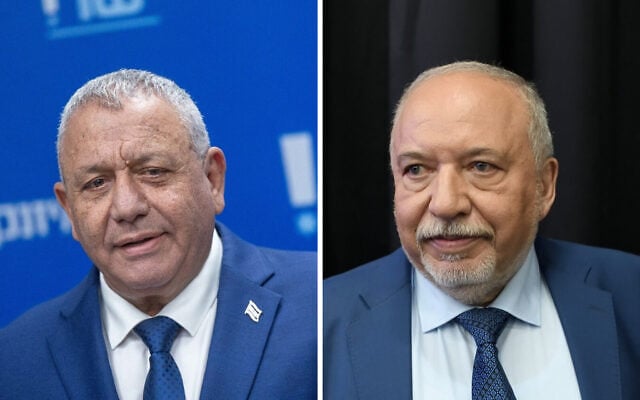
The developments came as Eisenkot is working to form a government following the inconclusive October 27 election that saw Netanyahu lose his Knesset majority to an opposition split between Jewish- and Arab-led factions.
Earlier this month, Eisenkot was tapped to have the first shot at forming a government, but most of his bloc, which controls 48 of the Knesset’s 120 seats, opposes partnering with the Arab-led parties’ 19 lawmakers. Eisenkot is also exploring partnering with ultra-Orthodox parties, longtime allies of Netanyahu, or finding a way to a unity government with Likud, though progress on those fronts has reportedly been halting.







The Times of Israel Community.