

Biden defends his support of Israel in presidential memoir, while urging it to ‘wake up’
In advance copy obtained by ToI, former US president recognizes that Hamas sought to increase Palestinian civilian harm during Gaza war, says Netanyahu played into terror group’s hands by not letting more aid in

 Add ToI as a Preferred Source on Google
Joe Biden passionately defended his support for Israel in his new presidential memoir, but he also warned the country that it will not enjoy such US backing if it continues rejecting Palestinian self-determination.
“I will never regret standing by Israel in the wake of October 7… and I will never agree with those who say we should stop supplying Israel with the weapons they need to defend and protect themselves,” the former US president wrote in ‘Promise Me, America,’ which was obtained by The Times of Israel ahead of its publication on Tuesday.
Biden came under significant opposition from progressives in his own party as he continued providing military and diplomatic assistance to Israel in the aftermath of Hamas’s October 7, 2023, attack and subsequent war in Gaza over the mounting Palestinian death toll.
The former president acknowledged that “tragedy,” while stopping short of suggesting that he would have acted differently if given the opportunity. Still, he offered a blunt message to Israelis on how they should operate moving forward.
“I hope Israel wakes up. The days of American leaders like me — passionate defenders of Israel to the core — are passing. I hope the Israelis accept the right of Palestinians to live in their own homeland,” he wrote.
“And I hope the Palestinians wake up. Walk away from Hamas. Accept Israel’s right to exist in safety and security. I pray both sides wake up to the wisdom of a two-state solution. It’s the only way Israelis and Palestinians can both have safety and security and peace,” Biden added.
(Mostly) not interfering in Bennett-Lapid government
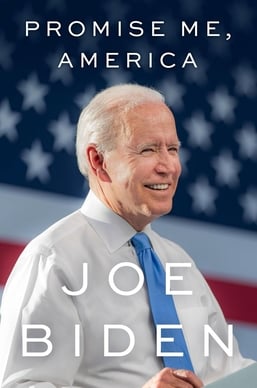
The new memoir offers Biden’s own account of his time in office from 2021 to 2025, which was significantly colored by the Gaza war. A 28-page chapter in the roughly 400-page book is dedicated to his Israel policy in the lead-up to the October 7 attack and its aftermath.
Several months after Biden entered office in Washington, Naftali Bennett and Yair Lapid banded together to form a new government in Jerusalem that removed Benjamin Netanyahu from power.
The coalition spanned the political spectrum and included an independent Arab party for the first time.
“The alliance was a fragile one, and I did not want to interfere in their difficult politics,” Biden wrote.
Indeed, Biden shelved plans to reopen the US consulate in Jerusalem to serve Palestinians amid pushback from the Israeli government, which argued that such a step would expose it to criticism from the Netanyahu-led opposition. The so-called “change government” also ended up approving more construction plans for West Bank settlements than previous Netanyahu governments.
Nonetheless, that government collapsed after just a year, with Lapid serving as caretaker prime minister for several months before the 2022 election that saw Netanyahu return to power.

During that time, Biden visited Israel and successfully pressed Lapid to publicly reiterate his support for a two-state solution.
Biden wrote that he built on that “important moment” by traveling to the West Bank, where he successfully urged a similarly reluctant Palestinian Authority President Mahmoud Abbas to get behind Washington’s efforts to broker a normalization deal between Israel and Saudi Arabia.
“I promised (Abbas) that we would not leave the Palestinians behind in a deal, and that they would have a seat at the table. He said he would support the process, and he asked me to convey that to the crown prince later that night. Another huge step forward,” the former US president wrote.
Biden then traveled directly to Saudi Arabia, thanks to an agreement his administration brokered with Riyadh for the latter to open its skies to flights from Israel. The president carried with him a letter from Lapid to Saudi Crown Prince Mohammed bin Salman in which the former expressed his desire for a peace deal with the Gulf kingdom that included a Palestinian-related component.
“The crown prince also told me he was ready to move toward ties with Israel, together with a series of bilateral agreements that my team would put together over the coming months, including on defense relations, civil nuclear cooperation and technology. We also discussed the need for an important role for the Palestinians in the deal,” Biden recalled.

‘Weeks away’ from peace
But by the end of 2022, Netanyahu was again prime minister, leading what has been widely regarded as the most right-wing government in Israel’s history.
Netanyahu campaigned on making no accommodations toward the Palestinians, with his government proceeding to issue record numbers of settlement tenders, while also withholding billions of dollars of tax revenues from Ramallah, which has brought the PA to the brink of collapse.
Still, Biden believed the possibility for an Israel-Saudi deal was real, thanks to a September 2023 agreement to establish the India–Middle East–Europe Economic Corridor (IMEC), which would include Israel along with its Middle East neighbors on a new trade route that boxed out China.
Biden claimed that “historic progress (toward Israeli-Palestinian peace) may have been only weeks away” until Hamas’s October 7 attack “shattered” such optimism.
“Even in the earliest minutes, I had a feeling that his response would be overwhelming — to compensate for what was close to dereliction of duty on (Netanyahu’s) part,” he wrote.
Biden acknowledged that he had long had a difficult relationship with Netanyahu, recalling an interaction during a previous visit to Israel when the issue of Israeli settlements in the West Bank was raised.

“Netanyahu rose from the table and walked to the window. ‘Come with me, I want to show you something.’ He wanted me to stand with him at the window so he could show me how close the settlements were to Jerusalem. I refused to stand up, and the tension in the room became palpable,” Biden wrote.
When Netanyahu tried again, Biden replied, “‘Bibi, sit down. I’ve been to the window, I’ve heard the stories. You have to do what’s right, and what’s right for Israel is to get back to the peace process and a two-state solution.'”
Biden wrote that Netanyahu has “Trump-like tendencies,” which include “play[ing] fast and loose with the truth, and think[ing] nothing of bending democratic institutions to serve his personal needs.” The former president took particular issue with the Netanyahu government’s effort to overhaul the judiciary, arguing that it “would further encourage corruption and harm Israel’s international standing… [and] encourage more settlers to occupy land in the West Bank, making a peace agreement impossible.”
Still, he said he respected the democratic process, which returned Netanyahu to the Prime Minister’s Office, and that he sought to work with the longtime Likud leader after Hamas’s October 7 attack.

Understanding Israel’s ‘anguish and rage’
Biden recalled a usually confident Netanyahu in shock in the days after the attack, writing that he was moments away from using faulty intelligence to authorize a massive offensive against the Hezbollah terror group in Lebanon that would have sparked a broader regional war.
“He took my advice and turned his planes around in midair. It was the right call, at a precarious moment,” the former president wrote.
Biden described the atrocities of the October 7 attack in great detail and shared how moved he was upon speaking to the relatives of the American citizens who were killed or taken hostage.
Less than two weeks after the attack, Biden decided to head back to the region in order to provide assurance to Israelis and counsel them through their response.
He hoped to also travel to Amman for meetings with the leaders of Jordan, the Palestinian Authority and Egypt to discuss the humanitarian response for Gazans.
But Egypt refused to open its border to Palestinians, fearing it would be complicit in the forced displacement of Palestinians, and the Amman visit was scrapped after a strike on a hospital in Gaza that was wrongly blamed on Israel provoked international outrage.

“What’s tragic about missing the Amman stop (because of the disinformation about the hospital) is that it was intended to find ways to avert the humanitarian crisis to come,” Biden wrote.
While he repeatedly knocked Israel for failing to take more care to prevent civilian harm, Biden admitted that it was easier said than done.
“I wished I could say there was an easy answer, or a way to fight Hamas with precision and special forces alone. Unfortunately, Hamas had built tunnels stretching multiple stories below ground and running longer than the Manhattan subway system. The entrances were in residences, schools, and hospitals. To find them, Israel had to move in on the ground, facing ambushes and booby traps and snipers,” he wrote.
Biden said struggled to break through the “anguish and rage” when counseling Israel’s leaders after October 7.
He managed to convince Netanyahu to begin allowing some aid into Gaza after his visit to Israel, but what came in did not end up being sufficient.
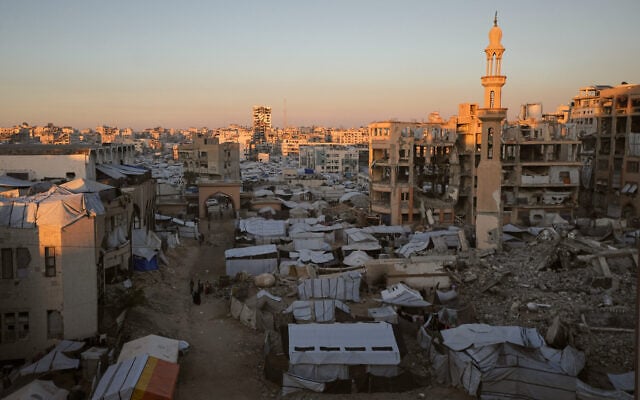
“The ensuing death, destruction, and deprivation for the people of Gaza have brought worldwide condemnation. We saw heartbreaking images of dead children, of a people surrounded by rubble, desperate for food and water and medicine. Hamas had spent decades embedding themselves in hospitals and schools and neighborhoods, making it impossible to go after them without also killing civilians. And that is what happened,” Biden wrote.
In a passage leaked last week to CNN, Biden vented that Netanyahu repeatedly made empty promises to mitigate civilian harm in Gaza.
Campus protesters ‘glibly threatened’ to displace Jews
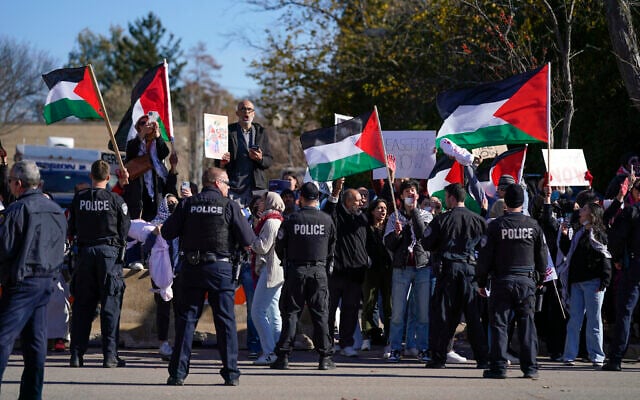
As the death toll in Gaza mounted, so did the pushback Biden received from progressives, particularly university students.
“On campuses, especially, there was a growing school of thought that Israel was a racist ‘occupier’ of Palestinian lands, in the worst traditions of the old European empires, oppressing an indigenous people,” Biden wrote, hitting back at some of his most vocal critics on the US left.
“These protests often conflated very different historical circumstances. But there was also an edge to them — many of the marchers seemed to believe that they could wish Israel out of existence, simply by chanting slogans about a Palestine that stretched ‘from the river to the sea.’ That slogan was more than a little provocative, as it glibly threatened to displace a people who had been displaced so many times in their history,” Biden argued.
“I was from a different generation than the protesters, of course. For me, Israel had always symbolized something profoundly important. From the ashes of the Holocaust, Jews had gathered together from around the world to build a new and democratic society, based on an extraordinary resilience,” he continued. “Now, Israel possessed overwhelming superiority, in a military sense. But it also risked squandering its moral high ground, as the victim of October 7, if too many civilians were killed in retaliation,” Biden added.
He insisted that he tried to restrain Israel and worked until his final hours in office to broker a ceasefire that would end the war and free the hostages. He secured such a truce in November 2023, though, it fell apart after a week.
Biden also addressed his decision in May 2024 to withhold a shipment of 2,000-pound bombs to Israel.
“The outcry was swift, from both Israel’s defenders and those who were critical of all we were doing to support Israel in other ways,” he wrote. “There was very little middle ground at a time when the conflict was creating difficult political fault lines in the United States and around the world.”
“But this decision, so indicative of the pressures of the presidency, was in keeping with my belief that complex and heart-wrenching challenges often require nuanced — and, to many, unsatisfactory — solutions,” Biden argued.
‘Israel went too far’
It took another six months to broker a ceasefire.
“Was it good enough? No. I wish we could have gotten there sooner, with less suffering along the way. Israel went too far. Yes, there was a fundamental difference. Hamas deliberately targeted innocents while Israel targeted Hamas. But Israel’s plans and attacks weren’t precise enough or careful enough,” Biden asserted.
Still, he noted that more aid entered Gaza while he was in office than in the immediate period that followed under his successor Donald Trump, when Israel imposed a full siege on the Strip by blocking all humanitarian assistance from entering for 78 days.

A ceasefire and hostage release deal commenced during Biden’s final days in office, thanks to unprecedented cooperation between his and Trump’s top advisers, who, together with Middle Eastern mediators, managed to squeeze key concessions from both sides.
But that truce fell apart in February 2025, with intensive fighting resuming in the Strip.
“Ultimately, it would require several months for the Trump administration to rebuild an agreement that was fundamentally the same as the one that was in place when I left office,” Biden said, referring to the October 2025 ceasefire deal that secured the release of all remaining hostages held by Palestinian terror groups.
That agreement has largely held, but provisions envisioning the reconstruction of Gaza and the handover of Hamas’s weapons have stalled.







The Times of Israel Community.