

Fabulous 1,400-year-old trove of gold coins sheds light on Galilee Christian city’s demise
Metal detector beeps lead archaeologists to nearly 100 coins and jewelry hidden during the 7th-century Sassanid invasion at Hippos (Sussita), including an unusual mix of denominations
 Add ToI as a Preferred Source on Google
Rossella Tercatin is The Times of Israel's archaeology and religions reporter.
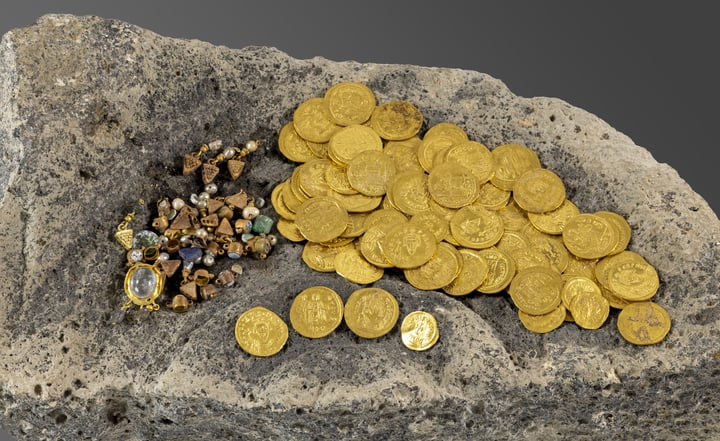
Nearly 100 pure gold coins and dozens of jewelry fragments have been unearthed in an excavation at the ancient city of Hippos, east of the Sea of Galilee, the University of Haifa announced Thursday.
The trove sheds new light on life in the city during the final years of the Christian Byzantine era (early 7th century CE), as the Sassanid (Sasanian) Empire swept into the Land of Israel in 614 CE, just a few years before the Islamic conquest would permanently reshape the region, according to Haifa University’s Dr. Michael Eisenberg.
Likely stashed by a wealthy resident — perhaps a goldsmith — as the Sasanids advanced on the city, the treasure lay undisturbed for some 1,400 years before being uncovered by pure chance.
Eisenberg’s team made the discovery in a section that had been excavated about six years earlier, but was not the focus of the current dig.
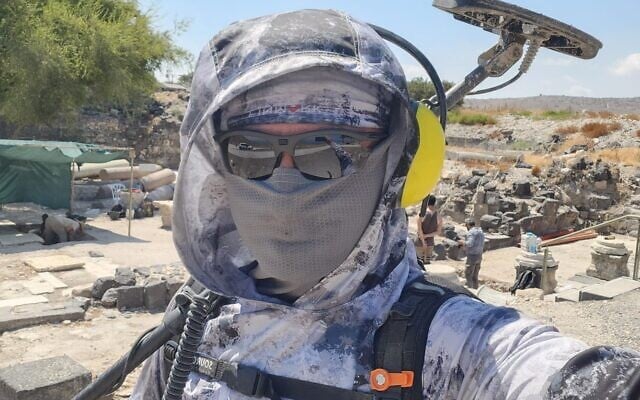
“Edie Lipsman [a metal detector operator with the expedition] was walking between excavation areas during our July season,” Eisenberg recounted. “He accidentally struck a stone, and the detector suddenly began to beep.”
The stone lay between two basalt walls in a burnt layer that had recently collapsed due to winter rains.
“The device went crazy,” Lipsman said in a statement from the university. “I couldn’t believe it — gold coins started appearing one after another.”
“He’s the only member of our expedition to have found gold,” Eisenberg noted (Lipsman also recently uncovered two Roman-era gold rings). “It seems the goddess of fortune smiles on him.”
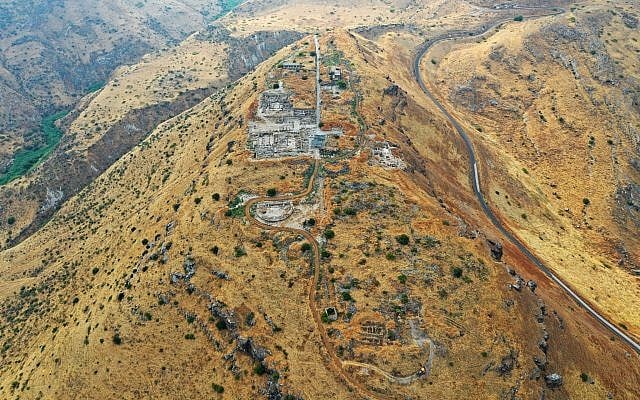
Antiochia Hippos (Sussita in Aramaic) is located around 2 kilometers (1.2 miles) east of the shores of the Sea of Galilee, at a height of about 350 meters (1,148 feet).
It was founded by the Greek Seleucids on the eastern shore of the Sea of Galilee in the 2nd century BCE. During the Byzantine period (330 CE-636 CE), Hippos became the seat of a bishop and an important Christian town. It endured even after the Arab conquest in the 7th century, until a devastating earthquake in 749 CE leveled the city, which was then permanently abandoned.
Archaeologists have uncovered the remains of seven churches built between the 5th and the early 6th centuries CE, all of which were still active for the following century.
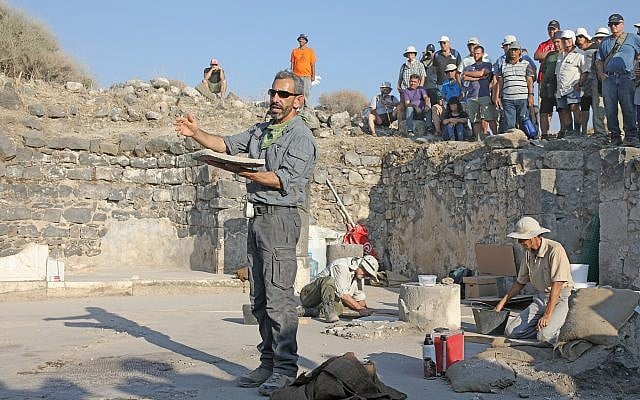
Eisenberg, who co-directs the expedition, has been digging at Hippos for 26 years.
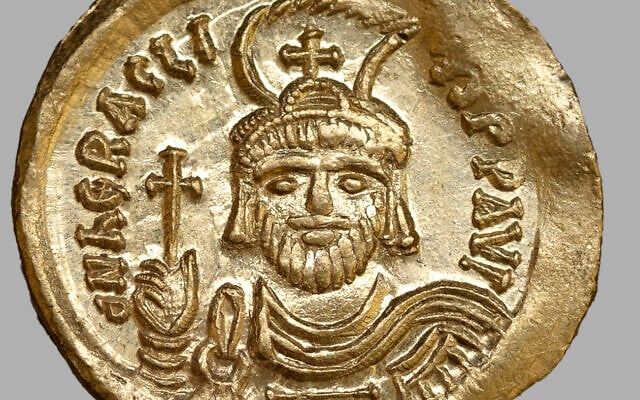
“This is a purely Byzantine hoard,” Eisenberg said. “With coin hoards, we can usually date them with considerable precision. This one spans roughly a century, beginning with Emperor Justin I [518–527 CE] and ending in the early reign of Emperor Heraclius [610–613 CE] — an ideal timeframe that helps explain why it was hidden in the first place.”
Eisenberg noted that similar hoards of the same era — both gold and bronze — that have been uncovered throughout the region are classified as “emergency hoards.”
“During this period, the Persian-Sassanian army was sweeping through Syria and advancing south, toward the vicinity of Hippos,” he explained. “Soon after, they would go on to conquer the Land of Israel.”
“Someone likely saw the enemy approaching, gathered the family’s wealth and hid it, hoping to retrieve it once the danger passed,” Eisenberg said. “We believe they chose an abandoned spot that had already fallen into disuse. Of course, they never returned.”
According to the researchers, the hoard was hidden inside a small cloth bag, as there were some fabric residuals on the coins.
Eisenberg said the hoard was most likely the property of a private family rather than a church or other public institution, pointing to the presence of jewelry — dozens of gold earring fragments set with semi-precious stones and glass — as key evidence.
“They’re eclectic,” he explained. “They look similar, but none are identical. Our initial assumption is that the hoard may have belonged to a jeweler.”
An inscription dated to 556 CE in Hippos’s Church of the Martyrion of Theodoron even mentions a goldsmith as a donor.
“Offering of the priest Symeonios, goldsmith, custodian (?). He (sc. the Lord God) will protect him and his children and his wife,” reads the inscription, as translated in a recent academic paper by Eisenberg, his excavation co-director at Hippos, Dr. Arleta Kowalewska from the University of Haifa, and Prof. Gregor Staab from the Universität zu Köln in Germany.
“Thanks to this inscription, we know that jewelers lived in the city,” Eisenberg said. “We don’t yet have additional evidence to confirm this theory, but the research is still in its early stages.”
According to the archaeologist, one of the hoard’s unique features is its mix of denominations: while some coins are solidi — full-value coins weighing 4.45 grams — others are semisses, worth half a solidus, or tremisses, a third of a solidus. The latter have been rarely found in the land of Israel.
In addition, the hoard contains a coin that is only the second of its kind found in Israel.
“It dates to 610 CE and was minted at a military mint, which were sometimes portable — likely in Cyprus,” Eisenberg explained.
An empire in turmoil
The artifact sheds light on another turbulent chapter in Byzantine history.
As the empire struggled on multiple fronts — including against the Sassanid Empire — Byzantine general Heraclius and his son staged a revolt against the reigning emperor, Phocas.
“They conquered vast territories around the Mediterranean, and as they marched toward Constantinople, they minted their own coins,” Eisenberg said. “This makes these coins very rare.”
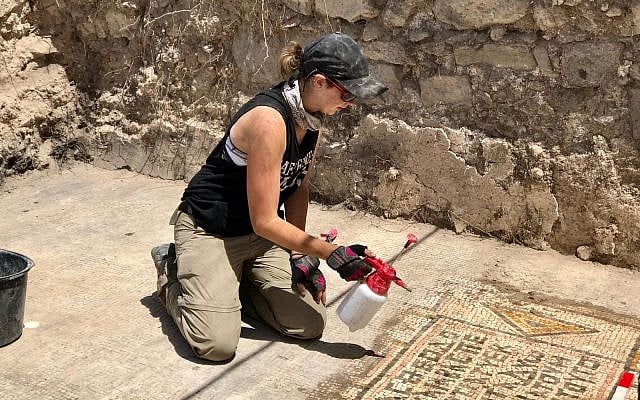
The hoard also challenges some previous assumptions about life in Hippos during the late Byzantine period.
“As we excavated the site, we noticed that architectural remains from the late 6th and early 7th centuries were less grand than those from the Roman and early Byzantine periods,” Eisenberg explained. “We had assumed this reflected a decline in wealth and a simpler lifestyle. Yet this hoard indicates that at least some affluent residents lived in Hippos, suggesting the city was prosperous enough to support them — otherwise they would likely have left.”
“One hoard is not going to change my mind, but the research is just at the beginning, and it could pave the way for rethinking the extent of decline in Hippos at the end of the Byzantine period,” he said.
Questions also remain about the events of the Sassanid conquest.
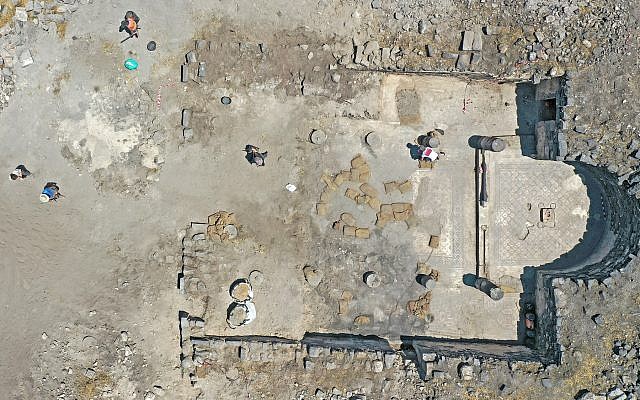
Scholars agree that the Sassanid army invaded the Galilee, the Jordan Valley and Jerusalem in 614 CE. However, the extent of the destruction and the ferocity of the conquerors remain subjects of debate. In Hippos, archaeologists uncovered evidence suggesting that the Church of the Martyrion of Theodoros was destroyed during the invasion, having been burned to the ground (and for this reason, dubbed it the “Burnt Church”).
“It’s possible that the church wasn’t burned by the Sassanids themselves, but rather by Jews coming from Tiberia,” Eisenberg noted. “Some historical sources indicate that Jews from Tiberias joined the Sassanids against the Byzantines, led by a man named Byniamin commanding an army of 20,000.”
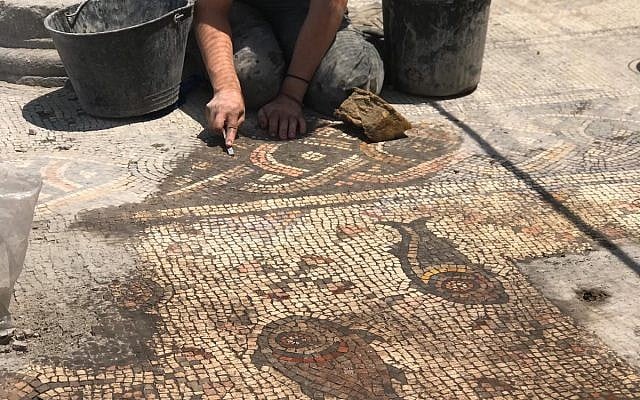
Although the Byzantines briefly reclaimed Hippos from the Sassanid Empire about 15 years later, the city fell again in 636, when the Rashidun Caliphate conquered the Land of Israel.
The new rulers stripped Hippos of its administrative status, transferring it to Tiberias, which became the region’s capital.
Hippos likely persisted as a Christian settlement but gradually declined, until the earthquake of 749 delivered the final blow.
“While stronger settlements were rebuilt after the earthquake, weaker ones were abandoned,” Eisenberg said. “For Hippos, the earthquake was the last straw.”










The Times of Israel Community.