

Likud slams Olmert for meeting with ‘real obstacle to peace’ Abbas
Members of Netanyahu’s party and coalition mock former premier, lambaste PA leader, who is said to be looking for way out of US pressure under Trump administration
 Add ToI as a Preferred Source on Google
The ruling Likud party on Saturday blasted former prime minister Ehud Olmert for meeting with Palestinian Authority President Mahmoud Abbas in Paris, calling the Palestinian leader “the true obstacle to peace.”
“Olmert, who offered the Western Wall to Abbas, is now also his loyal spokesman,” said a Likud official in a statement to the press.
“The United States and many Arab countries have already realized that Abbas is the real obstacle to peace and that the meaning of his extreme demands is not peace but the destruction of the State of Israel,” the official added.
The proposal Olmert made during talks with Abbas in 2008 did not include the Western Wall. Rather, the then-Israeli leader proposed that Jerusalem’s Old City, where the wall is located, be placed under international control.

The Friday meeting, which drew the ire of others on Israel’s right as well, saw Olmert praise Abbas as a partner for peace.
“The only person among the Palestinian people who is capable of doing it and who proved in the past that he is completely committed to do it is Dr. Mahmoud Abbas, and that’s why I have an immense respect for him,” Olmert said in English to the Palestinian Authority official television station, sitting alongside Abbas.
Olmert also called Abbas “a great political leader and the most relevant person for the future developments in the relations between Israel and Palestinians.”
The former Israeli leader, who was released from prison in July 2017 after serving 16 months behind bars for bribery, said there is no alternative to a two-state solution and stressed that he believes achieving such an outcome is still possible.
Olmert insisted that had his term not been shortened by the criminal convictions against him — offenses which he continues to deny he was guilty of — peace would have been achieved long ago.
Olmert also claimed that Abbas did not reject his proposals for peace during 2008 talks — though the PA leader has himself acknowledged doing so, at least tentatively.
“I am sure that as President Abbas said, had I been able to continue my tenure in office for three [to] four more months, then there would have been peace for years now between Israel and the Palestinians,” Olmert said in the interview.
The former premier said Abbas “doesn’t reject continuing within that framework which we discussed at the time.”
A source close to the former prime minister told Channel 10 Saturday that Olmert’s “impression was that Abbas was looking for a way out of the situation he faces with the US.”
Earlier this month, the US announced it will cut all aid to programs that bring together Palestinians and Israelis, in a move that will bring to an end all American funding of Palestinian civilians.
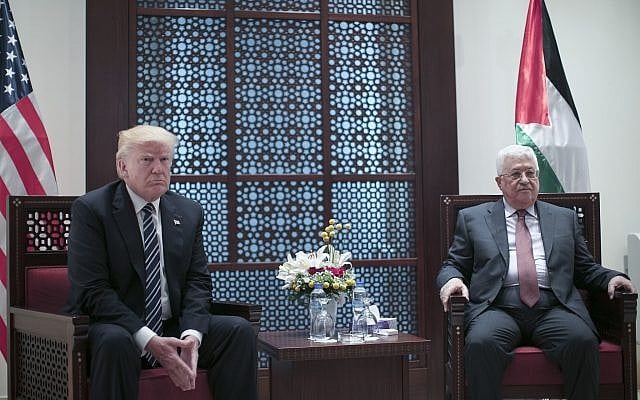
This came days after the Trump administration announced it would halt $25 million in aid to East Jerusalem hospitals, saying that money would go to other regional “priorities.”
The cuts came amid a wave of the US slashing financial support for Palestinians, including to the Palestinian Authority itself and the UN agency for Palestinian refugees.
Washington has defended the measures as a response to a Palestinian Authority leadership that it claims has rejected its peace push before ever having seen its plan.
The Palestinians, however, argue that since the Trump administration’s decision to recognize Jerusalem as Israel’s capital, the US has forgone its role as an “honest broker.”
Abbas and the PA have for months boycotted the White House, which has in turn has shuttered the PLO’s mission in Washington.
Nonetheless, the source close to Olmert told Channel 10 that Abbas told the former Israeli prime minister “he was willing to renew the peace talks with an Israeli partner who was willing to do so. The source also said that Abbas suggested that such talks take off where his negotiations with Olmert left off in 2008.
‘Flagrant violation of Israeli democracy’
The Friday Paris meeting between Olmert and Abbas drew criticism from Likud lawmakers including Gilad Erdan, Yuval Steinitz, and Anat Berko, who each released statements mocking Olmert and condemning Abbas.
Kulanu lawmaker Michael Oren called the sit-down a “flagrant violation of Israeli democracy” and called for legislation banning future such meetings from taking place.
“Ehud Olmert’s meeting with Abbas would have been considered a federal crime in the United States for which he would have been sentenced to at least 10 years in prison,” Oren claimed.
“The basis of the threat comes from the ‘Logan Act,’ which prohibits American citizens from meeting with foreign leaders – let alone the leaders of hostile states, without the approval of the elected political echelon,” Oren said, using as an example that the Trump administration was “threatening to prosecute former secretary of state John Kerry for meeting with Iranian Foreign Minister Mohammad Zarif without authorization.”
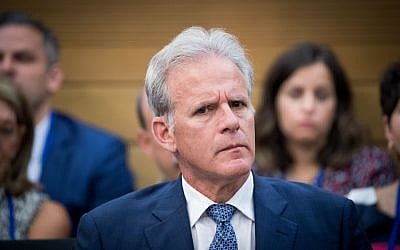
Oren was referring to Kerry’s meeting with Iranian officials in which he was accused of advising them to “wait out” the Trump administration. The former secretary rejected the allegations from senior US officials, including the president himself who called Kerry’s actions “illegal.”
The Logan Act criminalizes negotiations by unauthorized parties with foreign governments, not meetings such as the ones Kerry held with Zarif or Olmert with Abbas.
Earlier this month, the deputy head of the Likud party’s Youth Movement was ousted after he attended a meeting with Abbas in Ramallah that was organized by the Peace Now settlement watchdog.
In a statement explaining the move, Youth Movement Chairman David Shayan said that Yoel Nagar attended the meeting on his own accord. Shayan called Abbas an anti-Semite and a Holocaust denier and said that anyone with a position in the faction’s youth movement cannot meet with such a person.
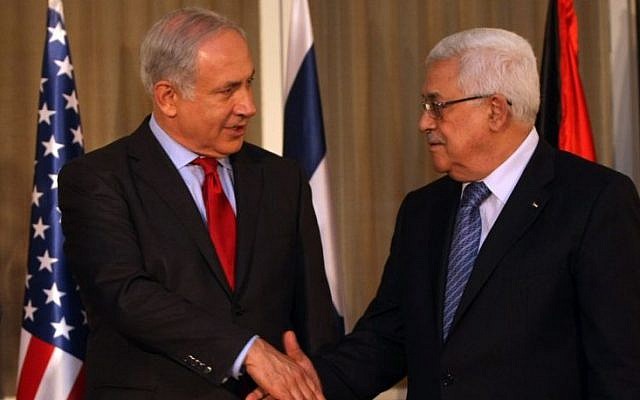
Netanyahu, for his part, has met with the PA leader on several occasions, including at the 2016 funeral of former statesman Shimon Peres.
However, the two have not met for substantive talks since 2010, and regional peace efforts have continued to falter since a US-led initiative collapsed in April 2014.
Nonetheless, Netanyahu has on numerous occasions expressed his willingness to sit down with the PA leader. Each has claimed that the other is to blame for the fact that no such meeting has taken place.
Since US President Donald Trump recognized Jerusalem as Israel’s capital and initiated the relocation of the US Embassy in the Jewish state to the city, Abbas has said on multiple occasions the Palestinians will no longer cooperate with a US-led peace process.
Israel has said that it will only work with a push for peace under the auspices of the US.
Adam Rasgon contributed to this report.







The Times of Israel Community.