Three scientists have won the Nobel Prize in chemistry for developing the world’s smallest machines, work that could revolutionize computer technology and lead to a new type of battery.
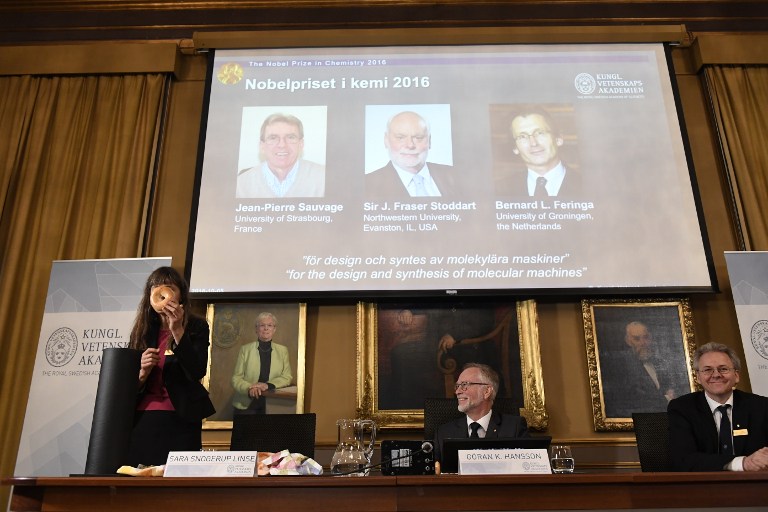
Frenchman Jean-Pierre Sauvage, British-born Fraser Stoddart and Dutch scientist Bernard “Ben” Feringa share the 8 million kronor ($930,000) prize for the “design and synthesis of molecular machines,” the Royal Swedish Academy of Sciences says.
Machines at the molecular level are 1,000th the width of a human hair and have taken chemistry to a new dimension, the academy said. Molecular machines “will most likely be used in the development of things such as new materials, sensors and energy storage systems.”
Professor of Physical Chemistry and Chairman of the Nobel Committee for Chemistry, Sara Snogerup Linse, left, uses a bagel to visualize her explanations during a press conference at the Royal Swedish Academy of Sciences in Stockholm on October 5, 2016. The winners of the 2016 Nobel Chemistry Prize, pictured behind her, are Jean-Pierre Sauvage, J Fraser Stoddart and Bernard L Feringa. (AFP / JONATHAN NACKSTRAND)
The academy said the laureates’ work has also inspired other researchers to build increasingly advanced molecular machinery, including “a robot that can grasp and connect amino acids” in 2013. Researchers are also hoping to develop a new kind of battery using this technology.
Sauvage, 71, is professor emeritus at the University of Strasbourg and director of research emeritus at France’s National Center for Scientific Research.
Speaking to French TV channel itele, Sauvage calls it a memorable moment and a big surprise.
Stoddart, 74, is a chemistry professor at Northwestern University in Evanston, Illinois. His daughter Alison says he was “absolutely ecstatic” at the honor.
Feringa, 65, is a professor of organic chemistry at the University of Groningen, the Netherlands.
“I don’t know what to say, I’m a bit shocked,” Feringa tells reporters in Stockholm by telephone. “I’m so honored and I’m also emotional about it.”
— AP
Help us report truthfully on social media
As a multimedia journalist, my job is to take the quality, fact-based journalism produced by The Times of Israel newsroom and make it accessible across every platform — from Instagram posts to podcasts to short-form videos.
This is how many, especially young people, consume news these days. But misinformation is rampant on social media. Our team at ToI produces accurate, responsible short-form reporting on Israel and the Jewish world.
If you believe in the importance of factual social media journalism, please consider joining our reader support group, The Times of Israel Community. Your financial support is essential to sustain responsible multimedia reporting.
We’re really pleased that you’ve read X Times of Israel articles in the past month.
That’s why we started the Times of Israel - to provide discerning readers like you with must-read coverage of Israel and the Jewish world.
So now we have a request. Unlike other news outlets, we haven’t put up a paywall. But as the journalism we do is costly, we invite readers for whom The Times of Israel has become important to help support our work by joining The Times of Israel Community.
For as little as $6 a month you can help support our quality journalism while enjoying The Times of Israel AD-FREE, as well as accessing exclusive content available only to Times of Israel Community members.
Thank you, David Horovitz, Founding Editor of The Times of Israel


 From the Liveblog of
Wednesday, October 5, 2016
From the Liveblog of
Wednesday, October 5, 2016
 Add ToI as a Preferred Source on Google