

Midnight ‘false alarm’ sends Golan residents running to shelters
Rocket sirens sound amid intense bombardment by Assad forces of rebel-held town on Syrian side of the border
 Add ToI as a Preferred Source on Google
Judah Ari Gross is The Times of Israel's religions and Diaspora affairs correspondent.
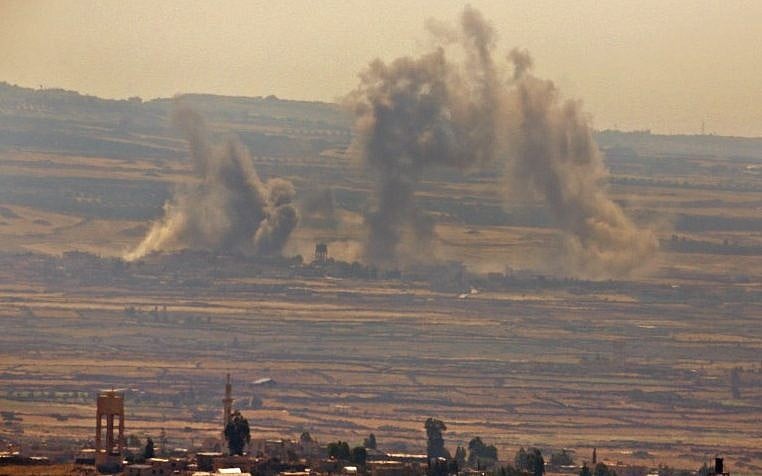
Incoming rocket sirens blared across the Israeli Golan Heights in the predawn hours of Wednesday morning, sending residents of the area scrambling to bomb shelters in what was later determined to have been a false alarm, the army said.
The military would not say what triggered the system shortly after midnight.
The warning sirens came amid a period of intense fighting between Syrian President Bashar Assad’s army and rebel forces in the Syrian village of Nawa, near the border with Israel.
The sensitive alarm system may have been triggered by the fighting there.
S. #Syria: Regime fired tonight scores of rockets at #Nawa using areas which surrendered in NW. #Daraa. https://t.co/xhSBazfQqB pic.twitter.com/ZWvvWs0Q0z
— Qalaat Al Mudiq (@QalaatAlMudiq) July 17, 2018
Earlier on Tuesday, more than a dozen civilians were killed in airstrikes in Syria’s southwest, near the Israeli Golan Heights, a war monitor said.
The regime and its Russian allies have been pounding the southwestern province of Quneitra since Sunday in a bid to retake it from rebels, after winning back most of the neighboring governorate of Daraa in less than a month.
The Syrian Observatory for Human Rights said the air strikes killed 14 civilians in Ain al-Tina village on Quneitra’s border with Daraa which had reportedly been taking shelter in a large building.
“They were all displaced from other areas. They included five children and three women,” Observatory chief Rami Abdel Rahman said.
Also on Tuesday, some 200 displaced Syrians approached the Israeli border, some of them waving white flags, in an apparent effort to reach out to the Jewish state for assistance in response to Assad’s onslaught.
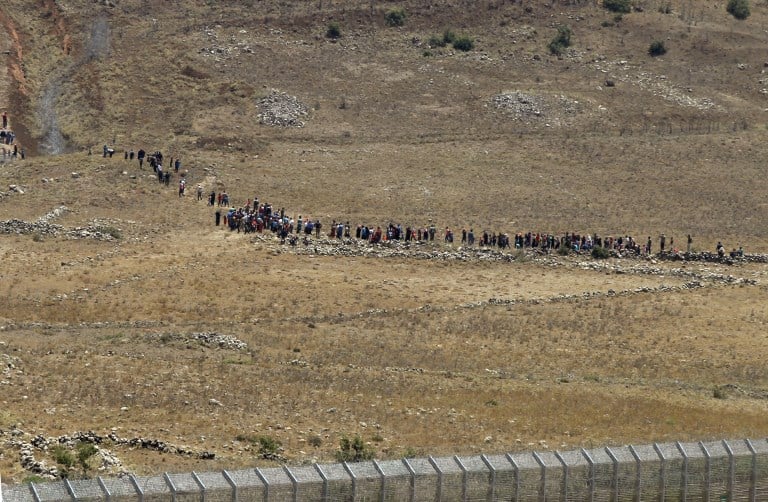
The military said that soldiers used bullhorns to tell approximately the Syrians to back away from the fence. An IDF spokesperson said that this was due to concerns that they were approaching a live minefield near the border
“Go back before something bad happens. If you want us to be able to help you, go back,” an Israeli officer told the crowd in Arabic. “Get a move on.”
The officer was also heard telling the Syrians that “we don’t want to hurt you,” according to Reuters.
After a few moments, the Syrians dispersed, the army said, and they could be seen walking back toward a displaced persons camp in the village of Bariqa, near the border.
Israeli officials have repeatedly stated that the country would not accept refugees, but it does provide humanitarian aid to those displaced by the fighting. The military detailed aspects of its Operation Good Neighbor program last year.
Since 2013, Israel has treated some 5,000 people injured in the civil war in field hospitals on the border and in public hospitals, mostly in northern Israel.
In addition, Israel also worked with international aid organizations to open a clinic along the border in 2017. Since its opening last year, the clinic has treated some 6,000 additional Syrian patients.
Israel has also insisted that the Syria abide by the 1974 Separation of Forces Agreement, which was reached following the Yom Kippur War the year before, that established a demilitarized zone along the border between the two countries. Syria is still formally at war with Israel.
Though the purpose of this demilitarized zone was to prevent further clashes between the two countries, by calling for a strict adherence to the ceasefire agreement, Israel has also established a de facto safe zone where fleeing Syrians can be spared from the Assad regime’s offensive, to a certain degree.
On Friday, Israel shot down a Syrian drone operating in this buffer zone, which Israel said amounted to a violation of the 1974 ceasefire agreement.









The Times of Israel Community.