

Morsi smiles to the military, while Iran stockpiles cash
Arab observers have little faith in the outcome of the Geneva conference on Syria
 Add ToI as a Preferred Source on Google
Elhanan Miller is the former Arab affairs reporter for The Times of Israel
The rising tension on the Syrian-Turkish border leads the news in the Arab media Monday.
“Turkey scrambles its airplanes and warns the Assad regime against crossing the border,” reads the main headline of Saudi-owned daily A-Sharq Al-Awsat. The daily reports that Ankara has created new rules of engagement with Syrian aircraft, putting its air force on alert.
In a separate article, the daily reports (based on opposition accounts) that Syrian forces are preventing bereaved families from approaching cemeteries where their loved ones are buried, turning some cemeteries into military camps.
Al-Hayat columnist George Samaan ridicules the Geneva meeting, convened over the weekend to discuss a solution to the situation in Syria.
“There was no choice but to draft a flexible agreement, vague in its phrasing but clear in spirit. It allows all participants — excluding the Syrians of course — to interpret it according to their will, their declared positions and their ties with the sides in the conflict,” writes Samaan.
‘There is no political solution in sight. Any solution outside the framework of the UN Security Council is useless unless it comes in the form of an external international coalition that will impose realities on the ground’
“Kofi Annan’s mission is no longer tied to a timetable. His mandate will not end in the middle of this month; the new plan gives him an entire year and perhaps more to end the road map and the transitional period.”
A-Sharq Al-Awsat editor-in-chief Tareq Homayed echoes these sentiments in his Monday editorial, asking, “What after Geneva?”
“The simple answer is that there is no political solution in sight. Any solution outside the framework of the UN Security Council is useless unless it comes in the form of an external international coalition that will impose realities on the ground, such as military intervention or a no-fly zone.”
Qatar-based channel Al-Jazeera shows footage of attack helicopters firing at villages in the vicinity of Damascus, and mass burials of bodies at the town of Zamalka, where a government massacre was reportedly perpetrated over the weekend. A tractor is viewed pouring earth over a mass grave where bodies are wrapped in white shrouds.
Morsi and Israel, Morsi and the army
The relationship between Morsi and his military, as well as his dealings with Israel, feature high in Arab news Monday.
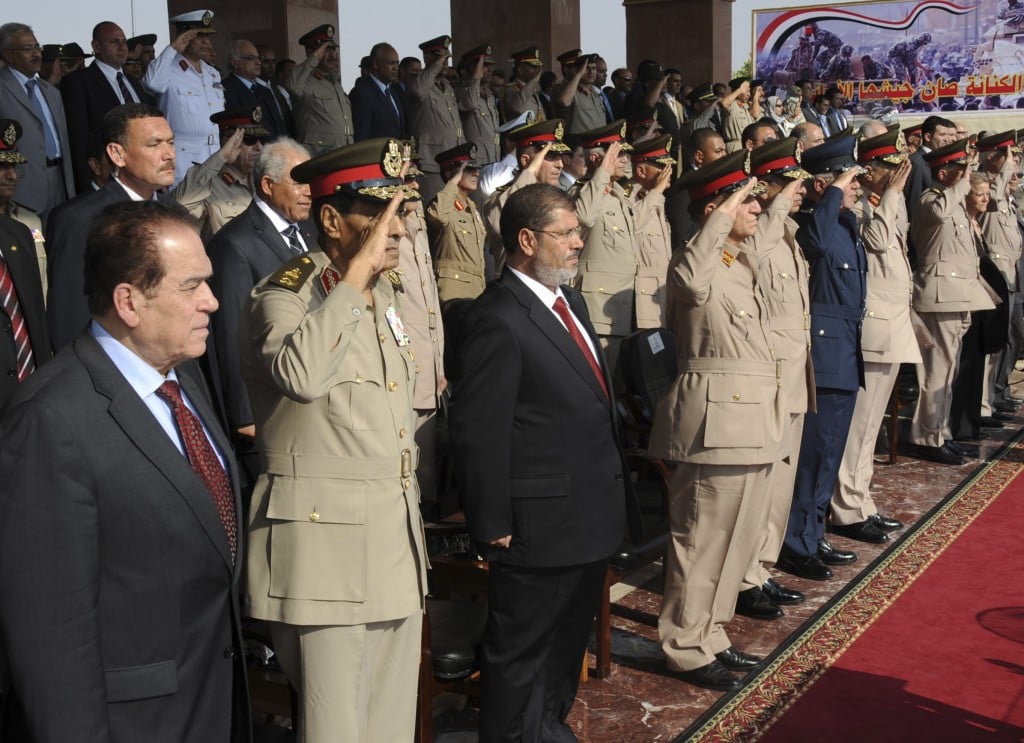
The headline of London-based daily Al-Quds Al-Arabi reads “Observers: Morsi will live with the influence of the military.” The daily notes Morsi’s public appreciation of the military for handing over power according to schedule.
“Observers believe that Morsi will not take any measure that will upset the continued hegemony of the military over the sensitive centers of state power, including the position of prosecutor-general, which — according to his office — will remain as it was, and only the military council will be able to dismiss him from office,” writes the daily.
A-Sharq Al-Awsat, strangely perhaps, dedicates its front-page Egypt coverage to the letters of congratulation sent to Morsi by Israeli Prime Minister Benjamin Netanyahu and Israeli President Shimon Peres. The daily attaches a photo of a smiling Mohammed Morsi shaking hands with a smiling Hussein Tantawi, head of Egypt’s Supreme Council of the Armed Forces (SCAF).
‘Observers believe that Morsi will not take any measure that will upset the continued hegemony of the military over the sensitive centers of state power’
Al-Quds Al-Arabi editor-in-chief Abd Al-Bari Atwan, rabidly anti-Israeli, writes in an editorial Monday that Israel has good reason to fear Morsi, who has already begun to shun the Zionist state only two days into office. According to Atwan, Morsi refused to accept a phone call from Netanyahu, despite American intercession.
“Dr. Morsi refused to speak to Netanyahu, because he [Morsi] is elected by the people, and his hands are clean. He receives his power from 90 million Egyptians, a strong military establishment and a civilization that dates back more than eight thousand years. Whereas Netanyahu heads the government of a state that is no older than 64 years, founded on the denial of the rights and lands of others. It maintains its existence by external support, especially American-Western support,” writes Atwan.
Al-Hayat reports that the great challenge now facing Morsi is appointing a prime minister whose task will be to draft a new constitution, achieve social reconciliation and save Egypt’s faltering economy. The daily claims that this appointment will be especially difficult since Morsi aspires “to please everyone,” meaning both his Brotherhood partners and his political opponents.
Iran amasses foreign currency for looming sanctions
Iran is preparing for Western financial sanctions by stockpiling foreign currency, A-Sharq Al-Awsat reports Monday. The daily says that the governor of Iran’s central bank claims his country has managed to put aside 150 billion dollars in hard foreign currency as an international oil embargo goes into effect.





The Times of Israel Community.