

NASA spacecraft blasts off toward sun for closest look yet
Launch comes after space agency scrapped Saturday’s launch; unmanned probe’s main goal is to unveil the secrets of the corona, the unusual atmosphere around the star
 Add ToI as a Preferred Source on Google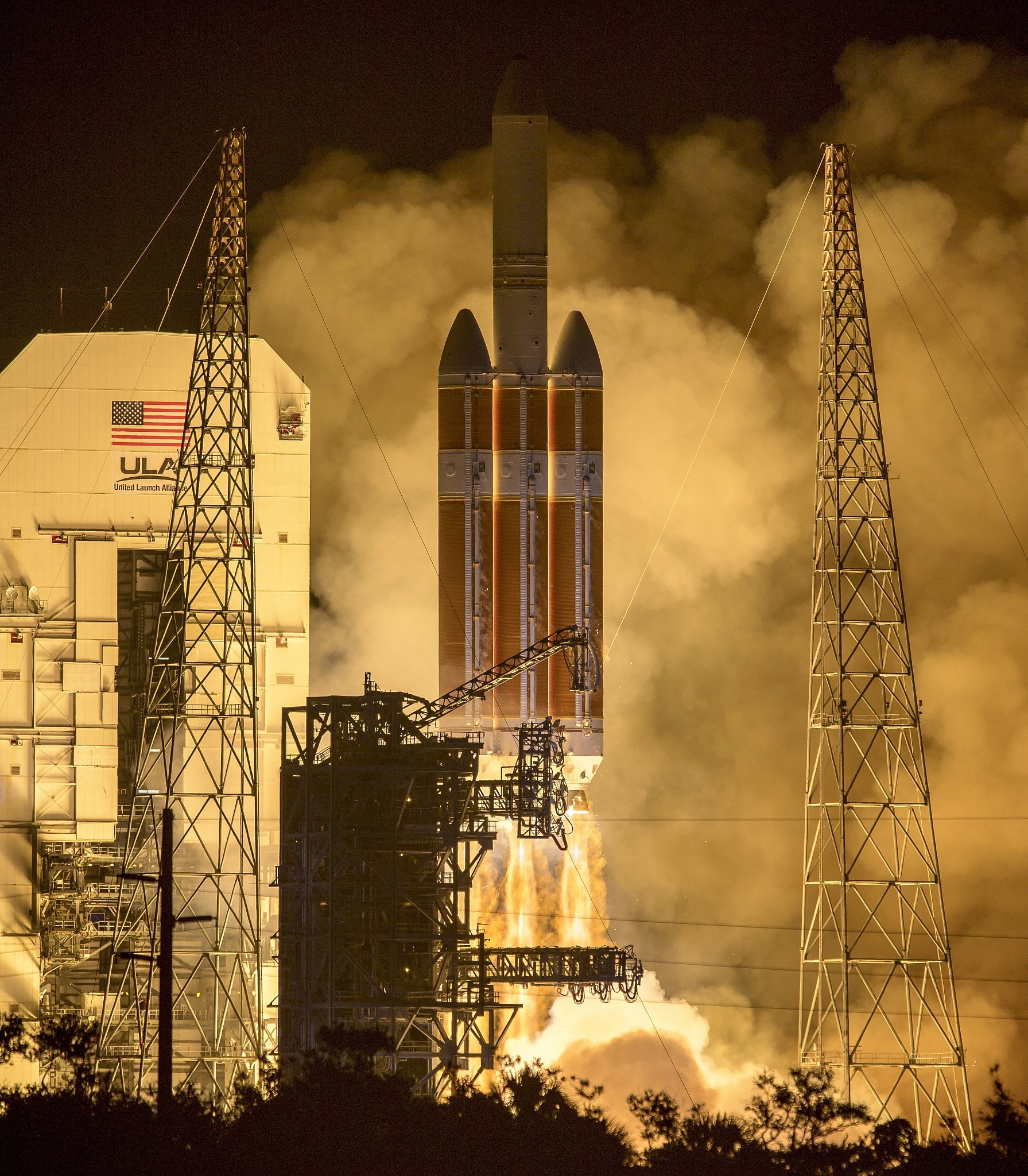
A NASA spacecraft rocketed toward the sun Sunday on an unprecedented quest to get closer to our star than anything ever sent before.
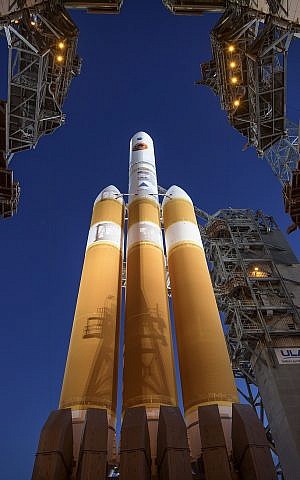
The car-sized, $1.5 billion Parker Solar Probe launched on a Delta IV Heavy rocket from Cape Canaveral, Florida.
A last-minute technical problem delayed the rocket’s planned Saturday launch, with the countdown halted with just one minute, 55 seconds remaining. This followed earlier trouble in the countdown.
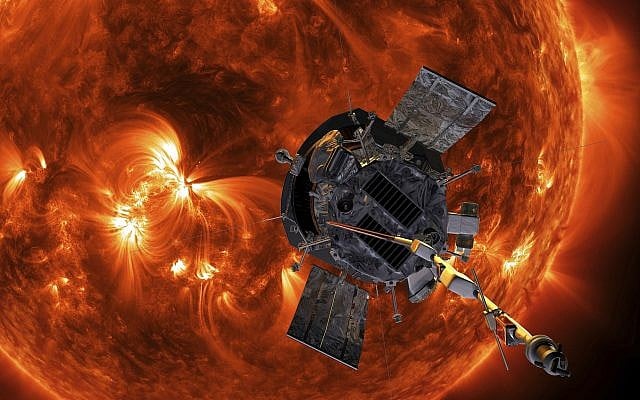
By coming closer to the Sun than any spacecraft in history, the unmanned probe’s main goal is to unveil the secrets of the corona, the unusual atmosphere around the Sun.
“We are going to be in an area that is so exciting, where solar wind — we believe — will be accelerating,” said NASA planetary science division director Jim Green. “Where we see huge magnetic fields that are passing by us, as coronal mass ejections make their way out into the solar system.”
Not only is the corona about 300 times hotter than the Sun’s surface, but it also hurls powerful plasma and energetic particles that can unleash geomagnetic space storms, wreaking havoc on Earth by disrupting the power grid.
But these solar outbursts are poorly understood.
“The Parker Solar Probe will help us do a much better job of predicting when a disturbance in the solar wind could hit Earth,” said Justin Kasper, a project scientist and professor at the University of Michigan.
Knowing more about the solar wind and space storms will also help protect future deep space explorers as they journey toward the Moon or Mars.
‘Full of mysteries’
The probe is protected by an ultra-powerful heat shield that is just 4.5 inches (11.43 centimeters) thick.
The shield should enable the spacecraft to survive its close shave with the fiery star, coming within 3.83 million miles (6.16 million kilometers) of the Sun’s surface.
The heat shield is built to withstand radiation equivalent to up to about 500 times the Sun’s radiation on Earth.
Even in a region where temperatures can reach more than a million degrees Fahrenheit, the sunlight is expected to heat the shield to just around 2,500 degrees Fahrenheit (1,371 degrees Celsius).
Scorching, yes? But if all works as planned, the inside of the spacecraft should stay at just 85 degrees Fahrenheit.
The goal for the Parker Solar Probe is to make 24 passes through the corona during its seven-year mission.
“The sun is full of mysteries,” said Nicky Fox, project scientist at the Johns Hopkins University Applied Physics Lab.
“We are ready. We have the perfect payload. We know the questions we want to answer.”
91-year-old namesake
The tools on board will measure the expanding corona and continually flowing atmosphere known as the solar wind, which solar physicist Eugene Parker first described in 1958.
Parker, now 91, recalled that at first some people did not believe in his theory.

But then, the launch of NASA’s Mariner 2 spacecraft in 1962 — becoming the first robotic spacecraft to make a successful planetary encounter — proved them wrong.
“It was just a matter of sitting out the deniers for four years until the Venus Mariner 2 spacecraft showed that, by golly, there was a solar wind,” Parker said earlier this week.
Parker said he was “impressed” by the Parker Solar Probe, calling it “a very complex machine.”
Scientists have wanted to build a spacecraft like this for more than 60 years, but only in recent years did the heat shield technology advance enough to be capable of protecting sensitive instruments, according to Fox.
Tools on board will measure high-energy particles associated with flares and coronal mass ejections, as well as the changing magnetic field around the Sun.
“We will also be listening for plasma waves that we know flow around when particles move,” Fox added.
“And last but not least, we have a white light imager that is taking images of the atmosphere right in front of the Sun.”
When it nears the Sun, the probe will travel rapidly enough to go from New York to Tokyo in one minute — some 430,000 miles per hour, making it the fastest human-made object.










The Times of Israel Community.