

‘Nazis out!’: Hundreds protest against AfD party across Germany after election
Demonstrators gather in Berlin, Hamburg, Frankfurt to show opposition to hard-right party, which won 13 percent of vote Sunday to become 3rd largest force in parliament
 Add ToI as a Preferred Source on Google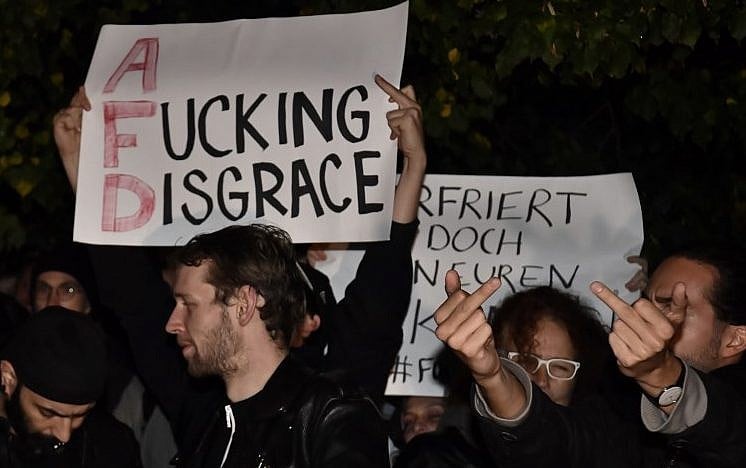
BERLIN, Germany — Hundreds of protesters gathered in Berlin and other cities in Germany to protest the surge of the hard-right Alternative for Germany (AfD) party, which captured around 13 percent of the vote in the German elections Sunday, catapulting it to become the country’s third biggest political force.
The vote yielded a fourth term for Chancellor Angela Merkel clinched whose victory is now clouded by the entry into parliament of the anti-Muslim, anti-immigrant party, in the best showing for a nationalist force since World War II.
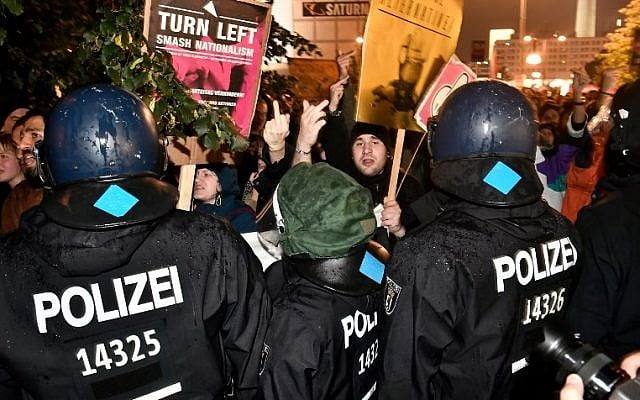
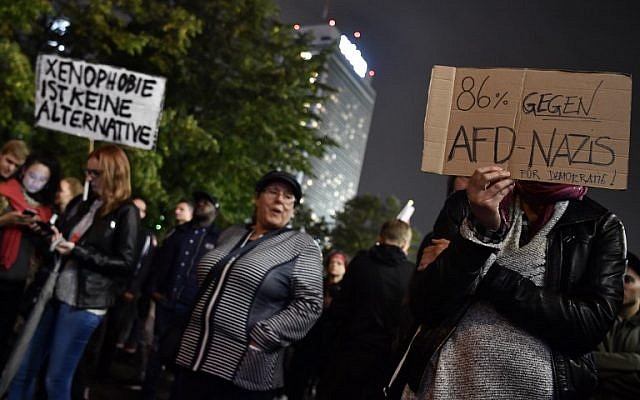
The protesters gathered at Berlin’s Alexanderplatz on Sunday night, near a victory party for AfD, and chanted slogans including “Racism is not an alternative,” “AfD is a bunch of racists” and “Nazis out!”
"Nazis raus!" Immer mehr @afd-Gegner vor der #AfD Wahlparty in der Nähe des Berliner Alexanderplatz #BTW17 #DeutschlandWaehlt pic.twitter.com/TURxh1FafM
— Kate Brady (@BradyinBerlin) September 24, 2017
“The whole of Berlin hates the AfD!” was also heard at the protest.
"Ganz #Berlin hasst die @AfD" / "The whole of Berlin hates the #AfD" #Alexanderplatz #GermanyDecides pic.twitter.com/E2CNN10sCF
— Kate Brady (@BradyinBerlin) September 24, 2017
Riot police were on hand and prevented the protesters from approaching the building where the AfD victory party was being held. Reuters reported that some demonstrators began throwing objects at AfD supporters on a balcony and were stopped by authorities.
Anti-AfD demonstrations were also held in Cologne, Hamburg, Frankfurt and Munich, according to a report in Deutsche Welle on Sunday night.
AfD’s strong showing has shaken the German establishment. Commentators called it a “watershed moment” in the history of the German republic. The top-selling Bild daily spoke of a “political earthquake.”
The four-year-old nationalist party with links to the far-right French National Front and Britain’s UKIP has been shunned by Germany’s mainstream but was able to build on particularly strong support in ex-communist eastern Germany.
It is now headed for the opposition benches of the Bundestag lower house, dramatically boosting its visibility and state financing.
Alarmed by the prospect of what Foreign Minister Sigmar Gabriel branded “real Nazis” entering parliament, the candidates had used their final days of campaigning to implore voters to reject the populists.
Turnout was markedly higher than four years ago, up to around 76 percent from 71.5 percent.
Jewish groups and others expressed their alarm with the results.
German Central Council of Jews President Josef Schuster said the party “tolerates far-right thoughts and agitates against minorities.”
He said he expects Germany’s other parties will “reveal the true face of the AfD and unmask their empty, populist promises.”
Charlotte Knobloch, chairwoman of the Munich Jewish community and a former president of the Central Council of Jews in Germany, described the strong showing as a “nightmare come true.”
“I am greatly concerned about democracy in our country,” she said. “This result is a nightmare come true, a historical change. For the first time [since the end of the Second World War], an extreme-right party will be strongly represented in parliament.”
World Jewish Congress President Ron Lauder said in a statement Sunday that anti-Semitism “is rising across the globe, including in parts of Germany,” and that it was “abhorrent that the AfD party, a disgraceful reactionary movement which recalls the worst of Germany’s past and should be outlawed, now has the ability within the German parliament to promote its vile platform.
‘Big new challenge’
Merkel, who after 12 years in power held a double-digit lead for most of the campaign, scored around 33 percent of the vote with her conservative Christian Union (CDU/CSU) bloc, according to preliminary results. It was their worst score since 1949.
Its nearest rivals, the Social Democrats and their candidate Martin Schulz, came in a distant second, with a post-war record low of 21 percent.
Merkel admitted that she had fallen far short of the 40-percent goal her party set.
“There’s a big new challenge for us, and that is the entry of the AfD in the Bundestag,” said Merkel, adding: “We want to win back AfD voters.”
Germans elected a splintered parliament, reflecting a nation torn between a relatively high degree of satisfaction with Merkel and a desire for change after more than a decade of her leadership.
Another three parties cleared the five-percent hurdle to be represented in parliament: the liberal Free Democrats at around 10 percent and the anti-capitalist Left and ecologist Greens, both at about nine percent.
As Merkel failed to secure a ruling majority on her own and with the dejected SPD ruling out another right-left “grand coalition” with her, the process of forming a viable government was shaping up to be a thorny, months-long process.
Merkel, 63, often called the most powerful woman on the global stage, ran on her record as a steady pair of hands in a turbulent world, warning voters not to indulge in “experiments”.
Pundits said Merkel’s reassuring message of stability and prosperity resonated in greying Germany, where more than half of the 61 million voters are aged 52 or older.
Her popularity had largely recovered from the influx since 2015 of more than one million mostly Muslim migrants and refugees, half of them from war-torn Syria, Iraq and Afghanistan.
Breaking taboos
But the AfD was able to capitalize on anger over the asylum issue during what was criticized as a largely lacklustre campaign bereft of real clashes among the main contenders.
The party has made breaking taboos its trademark.
Top AfD candidate Alexander Gauland has called for Germans to shed their guilt over two world wars and the Holocaust and to take pride in their veterans.
He has also suggested that Germany’s integration commissioner Aydan Ozoguz, who has Turkish roots, should be “disposed of in Anatolia”.
Merkel bound for ‘Jamaica’?
The SPD said its catastrophic result would lead it to seek a stint in opposition to rekindle its fighting spirit.
“This is a difficult and bitter day for German social democracy,” a grim-faced Schulz, a former European Parliament chief, told reporters, adding that he hoped to remain party leader.
This would leave Merkel in need of new coalition partners.
If the SPD sticks to its refusal to play ball, mathematically the most likely scenario would be a link-up with the pro-business Free Democrats, who staged a comeback after crashing out of parliament four years ago, and the left-leaning Greens.
That so-called “Jamaica” coalition, based on the party colours and the Caribbean nation’s flag, would be a risky proposition, given the differences between the parties on issues ranging from climate policy to migration issues.
Schulz, 61, struggled to gain traction with his calls for a more socially just Germany at a time when the economy is humming and employment is at a record low.
Meanwhile Merkel faced accusations from within her conservative camp that she had left its “right flank exposed” to the AfD’s challenge with her centrist stance on issues such as border policy.
“This is competition for the Union and the conservative spectrum in general,” said political scientist Lothar Probst of the University of Bremen of the AfD.
“A very difficult period is beginning for the chancellor.”








The Times of Israel Community.