

Netanyahu heads to Colombia next week for 2nd trip in less than a year
PM to attend inauguration of new president Iván Duque, who has said he’s open to moving country’s embassy to Jerusalem, and meet other regional leaders
 Add ToI as a Preferred Source on Google
Raphael Ahren is a former diplomatic correspondent at The Times of Israel.
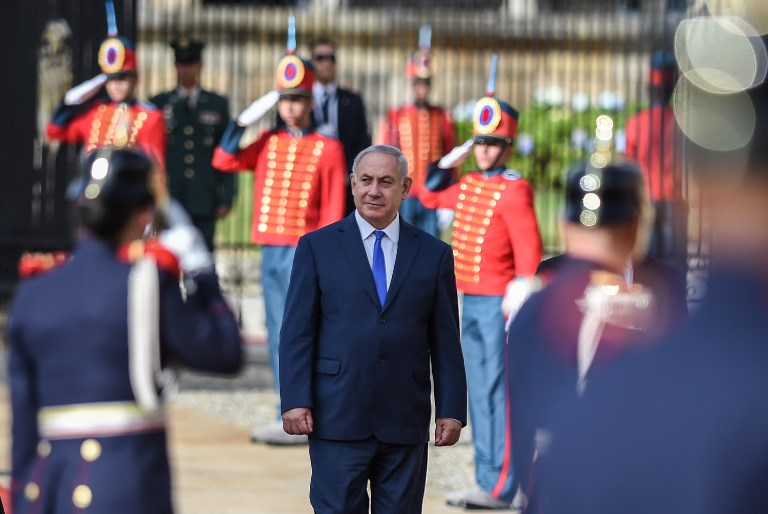
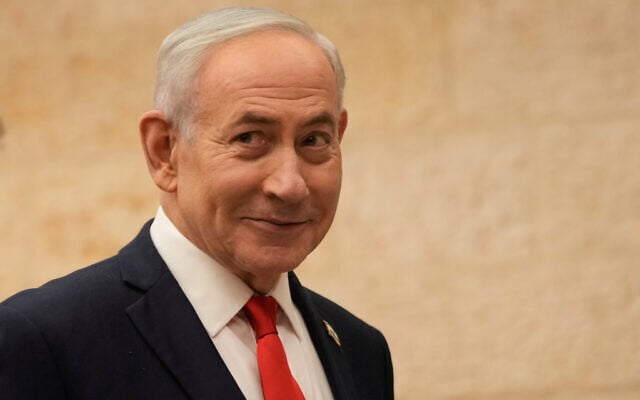
Prime Minister Benjamin Netanyahu is set to travel to Colombia next week for the inauguration of the country’s new president, Iván Duque.
It will be Netanyahu’s second trip to the South American state in less than a year.
During his three-day stay in Bogota between August 6-9, Netanyahu is also scheduled to meet with various regional leaders, his office announced Sunday. Besides his sit-down with Duque, Netanyahu is expected to meet with the presidents of Argentina, Honduras and Guatemala.
Duque, of the right-wing Democratic Center party, has said he wanted to improve good relations with Israel, even openly mulling the idea of moving his country’s embassy to Jerusalem.
On May 16 during a campaign event he said that, if elected, he would not rule out “the possibility of placing the diplomatic seat in Jerusalem.”
Duque also said he wanted to “maintain the best possible relations with the State of Israel.”
The statement came on the same day Guatemala became the second country to move its embassy to Jerusalem, two days after the United States. A week later, Paraguay became the third country to do so.
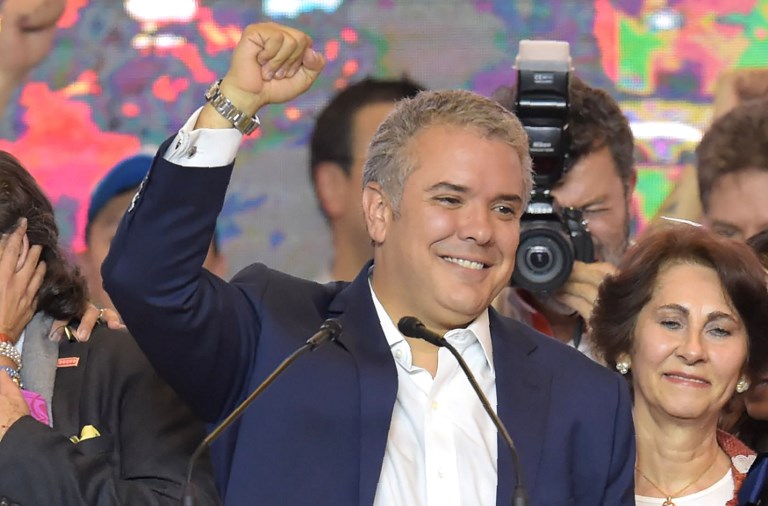
The comments from Duque garnered a harsh backlash from his opponents on the campaign trail, with most other candidates rejecting the position.
Questioned about his statement days later, Duque said he supported a two-state solution and wanted his eventual government to contribute to peace efforts.
“Colombia cannot stir up hatred in the Middle East,” he said.
In 2010 and 2011, Duque served as an assistant in a United Nations probe of the 2010 Mavi Marmara flotilla incident, in which Israeli solders brawled with Turkish protesters trying to break the Gaza blockade. The panel ultimately found that Israel’s blockade on Gaza was legal, but the raid, in which 10 Turkish activists were killed, was excessive.
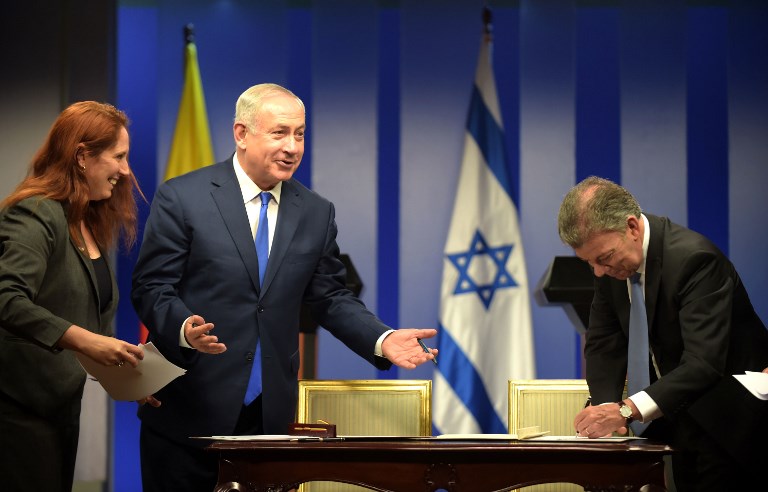
On September 13, 2017, Netanyahu spent three hours in Bogota, meeting with outgoing president Juan Manuel Santos and members of the local Jewish community, and signing two bilateral agreements on science and tourism.
His brief stay came as part of the first-ever visit to Latin America by a sitting Israeli prime minister.
“I don’t think that the [visits] of the prime minister of Israel… should be 70 years apart, so I guarantee you the next visit will be a lot closer at hand,” he said at the time during a press conference with Santos.
“We think that Latin America, as a whole, has tremendous potential,” he added.
“We would like to strengthen the magnificent relations that we’ve enjoyed for so many years,” Santos, who could not run for reelection this year, replied. “As in every relationship, there is always room for growth. We want to cooperate much more with Israel. You have a lot of what we need, and we have a lot of what you need.”
Colombia has been one of Israel’s closest friends in Latin America, with close political, military and economic ties.
In 2013, the two countries signed a free trade agreement that is awaiting ratification by the Colombian parliament.
In 2016, bilateral trade reached $580 million. Nearly 100 Israeli companies operate in the country.
Joshua Davidovich and agencies contributed to this report.







The Times of Israel Community.